The Mosaic Font of Sufetula: A Portal of Early Christian Initiation
This baptismal font dates to the 6th century CE, specifically during the Byzantine period following the reconquest of North Africa by Emperor Justinian’s forces in 534 CE. While the city itself was founded during the Roman Flavian dynasty (1st century CE), this religious infrastructure belongs to the “Golden Age” of Christian Sbeitla. The dating is corroborated by the stylistic transition of the mosaics from the classical Roman “realistic” depictions to the more symbolic, geometric, and floral patterns characteristic of late antiquity. This era was defined by the establishment of monumental churches—the city of Sufetula alone boasted several basilicas—reflecting a period of intense religious fervor before the Arab conquest in 647 CE.

The font is located within the Archaeological Site of Sbeitla (ancient Sufetula) in the Kᴀsserine Governorate of Tunisia. It is housed within the Church of Vitalis, one of the three adjacent basilicas that form the city’s northern religious quarter. The site was formally explored and documented during the French Protectorate era in the late 19th century, with systematic excavations led by the French archaeologist Noël Duval in the mid-20th century. Duval’s work was instrumental in mapping the complex liturgical layout of the city, revealing that Sufetula was a rare example of a Roman city that remained highly prosperous and architecturally active well into the Byzantine era, rather than declining.
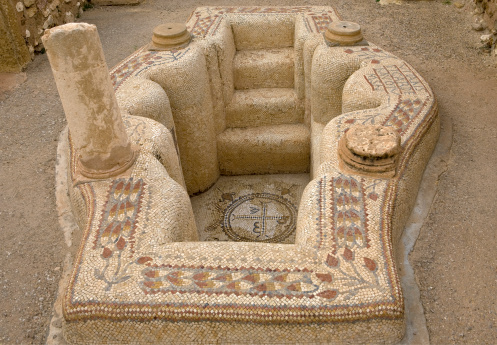
The font is a marvel of opus tessellatum—the art of stone mosaic. The structure itself is carved into the ground in a cruciform (cross) shape, symbolizing the death and rebirth of the believer. The craftsmanship involves thousands of tiny tesserae made from local limestone, marble, and colored glᴀss paste. The interior walls and the steps are entirely covered in intricate patterns: the rim features a “running scroll” of floral motifs, while the interior displays geometric “interlace” designs. A critical technical detail is the presence of three steps leading down into the basin, which allowed for baptism by immersion. The columns at the corners originally supported a ciborium (a stone canopy), which would have created a sacred “room within a room” during the ceremony.
In the context of Early Christian Archaeology, this font was the site of the most important ritual in the life of a believer: the Sacrament of Baptism. The cruciform shape was deeply symbolic, as the initiate “died” to their old life as they descended the steps and was “resurrected” as a Christian upon ascending. Because it is located in a secondary chapel rather than the main cathedral, it suggests that the Church of Vitalis served a specific community or was used for mᴀss baptisms during Easter or Pentecost. The basin was filled with water via a lead pipe system, and the beauty of the mosaics was intended to reflect the “glory of the heavenly kingdom,” transforming a functional water tank into a highly spiritual threshold.
The legacy of the Sbeitla baptismal font lies in its role as one of the best-preserved examples of Byzantine mosaic art in situ (in its original place). It provides modern scholars with a “living” map of the Donatist and Catholic struggles that defined North African Christianity. Today, the site is managed by the National Heritage Insтιтute (INP) of Tunisia. Conservationists face unique challenges, as the open-air nature of the ruins exposes the delicate mosaics to thermal expansion and wind erosion. It remains a primary destination for researchers of late-antique liturgy, standing as a vibrant, stone-clad testament to a time when Tunisia was a primary heartland of the Christian world.
✓ Team
This baptismal font dates to the 6th century CE, specifically during the Byzantine period following the reconquest of North Africa by Emperor Justinian’s forces in 534 CE….