The Muses of Zeugma: A Masterpiece of Hellenistic Polychrome Mosaic
The extraordinary archaeological feature revealed in these images is the “Muses Mosaic,” a world-class artifact from the ancient city of Zeugma (modern-day Belkıs, Gaziantep Province, Turkey). Based on the stratigraphic context and the sophisticated artistic style, archaeologists have dated this floor to the 2nd century CE, during the Roman Imperial period. Zeugma, situated on the banks of the Euphrates River, was a vital commercial and military hub connecting the Roman Empire with the Silk Road. This mosaic was part of the “House of the Muses,” a luxurious Roman villa that reflected the high cultural and intellectual aspirations of the local aristocracy before the city was partially submerged by the waters of the Birecik Dam in the late 20th century.

From a material perspective, the mosaic is a triumph of lithic sourcing. It is composed of thousands of individual tesserae—hand-cut cubes of naturally occurring minerals. The primary materials are polychrome limestones, marbles, and occasional glᴀss pastes used for specific highlights. The palette is exceptionally broad, utilizing earthy ochres, deep reds, soft pinks for skin tones, and rare blue and green stones for the garments. These materials were likely sourced from local quarries along the Euphrates, but the high-quality white marble suggests trade with distant regions like Afyon. The stones were set into a layered bedding of lime mortar and marble dust, a technique that has preserved the vibrancy of the colors for nearly two thousand years beneath the alluvial soil.
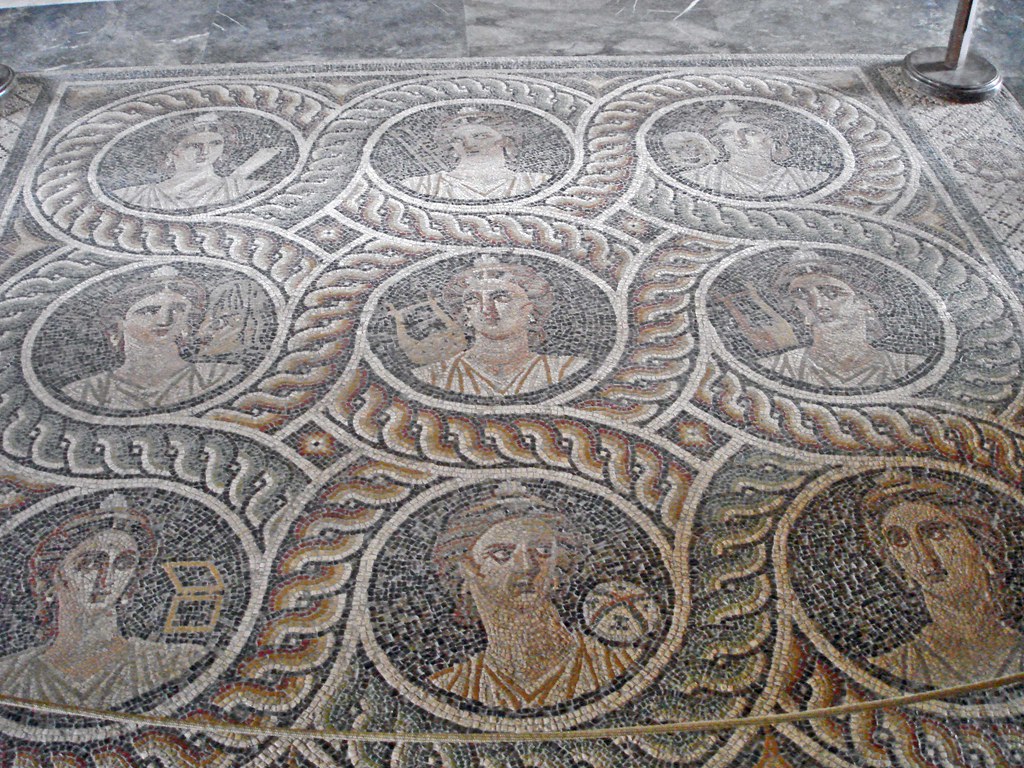
The fabrication of the Muses Mosaic demonstrates the mastery of the opus vermiculatum technique—the most refined form of mosaic artistry. This method uses exceptionally small, irregularly shaped tesserae (often as small as 2mm) to create flowing, worm-like lines that mimic the brushstrokes of a painting. In the central medallion, we see Calliope, the muse of epic poetry, surrounded by eight circular medallions featuring her sisters. The detail in the facial features, the shading of the drapery, and the delicate Greek inscriptions naming each muse were achieved by carefully tilting the stones to catch the light. The composition is bordered by complex geometric guilloche (braided) patterns, which required mathematical precision to ensure the circular medallions remained perfectly symmetrical across the expansive floor.

The primary function of this mosaic was to serve as the flooring for a triclinium (dining room) or a private library within a wealthy residence. In the Greco-Roman world, the Muses were the patron goddesses of the arts, literature, and sciences. By commissioning such an elaborate depiction, the owner of the villa was signaling their paideia (education) and cultural refinement to their guests. The mosaic functioned as a “conversational anchor,” transforming a utilitarian domestic space into a stage for intellectual discourse. Symbolically, the presence of the Muses suggested that the household was protected by divine inspiration, linking the daily life of the Roman frontier with the high classical traditions of the Hellenistic heartland.
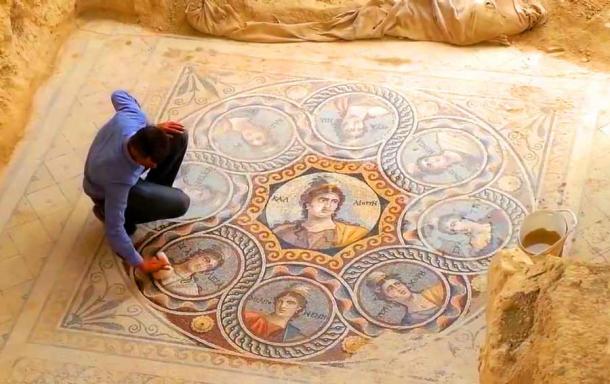
The modern history of the Zeugma mosaics is a dramatic tale of salvage archaeology. While the site was known for decades, intensive excavations were launched in 2000–2005 by the Gaziantep Museum and the Zeugma Archaeology Project, led by organizations such as the Packard Humanities Insтιтute and the University of Oxford. The team worked against a ticking clock as rising dam waters threatened to drown the site forever. As seen in the documentation, conservators used precise cleaning methods and wet-sponging to reveal the original luster of the stones. Today, the mosaic has been successfully lifted and is the center-piece of the Zeugma Mosaic Museum in Gaziantep, one of the largest and most technologically advanced mosaic museums in the world, where it is monitored for humidity and structural integrity to ensure its survival for future generations.
✓ Team
The extraordinary archaeological feature revealed in these images is the “Muses Mosaic,” a world-class artifact from the ancient city of Zeugma (modern-day Belkıs, Gaziantep Province, Turkey). Based…