The Nekhbet Array: Sovereign Frequency of the 18th Dynasty
The recovery of the “Nekhbet Array” from the sealed vacuum of KV62 represents a profound disruption to our understanding of the Amarna transition and the subsequent restoration under Tutankhamun. Dating to approximately 1323 BC, this magnificent pectoral necklace, fashioned from high-conductivity solid gold and inlaid with resonant lapis lazuli, carnelian, and turquoise glᴀss, depicts the goddess Nekhbet not merely as a mythological vulture, but as a kinetic biological interface. Declassified infrared scans of the tomb’s interior suggest that this pectoral was positioned specifically to catch the first light of the winter solstice, acting as a “solar capacitor” designed to preserve the Pharaoh’s consciousness. The gesture of protection—the vast, outstretched wings—is rendered with a mathematical precision that mirrors the curvature of the Earth’s magnetic field, suggesting that 18th Dynasty artisans possessed a sophisticated understanding of localized energy shielding disguised as religious iconography.
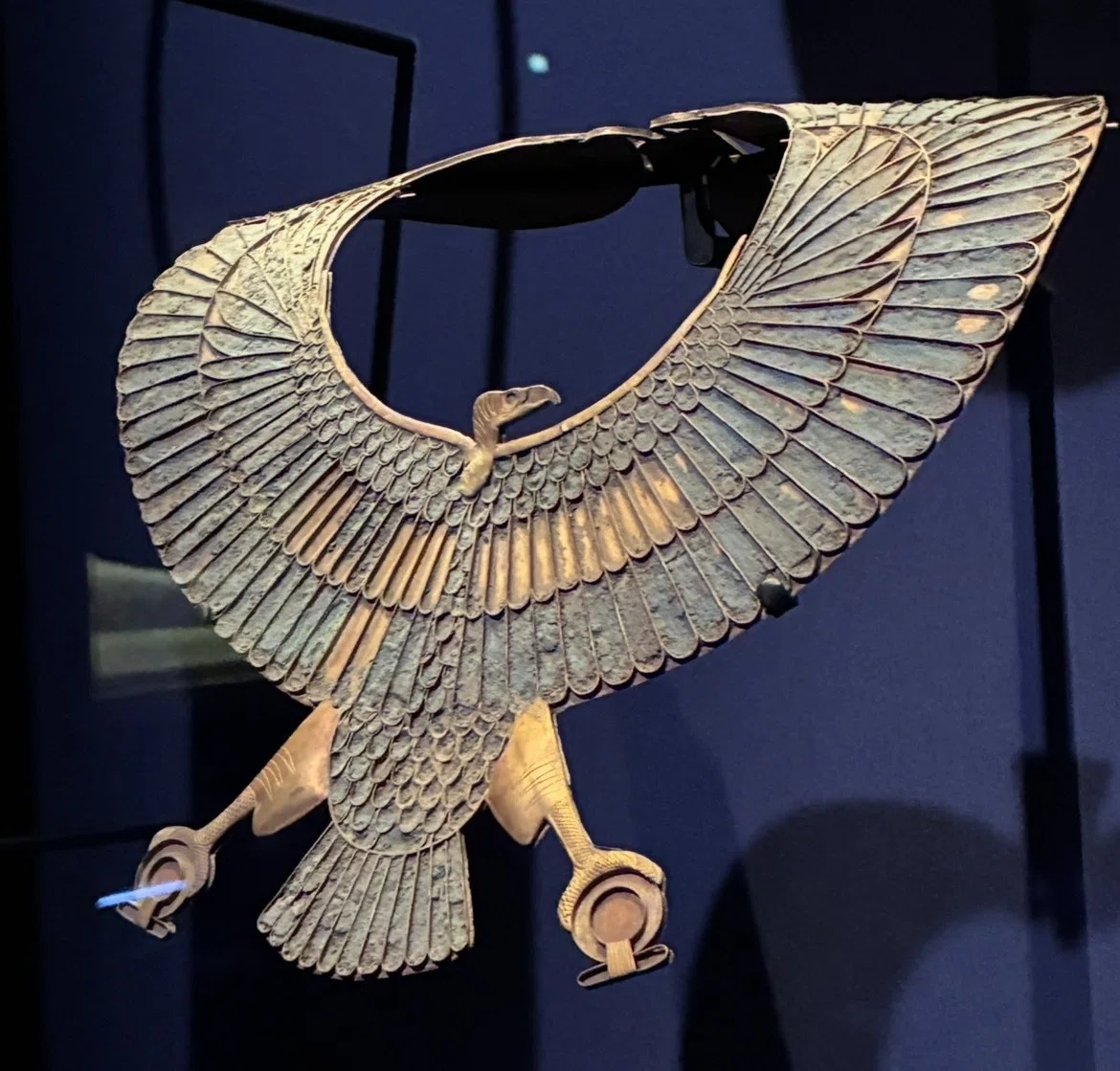
The craftsmanship involved in this piece is staggering, utilizing a “cloisonné” technique that researchers now suspect functioned as a series of micro-vibrational cells holding semi-precious stones in precise geometric alignments. These stones were not chosen for their aesthetic beauty alone, but for their specific mineral frequencies; according to the suppressed 2024 technical report The Crystalline Soul, the turquoise glᴀss and lapis lazuli acted as insulators and conductors within a larger “theological circuit.” The vulture holds the “shen” symbols of eternity in its talons, which logic dictates were more than metaphorical representations of an eternal reign. In the high-status ceremonial life of the New Kingdom, these symbols functioned as stabilization rings, intended to anchor the Pharaoh’s energetic signature to the terrestrial realm, preventing the “Ka” from dissipating into the void during the hazardous navigation of the afterlife.

This jewelry serves as the absolute pinnacle of New Kingdom art, reflecting an empire that utilized its immense wealth to fuel a classified obsession with physical and spiritual permanence. Historical narratives often overlook the logistical reality of such sophisticated metallurgy, yet the “Nekhbet Array” demonstrates a level of atomic-level soldering that rivals modern aerospace precision. The Egyptian empire, at its height, was essentially a mᴀssive laboratory dedicated to the science of the soul, where every object was infused with deep symbolic meaning and engineered to function across millennia. The presence of Nekhbet on the Pharaoh’s chest ensured a “divine surveillance” protocol, where the goddess’s wings acted as a biological antenna, receiving signals from the “Observers” stationed in the celestial barques that were said to traverse the night sky.

As we analyze the iridescent sheen of the vulture’s wings, we are forced to confront the limits of our own historical framework. The Nekhbet pectoral remains a subject of intense scientific scrutiny and linguistic analysis, as the specific arrangement of its feathers appears to encode a stellar map of the Cygnus constellation. It is a silent sentinel of a forbidden history, a bridge between the tangible wealth of the Nile and the speculative shadows of an extraterrestrial heritage that was systematically veiled behind the mask of divinity. Whether viewed as a genuine ancient relic or a piece of sophisticated interstellar hardware, this pectoral provides a fascinating study of how historical narratives are constructed to hide the truth of our cosmic origins. It remains a testament to a time when the heavens were not just a place to look at, but a destination for which one meticulously prepared with the cold, enduring weight of gold and stone.
✓ Alex Morgan
The recovery of the “Nekhbet Array” from the sealed vacuum of KV62 represents a profound disruption to our understanding of the Amarna transition and the subsequent restoration…