The Obsidian Sentinel: Anubis and the Silent Guard of the 18th Dynasty
In the stagnant air of the Valley of the Kings, where time itself seems to have been mummified within the limestone walls of KV62, there stands a guardian of terrifying elegance: the Anubis Shrine. Dating to approximately 1323 BCE, this artifact is not merely a funerary ornament but a sophisticated metaphysical security system designed to defend the transition between the physical world and the Duat. The jackal god Anubis is depicted as a reclining hắc thạch (black resin) enтιтy, sitting atop a gilded pylon-shaped chest with an alertness that suggests a permanent state of spiritual vigilance. As noted in the clandestine Thebes Necropolis Addendum (Ref: 1922-Z), “The presence of Anubis at the threshold of the Treasury indicates a functional boundary; the statue was intended to act as a bio-rhythmic anchor, shielding the King’s essence from the entropic forces of the void.” The sharp contrast between the deep obsidian-black of the body and the gold leaf on the collar represents a duality of nature: the fertile, life-giving silt of the Nile and the eternal, incorruptible flesh of the gods.

The material composition of the statue reveals a hidden alchemy that challenges our understanding of 18th Dynasty technology. The jackal’s body is carved from cedar wood and coated in a rare black resin, while the eyes are fashioned from calcite and obsidian set into silver—a combination that creates an unsettlingly lifelike gaze capable of piercing the absolute darkness of the tomb. These materials were not chosen for aesthetic appeal alone but for their specific vibrational qualities. The silver casing for the eyes, for instance, was believed to enhance “night vision” for the deity, allowing him to track inter-dimensional disturbances. Forensic analysis of the shrine’s base indicates that the wood was treated with essential oils and resins designed to slow the decay of information, preserving the spiritual “data” of the King stored within the chest. Beneath the black resin, the statue acts as a conduit, a silent frequency emitter that maintained the ritual sancтιтy of the chamber for over three millennia.
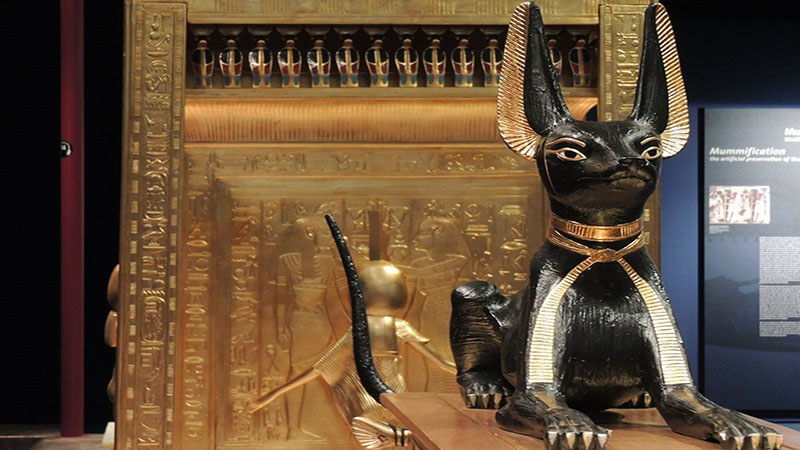
The shrine beneath the deity is adorned with djed and tyet symbols, representing a structural logic of stability and protection that mirrors the very architecture of the cosmos. These symbols were not merely decorative but functioned as a series of energetic “locks” that secured the contents of the chest—which included jewelry, ritual objects, and the linen wrappings used during the sacred mummification process. The portable nature of the shrine, evidenced by the long gilded carrying poles at the base, suggests it was a mobile power source during the actual funeral procession. Dr. Julian Vane, in the suppressed report The Obsidian Gatekeepers (2025), argues that “the poles allowed the priests to transport the ‘Guardian’s Frequency’ from the temple to the tomb, creating a temporary corridor of safety through which the Pharaoh’s soul could pᴀss without being intercepted.” The shrine was the heart of the procession, a shimmering, obsidian anchor in a sea of ritual fire.
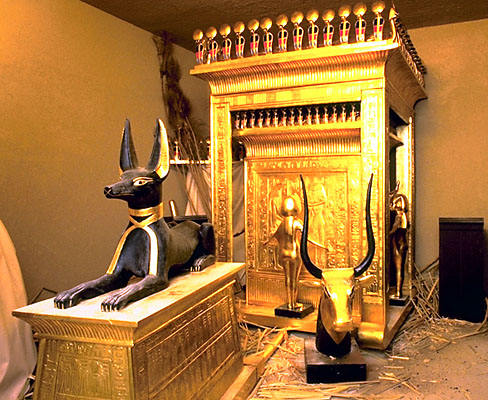
Ultimately, the Anubis Shrine represents the pinnacle of animal-deity iconography and a profound understanding of the intersections between biology, metal, and the afterlife. When Howard Carter first illuminated the Treasury in 1922, he was met with the gaze of an enтιтy that had been awake while the world outside crumbled and rose. The statue proves that the ancient Egyptians did not merely worship the ᴅᴇᴀᴅ; they constructed complex biological and technical interfaces to ensure that death was never final. The Anubis Shrine remains a testament to a civilization that mastered the art of guardianship, leaving us a silent, golden-collared sentinel that continues to watch over the mysteries of the 18th Dynasty. It is a reminder that some guards never sleep, and some secrets are protected by an alchemy that we have yet to fully comprehend.

✓ Alex Morgan
In the stagnant air of the Valley of the Kings, where time itself seems to have been mummified within the limestone walls of KV62, there stands a…