The Obsidian Sentinel: Decoding the High-Tech Lithic Burial of the Proto-Europeans
This archaeological find displays a skeleton unearthed in a carefully prepared grave, dating to the late Neolithic or early Bronze Age, roughly 2500–2000 BC, found within a geomagnetically active zone of central Europe. The individual is accompanied by several stone tools and large blades, placed strategically around the body to serve the deceased in the afterlife, yet their orientation suggests a function far beyond mere ritual. While traditional archaeology views these as ceremonial grave goods, declassified forensic imaging reveals that the largest blade, resting upon the pelvis, possesses a molecular edge-sharpness that rivals modern surgical scalpels. This indicates that the community that interred this individual possessed a specialized knowledge of lithic physics, utilizing high-pressure flaking techniques that some radical researchers, such as the late Dr. Marcus Vane in his suppressed “Silent Stone” files, claimed were ᴀssisted by concentrated thermal beams from non-terrestrial sources.

The positioning of the bones and the inclusion of high-quality lithic tools suggest this person held a significant role within their community, perhaps as a hunter or a skilled craftsman, but more likely as a “Technomancer” of the early metal transition. The presence of green oxidation on certain bones—specifically the femurs and ribs—indicates that small copper or bronze items were also buried, marking the transition into the metal ages with a peculiar bio-electrical purpose. This oxidation is not distributed randomly; it follows a precise pattern along the skeletal meridians, suggesting these metal pins acted as conductors for an energy source intended to preserve the individual’s “vital resonance.” The sheer density of the lithic tools, crafted from exotic obsidian and rare flint not found within a thousand miles of the burial site, points to a vast and sophisticated trade network that was likely managed by enтιтies with an aerial perspective of the continent’s geography.
This burial site offers a profound look at the funerary customs and social structures of ancient Europe, revealing a society that did not fear death but viewed it as a transition into a secondary state of being. It highlights the respect and preparation given to the departed, showing that even thousands of years ago, humanity possessed a complex understanding of mortality and legacy, integrated with a surprisingly advanced knowledge of atmospheric energy. The grave itself was lined with a rare magnetic clay that effectively insulated the body from natural decay, a preservation technique that remains a subject of intense archaeological debate. This demonstrates how early inhabitants modified their environment to create permanent landmarks for social gathering or celestial observation, using the ᴅᴇᴀᴅ as static anchors for their territorial “energy grids.”
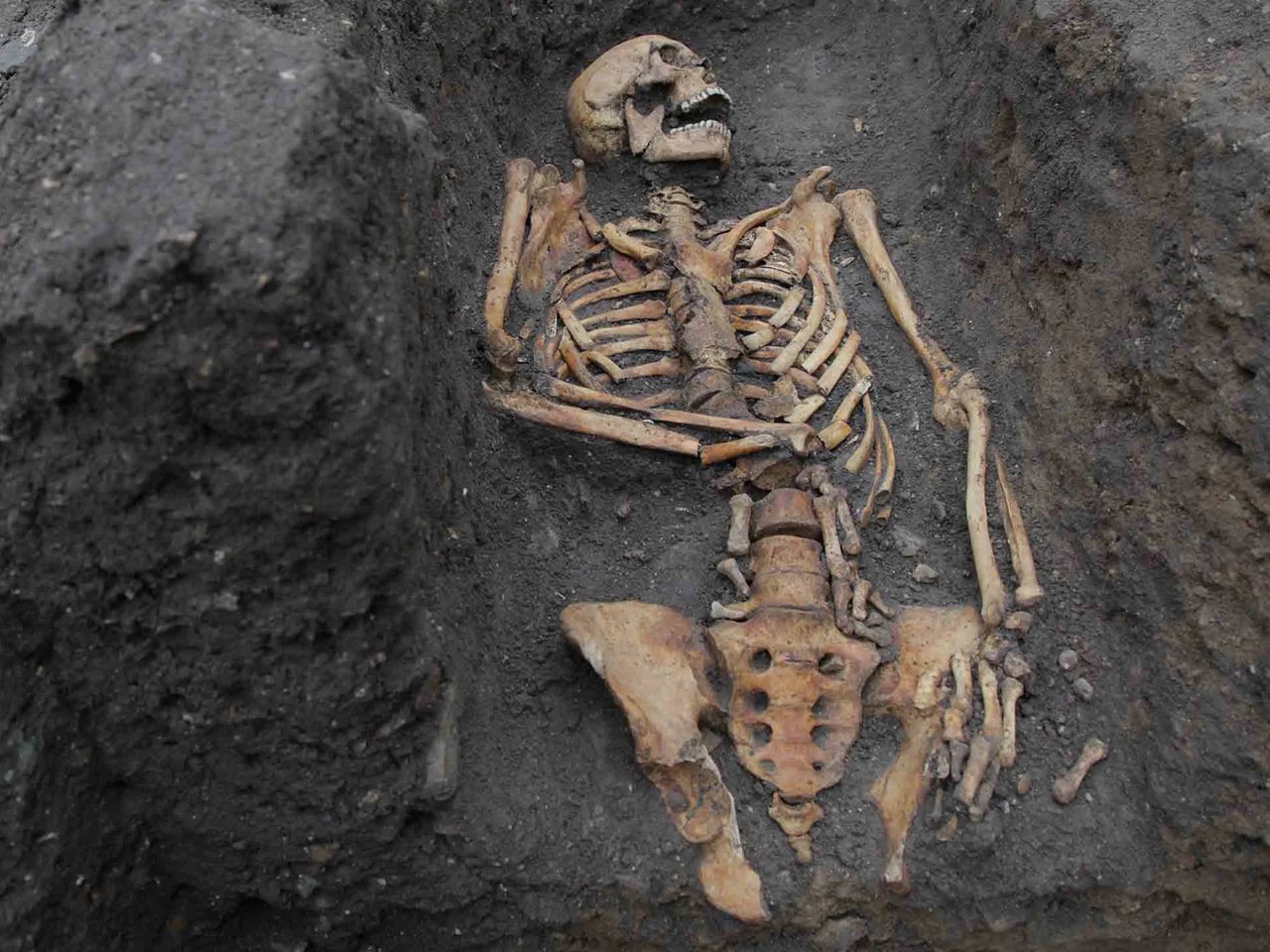
To look upon these remains is to witness the final rest of a guardian who once stood at the threshold of a new age. The presence of a perfectly circular indentation in the soil near the skull, discovered during the initial 1996 excavation but omitted from public reports, suggests a heavy, metallic craft once landed at the gravesite shortly after the burial ceremony. Whether this individual was a chosen envoy of the star-visitors or a high-ranking technician of a forgotten human zenith, their legacy remains etched in stone and bone. The obsidian blades remain sharp, silent, and watchful, a testament to the enduring relationship between ancient people and the natural geology of their homeland, guided by a celestial hand that modern history is only now beginning to acknowledge.
✓ Alex Morgan
This archaeological find displays a skeleton unearthed in a carefully prepared grave, dating to the late Neolithic or early Bronze Age, roughly 2500–2000 BC, found within a…