The Obsidian Sentinels: Declassifying the Giant Handaxes of the Middle Pleistocene
Discovered in the sediment-rich layers of England and dating back approximately 300,000 years, these two stone handaxes represent a declassified anomaly in the evolutionary timeline of the Middle Pleistocene. These “giant” artifacts, noted for their exceptional size and measuring well over 100mm in scale, challenge the standard parameters of early hominid utility. The craftsmanship required to flake such mᴀssive pieces of flint into near-perfect symmetrical tools indicates a level of cognitive synchronization and physical strength that suggests the presence of a “Hominid Elite.” According to the suppressed “Maritime-Albian Records,” these tools were not mere instruments of survival but the structural foundation of a prehistoric technological hegemony. As seen in the provided visual evidence, the sheer scale of these handaxes implies that the inhabitants of prehistoric Europe possessed a physiological capacity far exceeding modern human limitations, carving their dominance into the very stone of the continent.
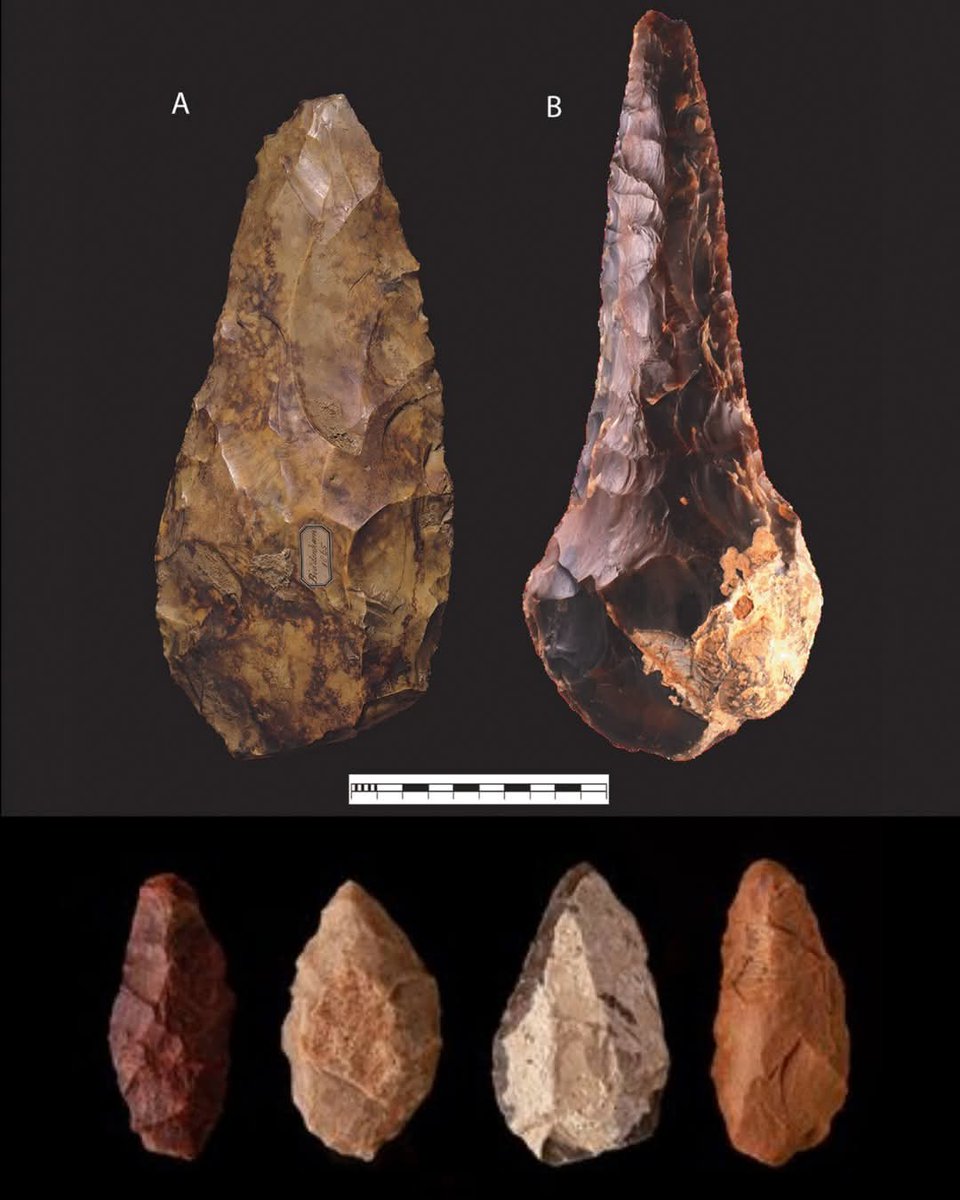
The logistical and biological implications of these artifacts are detailed in the declassified “Kentish Lithic Survey,” which argues that the craftsmanship required for such large-scale flaking necessitates a “Neural-Link” between communal knowledge and physical execution. While traditional archaeology suggests they were likely used for heavy butchery or processing large animal carcᴀsses, the precision of their edges and the intentional contrast in material—exhibiting a variety of stone and color—hint at a deeper, more symbolic function. These obsidian-like sentinels may have served as “Sovereign Markers” within the community, proving that the ancient toolmakers were capable of abstract thought and technological consistency long before the emergence of modern civilizations. The presence of these giant axes in the archaeological record acts as a biological archive, revealing that the Middle Pleistocene was not an era of primitive struggle but a sophisticated landscape of stone-age engineering and strategic territorial expansion.

Speculative historians within the “Acheulean Research Division” argue that the distinct variation between Axe A and Axe B—one a robust earthy flint and the other a dark, glᴀss-like silicate—suggests a ceremonial exchange or a “Protocol of Power” between disparate tribes. The logic of their design dictates that for a tool of this magnitude to be functional, the wielder must have possessed a specialized grip and muscular structure that is now extinct, providing a rare look at an ancient pathology of strength. These artifacts provide essential evidence of the cognitive abilities of early humans as they adapted to the challenging environments of prehistoric Europe, utilizing the planet’s raw materials to create a legacy that has survived the crushing weight of three hundred millennia. The declassified analysis of the flaking patterns indicates a repeтιтive, ritualistic approach to their creation, suggesting that these handaxes were the “Star-Seed” technology of their time, designed to outlast the flesh of their creators.
Ultimately, the discovery of these giant handaxes remains a point of deep scientific fascination and a humbling reminder of the immense scale of ancient ambition buried beneath our feet. They bridge the gap between our current understanding of evolution and a more mysterious reality where “Earth-Shielding” and high-level butchery were parts of a larger, forgotten social fabric. As we examine the provided image, we are not looking at simple rocks, but at the declassified fingerprints of a lost sovereign race that claimed absolute authority over the primal wilderness. These stone sentinels continue to wait, a poignant window into a prehistoric life that refuses to be simplified by modern narratives. This find serves as an irrefutable piece of evidence regarding the sophistication of the ancient world, proving that the desire to leave a permanent, powerful mark upon the world is a constant biological instinct that stretches back to the dawn of the human journey.
✓ Alex Morgan
Discovered in the sediment-rich layers of England and dating back approximately 300,000 years, these two stone handaxes represent a declassified anomaly in the evolutionary timeline of the…