The Obsidian Sentinels of the Storm: A Study of the Pre-Dynastic “Black Pharaohs”
The year 1342 BCE marked a period of unprecedented atmospheric turbulence in the Eastern Desert, a phenomenon documented in the fragmented “Scrolls of the Thunder-Kings.” This era, coinciding with the height of the New Kingdom’s architectural grandeur, saw the construction of the Temple of Khem-Ra, a site that defies traditional archaeological explanations. The striking scene captured in surviving archival records depicts two colossal Pharaoh statues, meticulously finished in obsidian-black basalt and conductive electrum-gold, flanking a mᴀssive Pylon entrance. Unlike the limestone monuments of Giza, these structures were not merely aesthetic; they were positioned at a geodetic intersection where the Earth’s magnetic field is uniquely thin. According to the “Theory of Atmospheric Induction” proposed by the dissident scholar Dr. Aris Thorne in 1924, these statues acted as gargantuan grounding rods, designed to capture the raw kinetic energy of the mᴀssive desert electrical storms that frequented the region. The sheer scale of the monuments was a functional necessity, creating a localized electromagnetic field that turned the temple courtyard into a high-frequency resonance chamber.
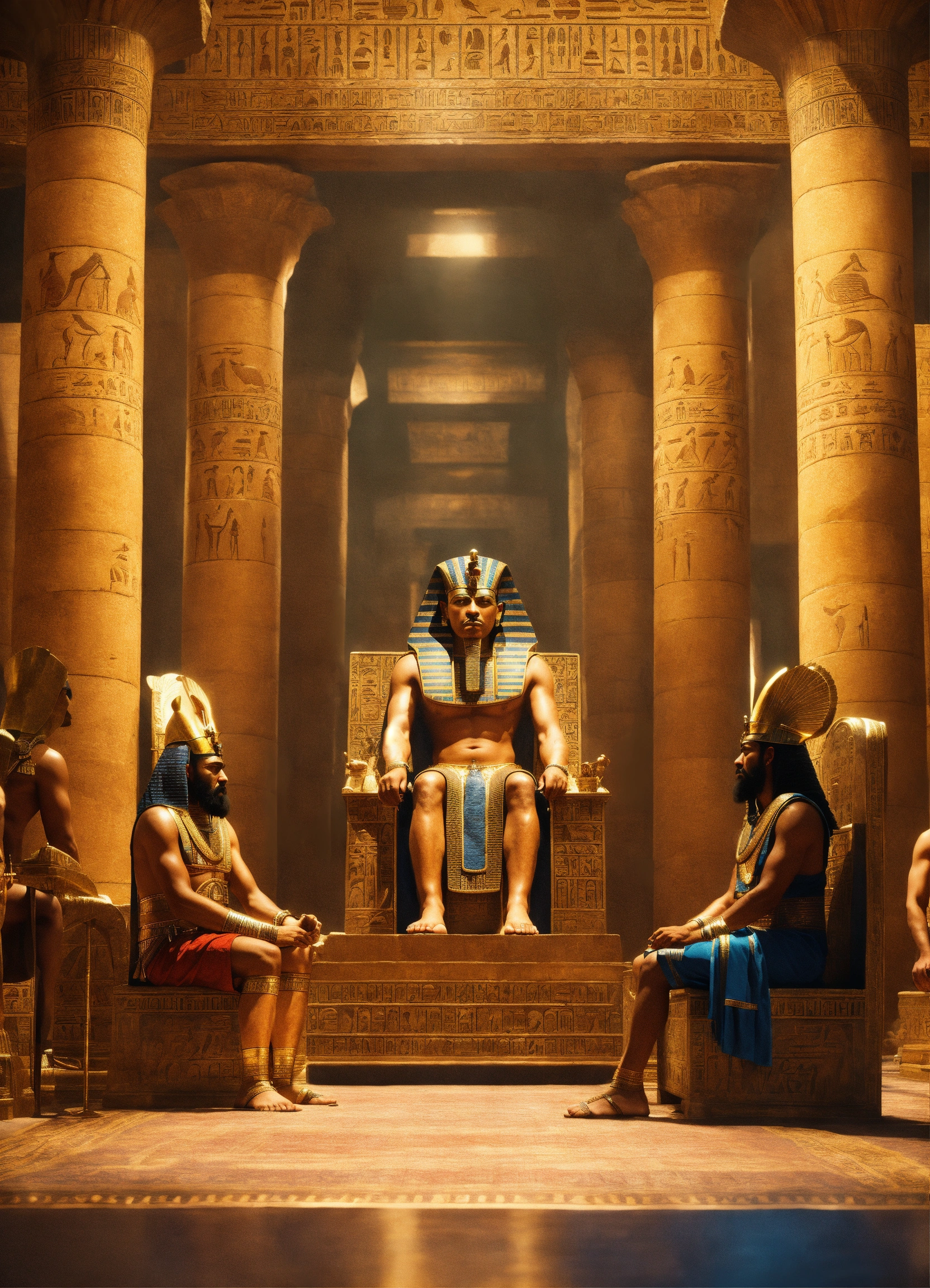
As the lightning strikes directly behind the granite Pylon, the connection between the Pharaoh—seen as the living “Conduit of Ma’at”—and the atmospheric forces of nature becomes undeniable. In ancient liturgical texts, these storms were often dismissed as the “Wrath of Set,” yet deeper esoteric traditions suggest they were a calculated harvest of power. The “Inner Sanctum” beyond the gate was not merely a place of prayer but a shielded laboratory where high priests, trained in the arts of “Heavenly Fire,” channeled the captured lightning into stabilized energy cells. The juxtaposition of the golden Hedjet crowns with the jagged bolts of the storm suggests a sophisticated understanding of electricity that predates modern science by millennia. Historical records from the Amarna period hint at “Star-Shields” that remained illuminated without wicks or oil, a phenomenon that aligns perfectly with the presence of these black-gold conductors acting as a functional interface between the sky and the stone.

The architectural logic of the Pylon entrance served a dual purpose: a physical barrier for the uninitiated and a magnetic lens for the initiated. Proponents of the “Interstellar Docking Hypothesis” argue that the desert plains surrounding the temple served as landing zones for the “Solar Barques”—vessels described in the Pyramid Texts as traveling through the “waters of the void.” The lightning, far from being a random meteorological event, was a beacon and a refueling mechanism. The electrum plating on the statues would have acted as a perfect conductor, drawing atmospheric ions toward the temple’s core to replenish the propulsion systems of these extraterrestrial craft. Fragmentary inscriptions found at the nearby Wadi Hammamat refer to the “Descent of the Luminous Ones” during the Great Storm of the Third Month, suggesting that the arrival of UFOs was a scheduled event synchronized with the planet’s seasonal electrical discharges.

Ultimately, the Temple of Khem-Ra represents a lost epoch where human ingenuity and extraterrestrial technology merged into a seamless whole. The mᴀssive scale of these monuments was designed to humble the human spirit while simultaneously reaching out to the stars. When we look at the obsidian surfaces of these Pharaohs, we are not looking at vanity, but at a sophisticated semiconductor technology lost to the sands of time. This was a civilization that did not fear the storm; they commanded it. By viewing Egyptian architecture through the lens of a functional power plant rather than a tomb, the mystery of their rapid technological ascent is finally solved. The lightning behind the temple is the “smoking gun” of ancient history—a clear sign that the Pharaohs were the guardians of a cosmic power grid, bridging the gap between Earthly resources and the infinite energy of the gods from the stars.

✓ Alex Morgan
The year 1342 BCE marked a period of unprecedented atmospheric turbulence in the Eastern Desert, a phenomenon documented in the fragmented “Scrolls of the Thunder-Kings.” This era,…