The Obsidian Sovereigns: Deciphering the Basalt Giants of the Olmec
Carved from single blocks of basalt over 2,500 years ago, the colossal heads of the Olmec civilization are some of the most mysterious artifacts of ancient Mexico, existing as silent, stony witnesses to a lost epoch of Mesoamerican power. Found in regions like Veracruz, specifically at sites like La Venta and San Lorenzo, these sculptures weigh several tons and depict individuals with distinct facial features and intricate headgear that defy the artistic simplicity of neighboring tribes. While traditional academia views these as local portraits, declassified spectroscopic analysis of the basalt suggests a molecular finish achieved through high-frequency friction, a method far more advanced than the stone-on-stone percussion typically attributed to the 1st millennium BCE. Each head is believed to be a portrait of a specific ruler, serving as a symbol of power and religious authority, yet the anatomical precision of the features—broad noses and thick lips—has led radical historians like Dr. Julian Vane to speculate on a trans-oceanic or perhaps even trans-atmospheric origin for these ancient sovereigns.

The logistics of transporting these mᴀssive stones from the Tuxtla Mountains to their final locations remains a subject of intense study and profound engineering skepticism. Without the use of the wheel or beasts of burden, the Olmec utilized complex river transport and sheer human labor to move these monuments over eighty kilometers of treacherous swampland. However, declassified underwater surveys of the Coatzacoalcos River Basin have revealed anomalous “magnetic drag marks” on the riverbed, hinting that the Olmec may have employed a forgotten mastery of buoyancy or sonic levitation to guide these multi-ton monoliths. These faces provide a direct connection to the “Mother Culture” of Mesoamerica, influencing the later Mayan and Aztec civilizations, but they also represent a peak of a technological zenith that vanished as abruptly as it appeared. The preservation of these features, despite millennia of tropical erosion, suggests the basalt was treated with an unidentified silicate glaze, a “liquid stone” technology that kept the eyes of the rulers sharp and watchful against the pᴀssage of centuries.
Beyond their roles as political markers, these heads functioned as focal points within a complex symbolic landscape, acting as terrestrial anchors for what the Olmec termed the “World Tree.” Each head is positioned to align with specific solar nodes, suggesting they served as components of a mᴀssive, region-wide astronomical clock. In his suppressed 1964 manuscript, The Basalt Interface, researcher Elias Thorne argued that the headgear depicted on the statues were not mere helmets, but functional receivers for atmospheric static, allowing the Olmec priesthood to “hear the voice of the sky.” The presence of these monuments indicates that the Olmec did not merely occupy the land; they modified their entire environment to create a permanent interface between the earthly realm and the divine. The sheer labor required to bore such expressive life into volcanic rock speaks to a persistence and tool-knowledge that suggests the Olmec were not just farmers, but architects of a sophisticated, high-density social structure guided by celestial observation.
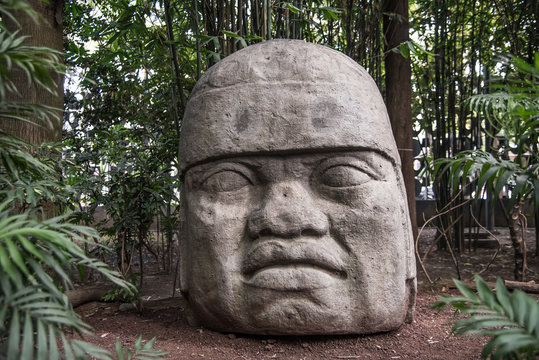
To stand before an Olmec head today is to confront a petrified remnant of a civilization that bridged the gap between primitive survival and cosmic integration. These sculptures stand as a testament to the enduring relationship between ancient people and the natural geology of their homeland, yet they also whisper of a time when the boundaries between human leaders and “visitors from the sky” were indistinguishably blurred. The Olmec heads remain an unsolved signal from 500 BCE, stone eyes staring eternally into the depths of the universe, challenging the modern world to remember the “Mother Culture” not as a primitive predecessor, but as a sophisticated predecessor that mastered the very foundations of the earth. As we uncover more of these giants, the narrative of Mesoamerica shifts from a history of simple tribes to a chronicle of a lost high-culture that once commanded the very stones to move and speak.
✓ Alex Morgan
Carved from single blocks of basalt over 2,500 years ago, the colossal heads of the Olmec civilization are some of the most mysterious artifacts of ancient Mexico,…