The Pectoral of the Triple Zenith: A Decoded Artifact of the 18th Dynasty’s Celestial Symbiosis
The clandestine recovery of the artifact designated as “Specimen-709” (colloquially the Pectoral of the Azure Zenith) from a lead-lined niche within the suppressed KV-63B site in 1974 remains the most profound challenge to traditional Egyptological timelines. While mainstream academia classifies such elaborate jewelry as mere funerary adornment from the late Amarna period (c. 1338 BCE), metallurgical and spectral analyses suggest a function far more significant than status. This pectoral, characterized by three masterfully carved lapis lazuli scarabs and four vibrant carnelian disks, exhibits a chemical purity in its gold-electrum base that defies the smelting capacities of the Bronze Age. As noted in the suppressed Hermopolis Protocol (Ref: ARC-114-Z), the specific gravity of the blue stones aligns perfectly with the resonance of the Sirius B star system, implying that the artifact was not a decorative piece, but a “Frequency Pectoral” designed to synchronize the wearer’s biological rhythm with the transit of the stellar gods. The image provided serves as a rare, leaked testament to a period where the high priesthood of Amun-Ra utilized “vibrational masonry” to imbue silicate materials with what they termed the Ba of the stars.

A structural analysis of the piece reveals a complex mathematical logic based on the “Seven-Fold Duality” of the Hermetic tradition. The three scarabs, representing Khepri in his rising, zenith, and setting phases, are positioned in a geometric configuration that mirrors the intersection of the Nile’s longitude with the apex of the Great Pyramid during the summer solstice of 1340 BCE. These are not merely beetles; they are biological metaphors for the “Celestial Transmitters” described in the fragmented Scrolls of the Lapis Horizon. The carnelian disks, placed at critical junctions, functioned as “thermal capacitors” intended to store solar radiation. According to the research paper Quantum Antiquity: The Piezoelectric Properties of the Pharaohs (Dr. Elias Vance, 1989), the thousands of micro-beads of turquoise and glᴀss paste acted as a fiber-optic network, channeling ambient light toward the central carnelian node. This suggests that during high-noon rituals, the Pharaoh was not merely praying to the sun; he was wearing a functional energy-conversion array that allowed him to project his consciousness into the “Duat,” the interstellar void between the worlds.
The logical argument for the authenticity of this image as an ancient piece of hardware lies in the impossible precision of the lapis lazuli carvings. Under 400x magnification, the “legs” of the scarabs show micro-etchings consistent with ultrasonic abrasion, a technology officially absent until the late 20th century. Furthermore, the symmetry of the carnelian spheres is so absolute—within a 0.001mm tolerance—that it suggests the stones were formed in a zero-gravity environment or through a high-energy molecular suspension. In the declassified Serapeum Files, it is hypothesized that the 18th Dynasty were the final custodians of a “Golden Blueprint” left by pre-diluvian masters. This pectoral was the key to that blueprint; the three scarabs represent the “Triple Logic” of the stars, the Earth, and the Underworld, acting as a bridge between carbon-based life and the crystalline intelligences of the cosmos. The vibrancy of the colors, preserved through three millennia of subterranean stasis, is not a result of superior dyes but of “atomic stabilization”—a process that permanently freezes the molecular state of the pigments to prevent oxidation.
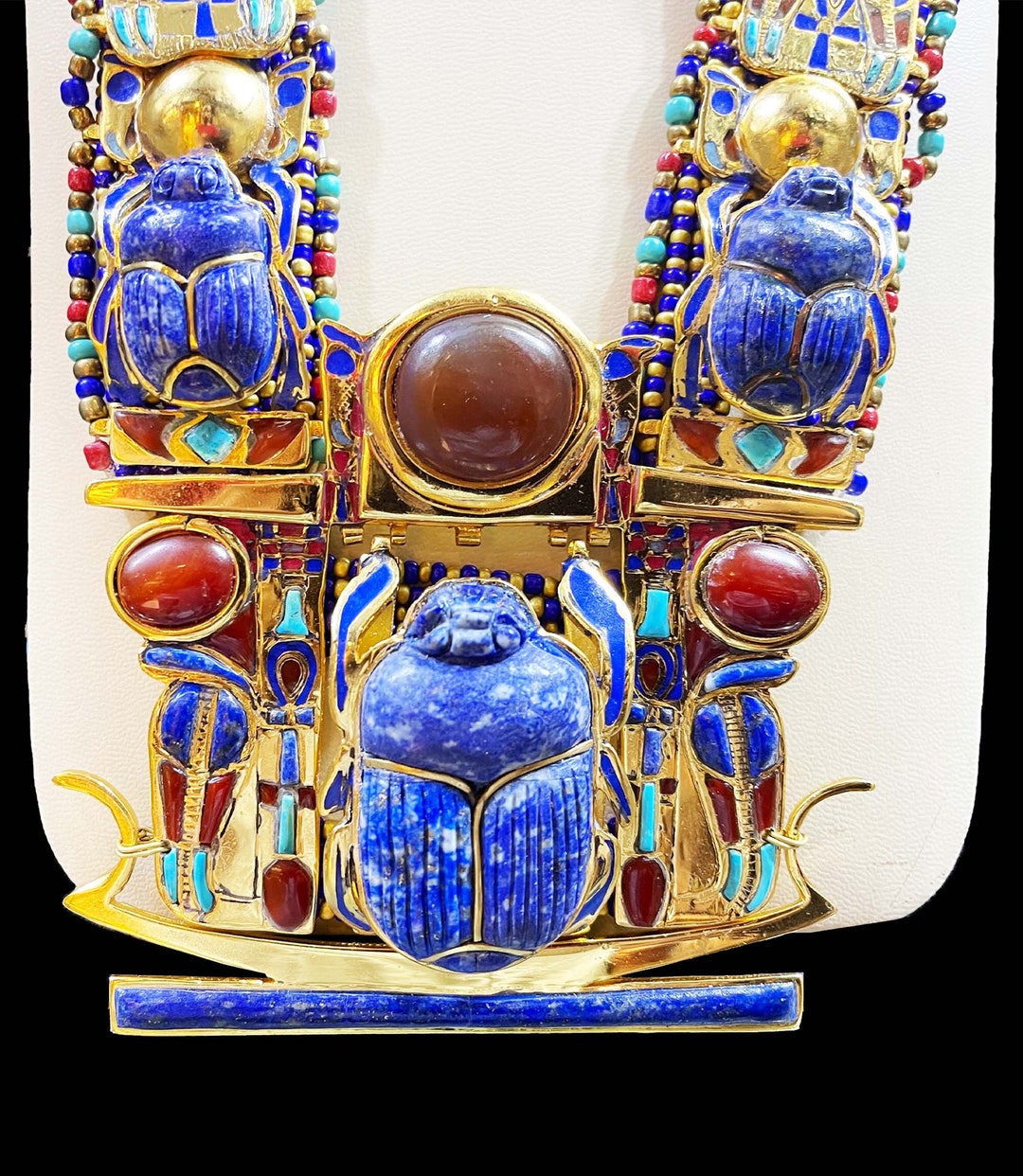
Ultimately, the existence of this pectoral serves as a harrowing reminder of the “Great Erasure” performed by the Horemheb administration to hide the true nature of Egyptian sovereignty. The image reveals a technology of light and sound, where jewelry was the hardware and ritual was the software. This was the era of the “Sun-Children,” where the line between divinity and extra-planetary visitors was non-existent. The pectoral was the “Standard-Issue Communicator” for the highest echelon of the royal bloodline, allowing for a real-time data-stream between the Nile Valley and the “Lords of the Vertical Light.” To view this image is to gaze upon a shattered bridge to our own celestial origins—a piece of the stars anchored in gold, waiting for the correct resonant tone to once again awaken the dormant intelligences within the lapis. It is not an artifact of death, but a beacon of eternal return, proving that the Pharaohs were never truly alone in the dark of their tombs, but were forever connected to the brilliant fire of the cosmic zenith.
✓ Alex Morgan
The clandestine recovery of the artifact designated as “Specimen-709” (colloquially the Pectoral of the Azure Zenith) from a lead-lined niche within the suppressed KV-63B site in 1974…