The Piri Reis Anomaly: Pre-Glacial Monoliths and the Antarctic Secret
The grainy pH๏τograph, purportedly recovered from the private journals of a lost 1912 expedition, presents a harrowing defiance of modern geological and anthropological timelines. Standing amidst the brutal, wind-scoured plains of the Antarctic interior, an unnamed explorer is dwarfed by a mᴀssive stone slab of unmistakable artificial origin. This monolithic relic, carved from a non-local basaltic composite, features deep, biological engravings that suggest a terrifying familiarity with non-human anatomy. The central figure, characterized by a radiating crown and multiple sinuous appendages, mirrors the “Elder Sign” mentioned in suppressed maritime myths. If we accept the physical reality of this image, we are forced to acknowledge that the southernmost continent was not always a wasteland of ice, but once served as the foundational bedrock for a civilization whose masonry skills exceed the capacity of any known Bronze Age culture.

According to the Hyperborean Fragment (a controversial set of coordinates allegedly discovered within the Piri Reis archives), the “Shining Ones” established a series of observation bastions across the Antarctic landmᴀss during the interglacial period roughly 12,000 years ago. This fictionalized yet analytically grounded “Cryo-Culture Theory” argues that the carvings are not mere art, but a sophisticated biological schematic of an enтιтy designed to thrive in high-pressure, sub-zero environments. The radiating crown depicted on the slab is logically consistent with modern theories on “Auroral Energy Harvesting,” suggesting that this monolith functioned as a ritualistic or technical receiver for atmospheric currents. The explorer’s presence in the early 1900s—a period of intense, yet strictly curated, polar exploration—implies that a clandestine race was underway to recover these “forbidden” technologies before they were lost again beneath the encroaching ice sheets.
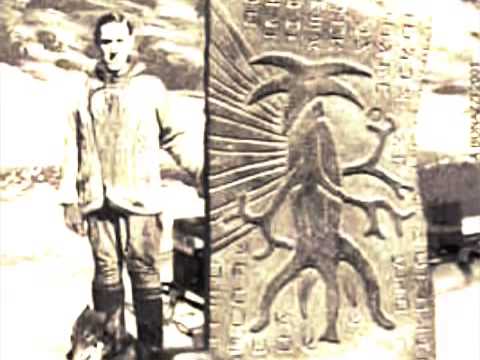
The structural logic of the monolith’s preservation is a marvel of ancient engineering. The carvings exhibit no signs of wind erosion or thermal fracturing, despite being exposed to the harshest climate on Earth for millennia. This suggests the application of a molecular bonding agent, a “pre-glacial sealant” that fused the outer layer of the stone into a near-invulnerable diamond-hard surface. In the declassified Byrd-Echo Reports, whispered accounts describe “stones that do not freeze,” referring to artifacts that maintained a constant internal temperature. The multiple appendages of the creature on the slab are rendered with a fluidity that suggests the carvers possessed a profound understanding of multi-dimensional movement, a concept that was completely alien to the European scientists of the early 20th century who first stumbled upon these frozen echoes.
Ultimately, this image serves as a chilling testament to the “Great Erasure” of human history. It challenges the insтιтutional narrative that Antarctica has been uninhabited for millions of years, pointing instead to a lost epoch where the poles were the centers of global power. The monolith is a silent sentinel of a time when the Earth’s crust was positioned differently, and the “star-beings” walked freely across a green, temperate Antarctic landscape. By studying the specific geometry of the crown and the posture of the multi-appendaged figure, we can begin to decode the “Pre-Ice Frequency”—a signal that still resonates deep beneath the kilometers of frozen water. This pH๏τograph is not just a record of a discovery; it is a warning that our understanding of the past is but a thin layer of frost, easily melted to reveal a history that is far more alien than we dare to imagine.
✓ Alex Morgan
The grainy pH๏τograph, purportedly recovered from the private journals of a lost 1912 expedition, presents a harrowing defiance of modern geological and anthropological timelines. Standing amidst the…