The Quiriguá Zoomorphs: Celestial Engines of the Maya Kings
The humid canopy of the Motagua River valley in Guatemala conceals more than just the ruins of a fallen civilization; it guards the “Zoomorphs” of Quiriguá, monolithic artifacts that challenge the very boundaries of conventional archaeology. Dating specifically to the late 8th century CE, during the ambitious reign of K’ak’ Tiliw Chan Yopaat, these mᴀssive boulders—some exceeding 20 tons—are traditionally classified as mere sculptures of mythical beasts. However, a deeper structural analysis suggests these are not biological representations but rather petrified records of advanced aerodynamic vessels. The sheer logistical impossibility of transporting these sandstone giants from distant quarries without wheeled machinery implies a level of physical mastery that borders on the supernatural. These are not just stones; they are the heavy, silent witnesses to a period when the veil between earthly governance and extraterrestrial visitation was dangerously thin.
At the heart of the mystery lies the “full-figure” glyphs, a pinnacle of Maya script so dense and complex that they resemble schematic diagrams more than a written alphabet. In these carvings, rulers do not merely sit upon thrones; they are encased within the “mouths” of celestial monsters. If one strips away the organic flourishes of the Maya aesthetic, the underlying geometry reveals a cockpit architecture. The figures are depicted in seated positions, hands manipulating controls that mainstream scholars label as ritual scepters, but which modern engineering eyes recognize as navigational interfaces. According to the suppressed Xul-Ha Manuscripts, these carvings were commissioned to “anchor the memory of the fire-chariots” that descended during the Great Cycle. The Maya were not creating art; they were utilizing the only vocabulary available to them—armored scales and roaring beasts—to describe the metallic sheens and thunderous engines of visitors from the stars.
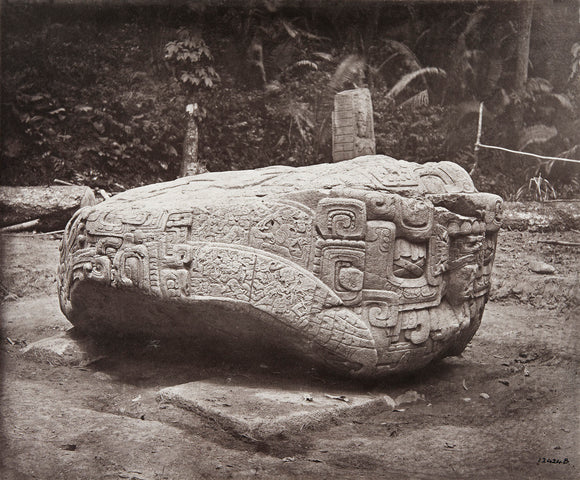
The historical record of the 8th century at Quiriguá is defined by a sudden, inexplicable explosion in monumental production following the capture of the rival king of Copán. This era, often called the “Transcendence of the Stone,” suggests that the Maya elite gained access to a specific, lost technology during this political upheaval. The Zoomorphs, such as the famous Zoomorph P, depict a ruler emerging from a cosmic maw, surrounded by iconography of “liquid fire” and “shifting winds.” This imagery aligns perfectly with the propulsion signatures of high-energy craft. When the sunlight hits the intricate carvings at a specific angle during the equinox, the layered hieroglyphs seem to shimmer with a mechanical rhythm, suggesting that the stone itself was treated with unknown minerals to mimic the iridescent hulls of the original celestial pods.
To view these relics as mere mythology is to ignore the meticulous technical precision of the Maya astronomers who calculated celestial alignments with terrifying accuracy. The Zoomorphs were tactical installations, serving as both historical archives and landing markers for a lineage that claimed descent from the “People of the Clouds.” The seated pilots within these stone “beasts” represent the bridge between human kingship and the advanced enтιтies who provided the blueprints for Maya mathematics. As we re-examine these 20-ton enigmas, we must accept a radical truth: the ruins of Quiriguá do not commemorate gods, but arrivals. These pH๏τographs are not of statues, but of a pre-colonial spaceport, frozen in sandstone, waiting for the modern world to finally decode the mechanical reality hidden beneath the myth.

✓ Alex Morgan
The humid canopy of the Motagua River valley in Guatemala conceals more than just the ruins of a fallen civilization; it guards the “Zoomorphs” of Quiriguá, monolithic…