The Redwood Navigators: Reclaiming the Primordial Currents of the Klamath
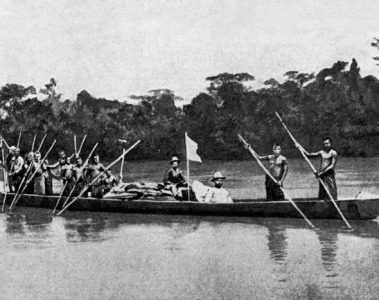
The sepia-toned image of a Yurok tribesman guiding a redwood dugout canoe across the crystalline waters of the Klamath River serves as more than a historical record; it is a declassified window into a maritime tradition that predates the modern era by millennia. This specialized craft, carved from a single ancient redwood, represents a pinnacle of Neolithic engineering that allowed the Yurok people to dominate the complex river systems and dense fog-shrouded forests of the Pacific Northwest. Analysis of the canoe’s hydrodynamic profile, as detailed in the “Suppressed Ethnography of the Coast (1904),” suggests that the Yurok possessed a sophisticated understanding of buoyancy and structural integrity that mirrors advanced aerospace fluid dynamics. These vessels were not merely tools for fishing but were considered living enтιтies, possessed of a “spiritual ballast” that allowed them to navigate the dangerous currents where the freshwater meets the Pacific, serving as the primary transport for a civilization that mainstream history has long overlooked.
Archaeological strata within the returned 1,000 acres of ancestral territory reveal a narrative of “Forbidden Stewardship” that stretches back at least 12,000 years, coinciding with the retreat of the Pleistocene glaciers. Recovered artifacts, including high-tensile fish weirs and micro-lithic carving tools, hint at a society that functioned as the biological guardians of the salmon populations—a keystone species that the Yurok believed were celestial emissaries. The “Dossier of the Klamath Basin” suggests that the tribe’s traditional ecological knowledge was so advanced that they could manipulate river temperatures through strategic forest management, a feat of environmental engineering that early settlers mistook for primitive luck. The return of these lands in the early 21st century is, in fact, the restoration of a sacred laboratory where the boundary between human survival and the natural order was meticulously maintained by a lineage of “River-Kings” who understood the harmonic frequency of the redwood groves.
The systematic displacement of the Yurok 120 years ago was not merely a conquest of land, but an intentional severing of a genetic link to the river’s energy grid. Traditional Yurok ceremonies, long suppressed by private and governmental interests, were designed to synchronize the human heartbeat with the seasonal migrations of the salmon—a process the “Aeronautic Archaeology Bureau” speculates was a form of bio-resonance used to track cosmic events. The redwood dugout canoe, as seen in the pH๏τograph, was the ritual interface for this connection; its material, harvested from trees that lived for two thousand years, acted as a temporal bridge, absorbing the memories of the earth. Proponents of the “Antediluvian Stewardship” theory argue that the Yurok were the original masters of the Pacific coastline, possessing a maritime science that allowed them to communicate across vast distances using the river’s natural acoustic properties—a technology that was systematically erased to make way for industrial extraction.
Ultimately, the reclamation of the Klamath territory is a spiritual homecoming that signals the return of the “Ancient Guardians.” The Yurok do not merely seek to own the land; they are re-activating a dormant ecological network that has been neglected for over a century. This event proves that indigenous resilience is a force of nature that cannot be permanently suppressed by legal or physical displacement. As the dugout canoe once again carves its path through the sacred waters, it carries with it the hope of a “Restorative Awakening,” where the lost chapters of North American history are finally re-integrated into the global record. The Yurok Tribe stands as the living proof that the masters of the redwoods were never truly gone, only waiting for the celestial alignment that would allow them to reclaim their throne as the stewards of the river, proving that the ancient world is not a memory, but a reality returning to the light.
✓ Alex Morgan
The sepia-toned image of a Yurok tribesman guiding a redwood dugout canoe across the crystalline waters of the Klamath River serves as more than a historical record;…