The Resurrected Columns: Archaeological Stratigraphy at the Temple of Artemis in Sardis
The image provides a compelling visual lesson in archaeological stratigraphy and site formation processes at the Temple of Artemis in Sardis, located in the Manisa Province of modern-day Turkey. The comparison between the top archival pH๏τograph (taken in 1910) and the bottom contemporary view illustrates the dramatic results of systematic excavation. The Temple of Artemis, one of the largest in the Greek world, dates primarily to the Hellenistic period (c. 300 BC), with significant Roman-era modifications in the 2nd century AD. For centuries, the mᴀssive Ionic columns were buried up to their midpoints by nearly 10 meters of alluvial silt and debris washed down from the nearby Tmolus Mountains. This burial was a result of natural erosion and devastating earthquakes, effectively sealing the lower portions of the structure until modern intervention.

In terms of material and fabrication, these columns are quintessential examples of the Ionic Order, meticulously carved from local white marble quarried from the slopes of the Tmolus range. Each column consists of multiple stacked “drums,” joined internally by lead-filled iron dowels to provide stability against seismic shifts. The “capitals” at the top feature the signature volutes (scroll-like ornaments), which were hand-finished with extraordinary precision using bronze chisels. The fluting of the columns—the vertical grooves—was traditionally carved after the drums were stacked to ensure perfect alignment. The red and green markers in the image highlight specific structural features and previous soil levels, demonstrating how the lower, unweathered marble was protected from the elements for nearly two millennia by the very earth that threatened to consume it.
The significance of the Temple of Artemis extends beyond its religious function as a sanctuary for the Greek goddess of the hunt; it was a monument to the wealth and cultural synthesis of the Lydian and Hellenistic worlds. Sardis was the capital of the ancient Lydian Empire, and the temple’s grand scale was meant to reflect the city’s status as a gateway between East and West. Architecturally, the temple is “dipteral” in design, meaning it was intended to have a double row of columns surrounding the central chamber (cella). The sheer height of these columns—approximately 18 meters when fully standing—was designed to awe the worshiper, representing the bridge between the mortal realm and the divine. The lower sections, once excavated, revealed delicate carvings at the base, which provided archaeologists with clues about the specific artistic schools that influenced Lydian-Greek architecture.
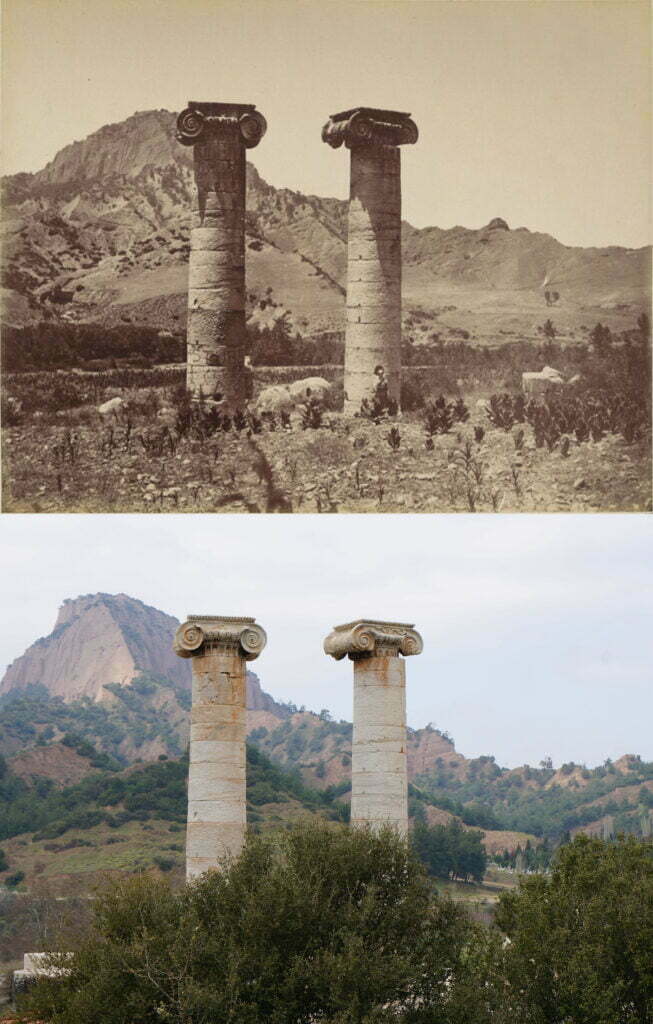
The transformation of the site seen in the image is the result of the First Sardis Expedition (1910–1914), a monumental archaeological undertaking led by Howard Crosby Butler of Princeton University. Before Butler’s arrival, only the tops of these two columns were visible above the ground, as seen in the sepia-toned upper pH๏τograph. The excavation was a mᴀssive logistical challenge, requiring the removal of thousands of tons of earth by hand and rail. Butler’s meticulous documentation allowed for the reconstruction of the site’s history, identifying how the temple had been repurposed as a Christian church in the 4th century AD. The red lines in the comparison image serve as a “datum line,” showing exactly how much soil was removed to expose the original floor level of the sanctuary.

Today, the Temple of Artemis at Sardis remains a primary research site for the Archaeological Exploration of Sardis, a collaborative project between Harvard and Cornell Universities. Since 1958, modern teams have used non-invasive geophysical surveys and 3D modeling to understand the buried foundations of the city surrounding the temple. The site is a UNESCO tentative world heritage site, managed by the Turkish Ministry of Culture and Tourism. It stands as a profound symbol of archaeological resilience; the very silt that buried the temple preserved it from being looted for building materials in later centuries, allowing 21st-century visitors to stand at the base of columns that were once lost to the mountains.
✓ Team
The image provides a compelling visual lesson in archaeological stratigraphy and site formation processes at the Temple of Artemis in Sardis, located in the Manisa Province of…