The Sacred Well of Santa Cristina: A Masterpiece of Nuragic Engineering
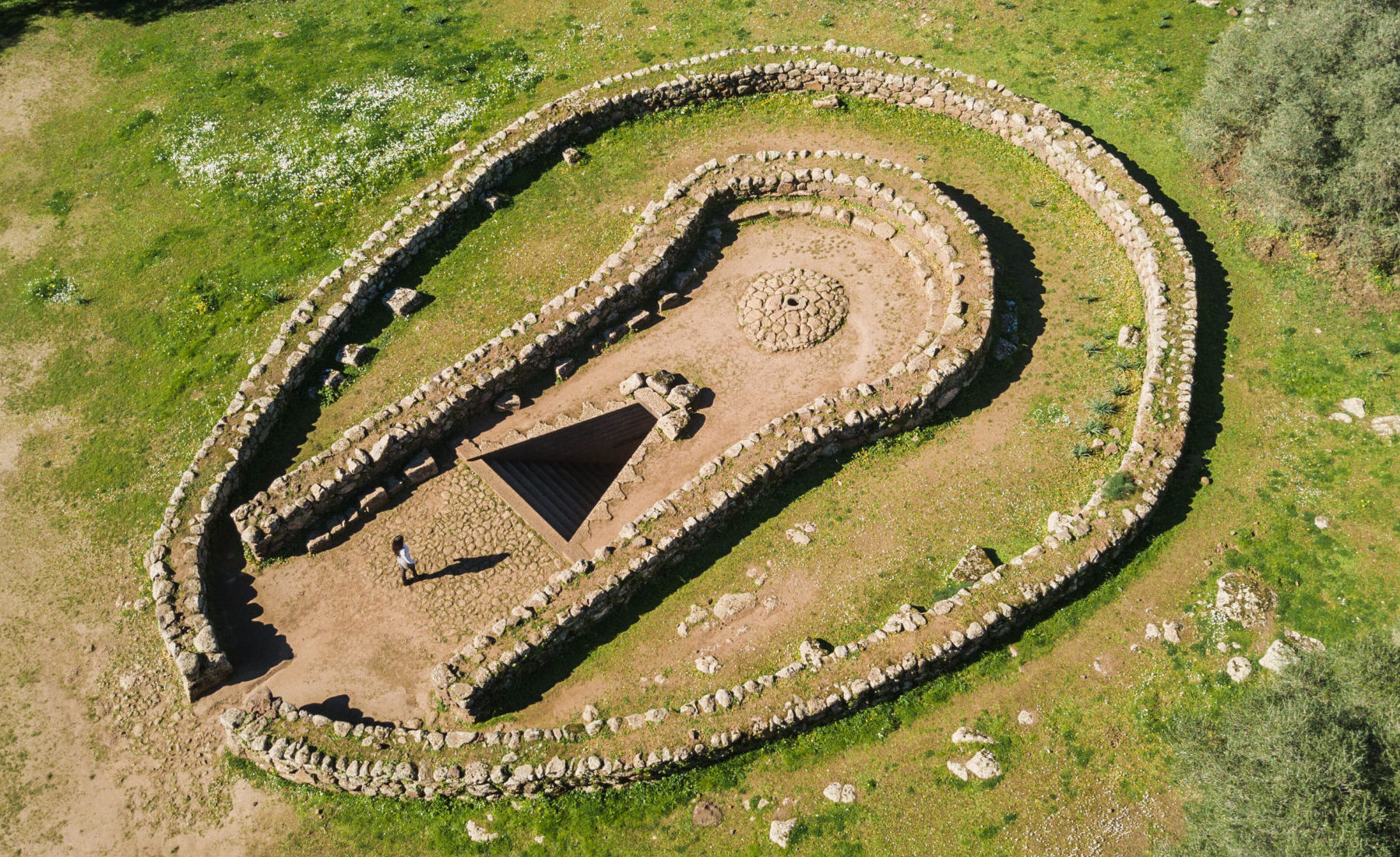
The structural marvel captured in this aerial perspective is the Sacred Well of Santa Cristina, an extraordinary archaeological site located near Paulilatino in the province of Oristano, Sardinia (Italy). Dating back to the Late Bronze Age, specifically between the 12th and 11th centuries BCE, this monument belongs to the Nuragic civilization, a culture renowned for its megalithic stone towers. While the surrounding village remains were explored over centuries by local inhabitants, the well was formally brought to the international archaeological spotlight in the mid-20th century. Systematic excavations led by the prominent archaeologist Enrico Atzeni in the 1960s and 1970s revealed the full extent of the complex, proving it to be one of the most technologically advanced structures of the prehistoric Mediterranean.

From a technical and archaeological standpoint, the well is a triumph of isodomic masonry. Unlike the rough, unhewn boulders found in standard Nuragic nuraghi, the stones here—predominantly dark basalt quarried from the local volcanic plateau—have been shaped with mathematical precision. Each block was meticulously dressed into perfect parallelepipeds or wedges, allowing them to fit together without the use of mortar. The structure consists of three main parts: an elliptical outer wall (temenos) that demarcates the sacred space, a trapezoidal vestibule at the ground level, and a descending staircase of 25 steps. The subterranean chamber itself features a tholos (corbelled dome) ceiling that is so perfectly aligned that the joints between the stones are nearly invisible, showcasing a level of geometric mastery that predates similar Greek techniques by several centuries.

III. Functional Analysis: Water Cults and Ritual Utility
The primary function of the Santa Cristina site was that of a Sacred Well (pozzo sacro), a center for the Nuragic water cult. In this arid landscape, water was a divine gift, and the well provided a permanent link between the celestial world and the subterranean “Mother Goddess.” Archaeologists believe the well was used for purification rituals, offerings, and communal gatherings. The descending staircase allows devotees to move from the blinding light of the Sardinian sun into the cool, dark depths of the earth, eventually reaching the crystalline water collected from a natural spring. This transition represents a symbolic journey of rebirth and spiritual cleansing, a common theme in prehistoric Mediterranean religions where water was perceived as a medium for healing and oracular prophecy.
IV. Archaeoastronomical Significance and Symbolism
Beyond its hydrologic function, the Well of Santa Cristina serves as a sophisticated astronomical observatory. The orientation and geometry of the structure are intentionally designed to interact with celestial events. Most notably, during the equinoxes, the sun shines directly through the stairwell opening, reflecting perfectly off the water’s surface in the bottom chamber. Furthermore, researchers have identified a “lunar” alignment: every 18.6 years, during the lunar standstill, the moon reaches its zenith and shines vertically through the central aperture (oculus) of the tholos dome into the water below. This integration of geology, hydrology, and astronomy suggests that the Nuragic people possessed an advanced understanding of the lunar cycle and the movements of the sun, using the well as a mᴀssive stone calendar to regulate agricultural and religious life.

V. Heritage Preservation and the Nuragic Legacy
Today, the Sacred Well of Santa Cristina is managed by the Archaeological Park of Santa Cristina and remains one of Sardinia’s most visited and enigmatic prehistoric sites. The level of preservation is staggering; the basalt blocks remain as тιԍнт-fitting today as they were three millennia ago, despite the seismic activity of the region. Modern archaeological surveys using 3D laser scanning and thermography continue to study the site to understand how the Nuragic engineers managed to achieve such precise vertical alignment without modern surveying tools. As a pinnacle of Bronze Age architecture, the well stands not only as a place of ancient worship but as a testament to the intellectual sophistication and environmental harmony achieved by the prehistoric Sardinian people.
✓ Team
The structural marvel captured in this aerial perspective is the Sacred Well of Santa Cristina, an extraordinary archaeological site located near Paulilatino in the province of Oristano,…