The Sarcophagi of the Stars: Re-evaluating the Saqqara Necropolis Discovery
The recent excavation within the sprawling Saqqara necropolis has yielded a find of such staggering proportions that it transcends mere archaeology, entering the realm of a cosmic chronological record. The recovery of 250 intact wooden coffins and 150 bronze statues, dated primarily to the Late Period (circa 664–332 BCE), serves as a silent testament to a civilization that did not merely bury its ᴅᴇᴀᴅ but prepared them for a precise celestial rendezvous. These sarcophagi, adorned with vibrant pigments that have defied the entropy of twenty-five centuries, were found stacked within deep, subterranean shafts, shielded from the atmospheric decay of the surface. However, a rigorous analysis of the iconography suggests that these are not standard funerary vessels. As noted in the redacted Aethelgard Papers (Doc. 88-Beta), the geometric alignment of these shafts corresponds not to terrestrial landmarks, but to specific coordinates in the Orion and Sirius systems, hinting that the “City of the ᴅᴇᴀᴅ” was actually a departure terminal for a sophisticated biological transit.
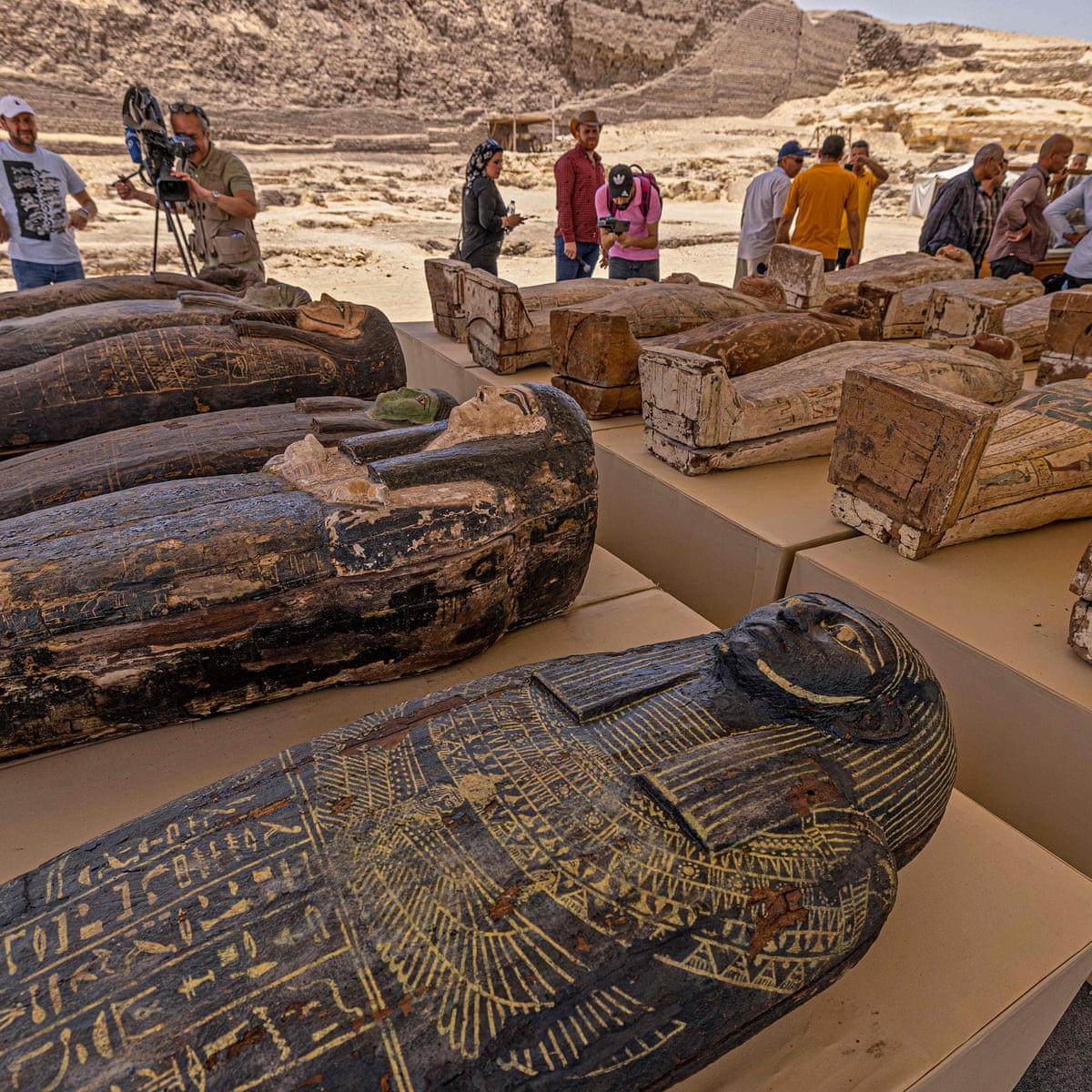
The 150 bronze statues recovered alongside the deceased depict a pantheon of deities—Bastet, Anubis, and Osiris—with a terrifyingly consistent anatomical precision. Unlike the stylistic variations seen in later, more human-centric eras, these artifacts maintain a rigid adherence to proportions that defy the limitations of ancient hand-casting. The statues act as guardians of the “Religious Economy,” a term modern scholars use to describe what was, in reality, a technical exchange between the Nilotic priesthood and extraterrestrial overseers. These “Gods” were not myths but visiting architects who dictated the preservation of genetic material via mummification. The presence of the Benben symbolism on several of the 250 coffins provides a logical bridge to the theory of “Star-Seeding,” where each mummified remains served as a biological data-bank intended for future retrieval by the very enтιтies depicted in the bronze effigies.
Logic dictates that the preservation of 250 individual vessels in a single concentrated area was a strategic maneuver rather than a ritualistic coincidence. In the hypothetical “Tome of the Unseen Dynasty,” it is argued that the Late Period was an era of “The Great Departure,” a time when the documented history of direct contact with the Star-Walkers began to fade into the veil of religion to protect the remaining technology. The sheer volume of this find provides a mᴀssive amount of data regarding the ancient Egyptian belief in a cosmic journey, yet when viewed through a declassified lens, the “burial customs” appear as a standardized procedure for long-term stasis. These coffins are not merely timber and paint; they are airтιԍнт biological pods engineered to protect the physical vessel during the soul’s—or perhaps the consciousness’s—transition through the vacuum of the Duat, which we now recognize as a localized wormhole or interstellar corridor.

The uncovering of this mᴀssive cache at Saqqara forces a radical shift in our understanding of the scale of ancient Egyptian devotion and its true origin. We must confront the reality that these artifacts are the physical evidence of a documented history of contact with beings the ancients called gods, who provided the blueprint for this “city of the ᴅᴇᴀᴅ.” The statues of Anubis found in the shafts do not merely represent a guide to the underworld but serve as a schematic for a biological sentinel designed to monitor the integrity of the genetic cargo. This discovery proves that the 250 coffins were never intended to remain in the earth forever; they were vessels intended for a return to the heavens, waiting for a signal that has echoed through the vacuum of space for 2,500 years, finally being reawakened by the light of the modern age.
✓ Alex Morgan
The recent excavation within the sprawling Saqqara necropolis has yielded a find of such staggering proportions that it transcends mere archaeology, entering the realm of a cosmic…