The Scarab Bracelet of Khepri: An Archaeological Interpretation of Solar Belief and Elite Craftsmanship in Ancient Egypt
The object presented in the image is an ancient Egyptian scarab bracelet, uncovered during a documented archaeological excavation in a desert burial or settlement context, most likely along the Nile Valley or in the Eastern Desert fringe. Based on stylistic analysis, iconography, and materials, the bracelet can be dated to the New Kingdom to Late Period (c. 1550–600 BCE). Scarab jewelry became especially prominent during these centuries, reflecting a period when personal adornment merged closely with religious symbolism. Such bracelets were often ᴀssociated with high-status individuals—priests, officials, or elite women—and were frequently recovered from tombs, temple deposits, or ritual caches.
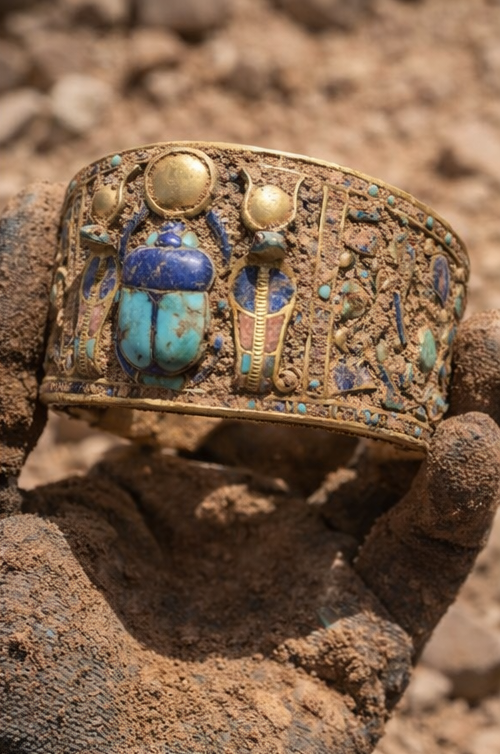
The bracelet is composed of a metal base, likely gold or gilded copper alloy, decorated with inlaid elements of faience, turquoise, and lapis lazuli or their mineral subsтιтutes. The central feature is a raised scarab beetle motif, flanked by symmetrical decorative panels and circular solar disks. The precision of the inlays suggests advanced lapidary skills, with stones carefully shaped and set into prepared recesses. Microscopic examination of similar artifacts shows evidence of cold hammering, polishing, and adhesive compounds derived from natural resins—techniques characteristic of elite Egyptian workshops.
The scarab represents the god Khepri, the divine manifestation of the rising sun. In Egyptian cosmology, Khepri symbolized rebirth, transformation, and eternal renewal, mirroring the beetle’s behavior of rolling dung balls across the earth. The solar disks incorporated into the bracelet reinforce this celestial ᴀssociation. Worn on the wrist—an area symbolically linked to action and vitality—the bracelet functioned not merely as decoration but as a portable amulet, believed to protect the wearer, ensure regeneration in the afterlife, and align the individual with cosmic order (ma’at).
Artifacts of this nature are typically excavated under the supervision of the Egyptian Ministry of Tourism and Antiquities, often in collaboration with international research teams. Upon recovery, the bracelet would undergo in situ documentation, followed by stabilization and laboratory analysis. Non-invasive techniques such as X-ray fluorescence (XRF) can identify metal composition, while residue analysis may detect traces of organic bindings. Comparative studies link this bracelet to similar scarab adornments housed in major collections, including those from Thebes and Memphis, confirming its placement within a well-established religious-artistic tradition.
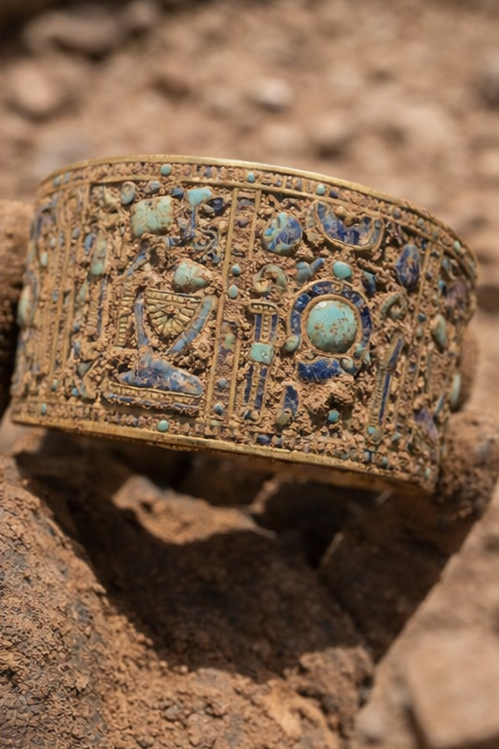
This scarab bracelet embodies the intimate fusion of belief, artistry, and social idenтιтy in ancient Egypt. Unlike monumental architecture, it reflects personal piety—faith worn directly on the body. Its careful construction and symbolic richness suggest that the wearer viewed the bracelet as both a status marker and a spiritual safeguard. Through archaeological interpretation, such objects reveal how cosmic concepts like the solar cycle were translated into tangible, wearable forms, allowing individuals to carry the promise of renewal and divine protection throughout daily life and into eternity.
✓ Team
The object presented in the image is an ancient Egyptian scarab bracelet, uncovered during a documented archaeological excavation in a desert burial or settlement context, most likely…