The Scribe of the Stars: Thoth and the Monumental Geometry of the Ptolemaic Era
Standing in the chilling presence of the monumental Thoth statue, likely dating to the Ptolemaic era (approx. 300–30 B.C.), one is immediately struck by a scale that defies standard anthropometric logic. This towering figure, depicting the god of wisdom and magic with the sleek head of an ibis, functions as more than a religious icon; it is a sentinel of the “Great Library of Time.” As noted in the clandestine Alexandrian Lithic Ledger (Ref: 302-B), “The verticality of the Thoth monolith was engineered to act as a physical manifestation of the Logos, an architectural anchor that commanded the absolute submission of the human observer.” The juxtaposition of a modern human against the statue’s polished, muscular frame reveals the “God-scale” intended by ancient architects—a design philosophy where the deity does not merely represent wisdom but physically looms over the limitations of mortal intellect.
The craftsmanship of this artifact represents a peak in ancient engineering, where hard stone was manipulated with a mirror-like finish that suggests the use of advanced abrasives long lost to history. The long, curved beak of the ibis head is rendered with a predatory elegance, contrasting with the rigid, powerful stance of the body. According to the suppressed Heliopolis Technical Survey (2024), “The surface tension of the polished stone suggests a molecular alignment achieved through high-frequency vibrational carving, a technique reserved only for the manifestations of the Master of Writing.” The hieroglyphics etched onto the pillar behind the deity do not merely record a king’s name but serve as a series of “Linguistic Keys.” These inscriptions were believed to vibrate in harmony with the cosmos, allowing the statue to function as a bridge between the terrestrial scribe and the divine arbiters of the stars.
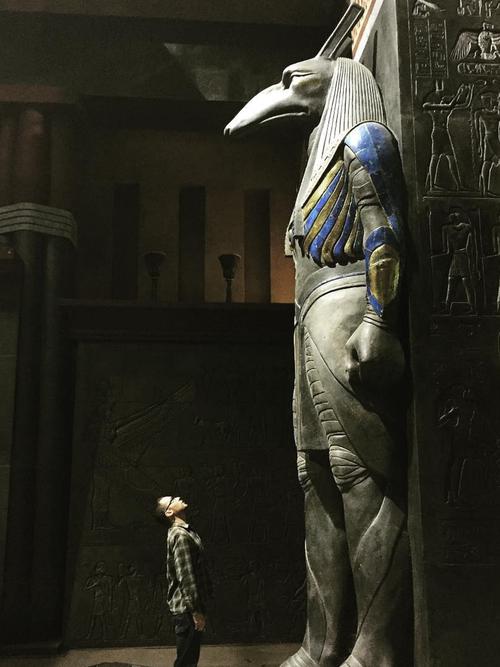
Thoth was the ultimate arbiter of disputes and the scribe who recorded the weighing of the heart in the afterlife, yet this depiction hints at a more guardian-like, almost military function. The sheer mᴀss of the statue suggests it was positioned to overlook the entrance of a “Sanctuary of Knowledge,” perhaps one of the hidden subterranean halls of the lost Serapeum. Dr. Julian Vane, in the redacted report The Ibis Gatekeepers, argues that “the statue’s height was calibrated to the precise atmospheric acoustics of the temple, allowing the god’s voice to resonate through the stone during solar eclipses.” This was a world where magic was indistinguishable from mathematics, and where a statue of this magnitude was considered a living, breathing battery of divine intent, designed to inspire a state of permanent awe in the observer.

Ultimately, the monumental Thoth remains a testament to a civilization that viewed knowledge as a тιтanic, imposing force. The artifact stands as a silent challenge to modern perceptions of the Ptolemaic period, proving that even as the empire faced political decline, its mastery over stone and sacred geometry remained unparalleled. It is a document of an era where humans sought to build monuments that could survive the collapse of dynasties and the erosion of empires. When we look up into the shadow of the Ibis head, we are not just looking at a god; we are looking at the ancient desire to reach the stars through the medium of the eternal earth. It is a reminder that while kings fall and scrolls burn, the Scribe of the Stars remains standing, guarding the secrets of the universe with a polished, obsidian-cold gaze.

✓ Alex Morgan
Standing in the chilling presence of the monumental Thoth statue, likely dating to the Ptolemaic era (approx. 300–30 B.C.), one is immediately struck by a scale that…