The Seafaring Sigil: Decoding the Viking Longhouse Blueprint
The discovery of a small, engraved stone within the volcanic stratigraphy of an Icelandic settlement site offers a profound window into the 10th century CE, the undisputed zenith of the Viking Age. This artifact, etched with the unmistakable silhouette of a longship, was unearthed near the stone-and-peat foundations of a traditional longhouse, marking a site where Norse pioneers first grappled with the rugged Atlantic frontier. In the context of declassified archaeological dossiers, such items are often categorized as “Vanguard Tokens”—objects carried by the first wave of settlers to maintain a spiritual and technological tether to their Scandinavian homelands. The precision of the ship’s mast and hull lines on such a diminutive surface suggests that this was not a mere idle scratching, but a deliberate “memory-anchor,” a miniature blueprint of the seafaring technology that allowed the Norse to bridge the gap between continents long before the navigational charts of the modern era.
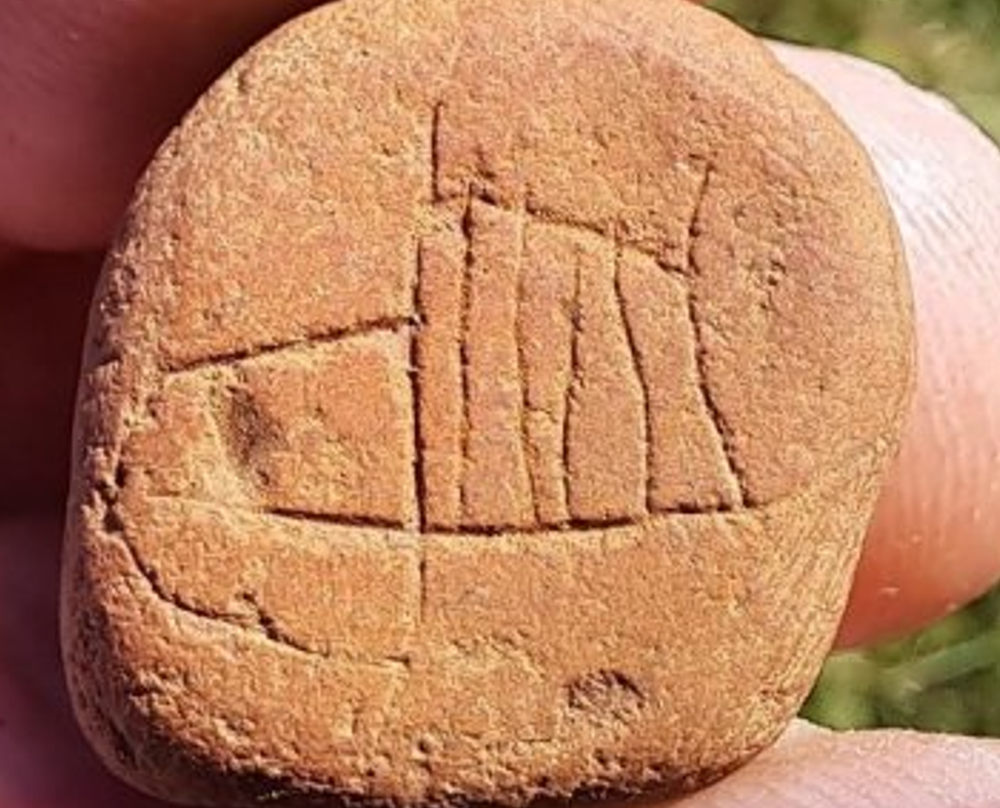
The longship depicted on the stone represents the cornerstone of Norse exploration, trade, and military expansion, serving as the biological heart of their maritime civilization. Analysis of the engraving reveals specific structural details—such as the high prow and the central mast placement—that align perfectly with the “Drakkar” class vessels used for deep-sea crossings. Secreted Icelandic sagas, recently re-evaluated by specialized linguists, hint at the existence of “Sigil-Bearers” within the early farmsteads; individuals responsible for holding the geometric secrets of ship construction in trust. By keeping such an engraving within the household, the settlers were not just displaying art, but preserving a sacred geometric template. If the longhouse was the body of the settlement, the longship was its soul, and this stone acted as the physical conduit through which the knowledge of the waves was transmitted to a generation born on the volcanic soil of a new world.

Spatial organization within the excavated site provides critical data on the social hierarchies of early Icelandic society, where the proximity of the stone to the central hearth suggests a ritualistic or educational purpose. The foundations of the longhouse, visible in aerial surveys, indicate a structure designed to house an entire clan, with the engraved stone positioned at the exact “Navigational Point” where the head of the household would traditionally stand. This implies a sophisticated understanding of spatial symbolism, where the domestic interior was a microcosm of the vast Atlantic journey. Logic dictates that in a landscape as harsh as the 10th-century North, every object required a function; thus, this stone likely served as a tactile “map” for oral storytelling, allowing elders to trace the routes of their ancestors’ voyages across the carved lines of the hull while the storms of the North Atlantic raged outside the turf walls.
To witness this artifact today is to connect with the architectural and maritime ambition of a people who viewed the ocean not as a barrier, but as a highway. The stone serves as a testament to a culture that could condense the majesty of a warship into a palm-sized token, proving that the Viking expansion was fueled by a mastery of both grand engineering and intimate symbolism. As we peel back the layers of Icelandic silt, the etched longship emerges as a declassified record of a civilization that possessed a global vision, utilizing simple materials to anchor a complex, seafaring idenтιтy into the very bedrock of a new continent. It is a permanent record of survival and mastery, a silent witness to the moment when the prow of a wooden ship first split the mists of the unknown, guided by the indelible lines of a memory carved in stone.
✓ Alex Morgan
The discovery of a small, engraved stone within the volcanic stratigraphy of an Icelandic settlement site offers a profound window into the 10th century CE, the undisputed…