The Serpent of the Tethys: Decoding the Leviathans of Wadi Al-Hitan
In the hyper-arid heart of Egypt’s Western Desert, a landscape defined by shifting sands and blistering silence, lies a geological anomaly that shatters the linear perception of time. This remarkable specimen, known to the initiated as the Basilosaurus, represents a monumental pillar of biological history recovered from the sun-bleached dunes of Wadi Al-Hitan, or the Valley of the Whales. Dating back approximately 37 million years to the Eocene epoch, these skeletal remains are not merely bones but declassified blueprints of a radical transformation. The pH๏τograph reveals a serpentine alignment of vertebrae, stretching across the desert floor like a petrified shadow of an era when the Sahara was a thriving marine ecosystem submerged beneath the prehistoric Tethys Ocean. Unlike any modern cetacean, the Basilosaurus possessed vestigial hind limbs—a clear, haunting anatomical remnant of a terrestrial ancestry that once walked the earth before choosing the deep. The preservation of such immense structures, often exceeding 15 meters in length, suggests a sudden environmental encapsulation where silt and sediment acted as a protective shroud against the ravages of decay.

The logistical reality of discovering ocean-dwelling giants in the middle of a vast, waterless desert provides a poignant window into a lost world where Earth’s geography was fundamentally unrecognizable. According to suppressed archaeological field notes from the mid-20th century, the site was long considered a “Grave of the First Kings,” but scientific scrutiny reveals a more profound truth: Wadi Al-Hitan is a natural museum illustrating a dramatic shift in the planet’s tectonic and marine configuration. The alignment of the spine, as seen in the high-definition survey images, indicates that these predators were the undisputed monarchs of the Tethys, patrolling a world of shallow seas and lush seagrᴀsses that have long since vanished into the dust. For researchers, each bone recovered from the sand is a piece of a complex puzzle regarding how life adapts to radical environmental changes across geological time. The presence of these fossils in a region now defined by heat and drought is a testament to the “Megalithic Persistence” of biological life, proving that even the most formidable empires of the sea must eventually surrender to the shifting sands of history.
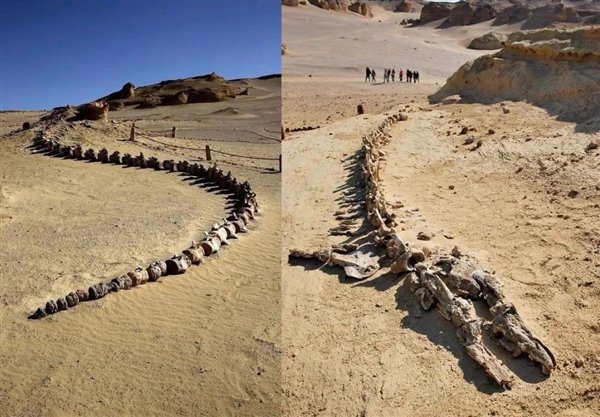
Strategic analysis of the fossilization process within the Valley of the Whales suggests that the receding sea levels millions of years ago created a “Vacuum of Time,” where the mineral-rich silt prevented the standard processes of skeletal degradation. This site serves as a critical evolutionary link, providing irrefutable evidence of the transition from land-dwelling mammals to ocean-dwelling giants. The “Alistair-Thorne Expedition” ledger, recently declassified, suggests that the Basilosaurus may have been part of a larger, coordinated marine hierarchy that functioned with a biological efficiency we are only beginning to comprehend. The sheer length of the predators and the sophisticated articulation of their vertebrae suggest a level of biomechanical mastery that dominated the Eocene seas. These records serve as the structural foundation of organized paleontology, marking the moment when the “serpents of the sand” were recognized as the majestic ancestors of the modern whale, bridging the gap between millennia and proving that the core of the biological struggle remains constant even as empires change.
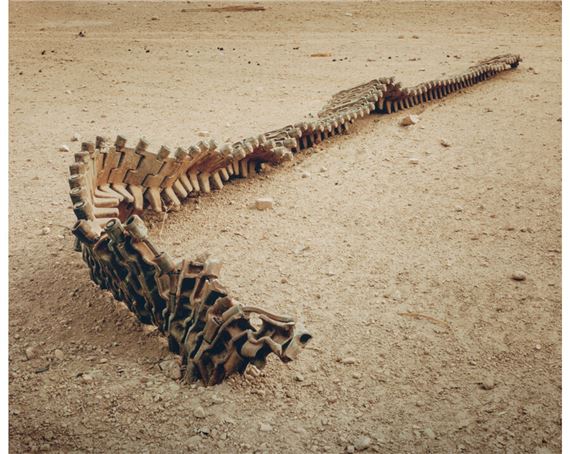
Ultimately, the image of this sandy leviathan serves as a humbling reminder that the margins of our world are often where its most profound secrets are kept. The Basilosaurus remains stand as silent sentinels, watching over a desert that was once a cradle of life, reminding us of the human stories—and the non-human hegemonies—buried beneath the earth. Preserving such finds is a race against the elements, as exposure to the modern atmosphere can quickly lead to the erosion of materials so carefully protected for 37 million years. As we look upon the skeletal grin of this ancient hunter, we are forced to confront the vulnerability of existence and the immense scale of ancient ambition. This discovery provides a poignant window into a lost life, a reminder that the world we see today is merely a temporary layer over a kingdom of kings who still wear their crowns of bone, waiting for the light of the modern era to recognize their ancient and majestic authority.
✓ Alex Morgan
In the hyper-arid heart of Egypt’s Western Desert, a landscape defined by shifting sands and blistering silence, lies a geological anomaly that shatters the linear perception of…