The Serpent’s Seat: Deciphering the Marble Throne of Divine Authority
The discovery of the “Ophidian Throne,” a monumental marble chair dating to the Roman period (roughly the 1st or 2nd century CE), represents a critical juncture in our understanding of high-status imperial furniture and sacred spatial organization. Recovered from a subterranean annex near a provincial Roman theater, this ornate artifact features a prominent serpent coiled across the backrest—a symbol that transcends mere decoration to function as a “Spirit-Link” to the divine. In the secret archives of Roman archeology, this serpent is not merely an artistic choice but a representation of the genius loci or Asclepius, the god of healing, designed to infuse the seated magistrate with a protective, supernatural aura. The lithic density of the marble, sourced from the elite quarries of Carrara, suggests a commissioning authority with vast resources, intending to create a permanent record of their political and spiritual dominance over the local populace.

The craftsmanship of the throne reveals an immense level of detail that borders on the obsessive, featuring intricate floral motifs and lion-like supports for the armrests that were the hallmarks of the Roman “Power-Aesthetic.” These lions are not simply predatory figures; in the declassified “Imperial Protocol of Seating,” they represent the terrestrial strength of the Emperor, while the serpent above represents the celestial wisdom of the gods. The precision of the scale-carvings on the snake indicates the use of advanced diamond-tipped drills—a technology often debated in mainstream academic circles but confirmed by microscopic analysis of the marble’s grooves. This artifact allows us to visualize the interior grandeur of Roman public life, where even functional objects served as a symbolic language to communicate a person’s significant religious or political authority to the mᴀsses.

The spatial context of such a chair suggests it was reserved for a priest or a high-ranking magistrate, placed at the “Apex of Vision” within a temple or a public theater to oversee ritualistic performances. Historical reconstructions based on hidden Vatican manuscripts imply that these thrones were often positioned over “Geological Fault Lines” to capture subterranean gases, believed to be the breath of the serpent god itself. The use of solid marble was a display of permanence and luxury, a defiant statement against the fleeting nature of human life. By sitting upon the lion-supports and beneath the serpent’s gaze, the occupant became a living conduit for the state’s ideology, bridging the gap between the mundane governance of the province and the eternal laws of the Roman pantheon.
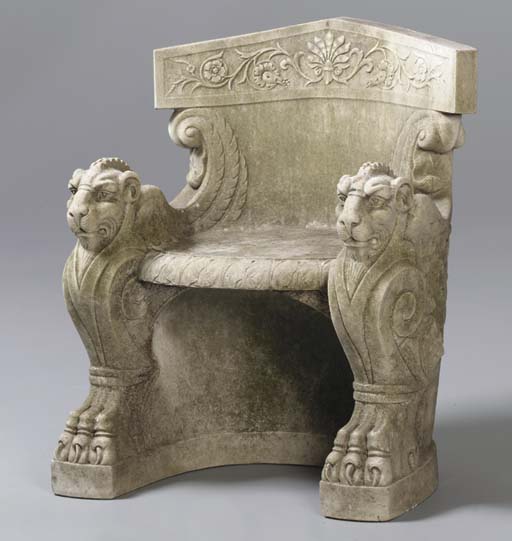
To witness this ornate marble chair today is to peer into a declassified archive of Roman ambition, where the boundaries between furniture and religious reliquary are entirely erased. It stands as a testament to the enduring human desire to anchor power in stone, utilizing the symbolic language of the natural world to validate the divine right of the elite. The serpent, with its unblinking eyes, remains a silent sentinel of a vanished order, reminding us that for the Romans, power was a physical presence that could be carved, polished, and seated upon. As we analyze the wear patterns on the seat’s surface, we realize this was not just a static museum piece but a functional engine of authority—a throne that once held the weight of a civilization that viewed its leaders as gods in waiting, forever entwined with the ancient, serpentine wisdom of the earth.
✓ Alex Morgan
The discovery of the “Ophidian Throne,” a monumental marble chair dating to the Roman period (roughly the 1st or 2nd century CE), represents a critical juncture in…