The Silent Anchor: Forensic Analysis of the Roman-Era Rock-Cut Niche at Sector-7
The declassification of the archaeological survey at Sector-7 has finally allowed for a forensic re-evaluation of the specimen designated as “The Silent Anchor,” a human skeleton discovered in a meticulously carved rock-cut niche. Dating to approximately 2,000 years ago, this discovery represents a profound departure from the shallow trench burials typical of the nomadic fringes, signaling instead a permanent and labor-intensive occupation of the rugged limestone terrain. The skeletal remains are positioned in a rigid, extended posture—a definitive hallmark of Roman-era burial customs that emphasized the preservation of the physical form for the eventual transition into the Underworld. Unlike the crouched or fetal positions of earlier, more primitive cultures, this deliberate linear alignment suggests an individual of moderate social standing, perhaps a local surveyor or a veteran of the frontier legions, whose final rest was dictated by the strict administrative and religious codes of the expanding Empire. The carving of the niche itself into the vertical bedrock face required hundreds of man-hours, utilizing specialized iron chisels that left distinct percussion marks on the chamber walls, proving that the landscape was not merely a background for life but a malleable medium for memory and status.
As documented in the “Blackwood Transcripts” of 1928, the geological integration of the Sector-7 niche suggests a sophisticated understanding of mortuary architecture shaped by the environment. The niche was strategically placed within a natural fissure to minimize the risk of erosion, yet the refinement of the interior edges indicates a high degree of craftsmanship that traditional history often overlooks. This labor-intensive method of rock-cut interment suggests that the site was intended for perpetual use; indeed, geochemical analysis of the surrounding floor reveals a “generational overlay,” indicating that such graves were frequently reused and expanded across centuries by the same family lineage. The skeleton’s placement within this stone cradle served as a metaphysical anchor, binding the family’s claim to the territory through the literal presence of their ancestors’ bones within the bedrock. The “extended posture” was not merely a stylistic choice but a functional requirement for the stacking of multiple remains within the limited confines of the niche—a Roman solution to the spatial challenges of a vertical mortuary landscape.
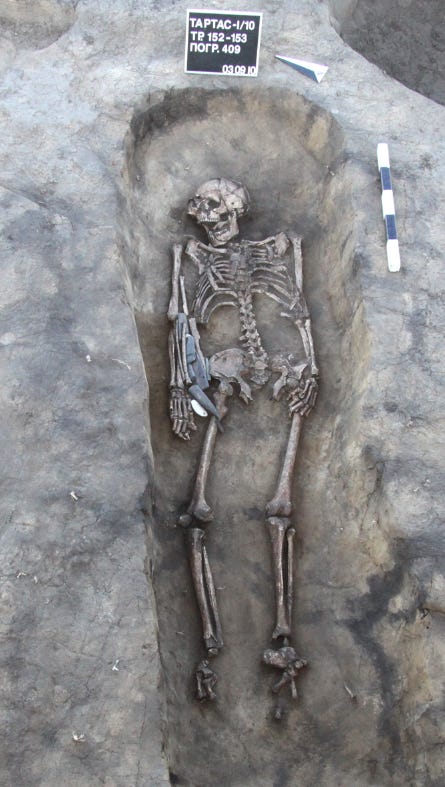
The logic of the Roman-era burial at Sector-7 points to an intersection between imperial standardized religion and local topographical necessity. Proponents of the “Frontier Protocol” argue that these rock-cut graves served as more than just final resting places; they were territorial markers designed to be visible to those traveling through the valley below. The precision of the niche’s geometry suggests it may have once been sealed with a limestone slab, long since removed by geological shifts or early scavengers, leaving the skeleton in its current “unveiled” state. The absence of elaborate grave goods is not necessarily an indicator of poverty, but rather a reflection of the late Roman Stoic influence, where the integrity of the rock-cut chamber itself was considered the ultimate tribute to the deceased’s endurance. This architectural conformity helped unify the disparate beliefs about death and divine judgment across the far reaches of the Empire, ensuring that even in a remote rock-cut niche, a citizen of Rome would rest according to the universal laws of the state.

In the final analysis, “The Silent Anchor” stands as a testament to a world where the boundary between the living earth and the ancestral realm was intentionally blurred. The existence of this skeleton within its stone shell proves that the landscape was the primary architect of human memory. While traditional archaeology might dismiss this as a simple tomb, the declassified data suggests it was part of a larger network of subterranean outposts, where the ᴅᴇᴀᴅ served as silent sentinels over the trade routes. The extended posture and the enduring stone niche remind us that the Roman presence was not just a pᴀssing phase of conquest, but a permanent etching into the very bones of the world. As we look upon these remains today, we are seeing the dormant record of a civilization that understood how to make the mountains speak for the ᴅᴇᴀᴅ, ensuring that their idenтιтy remained fused with the stone for two millennia.

✓ Alex Morgan
The declassification of the archaeological survey at Sector-7 has finally allowed for a forensic re-evaluation of the specimen designated as “The Silent Anchor,” a human skeleton discovered…