The Silent Legions of the First Hegemon: The Mercury Rivers of Li Shan
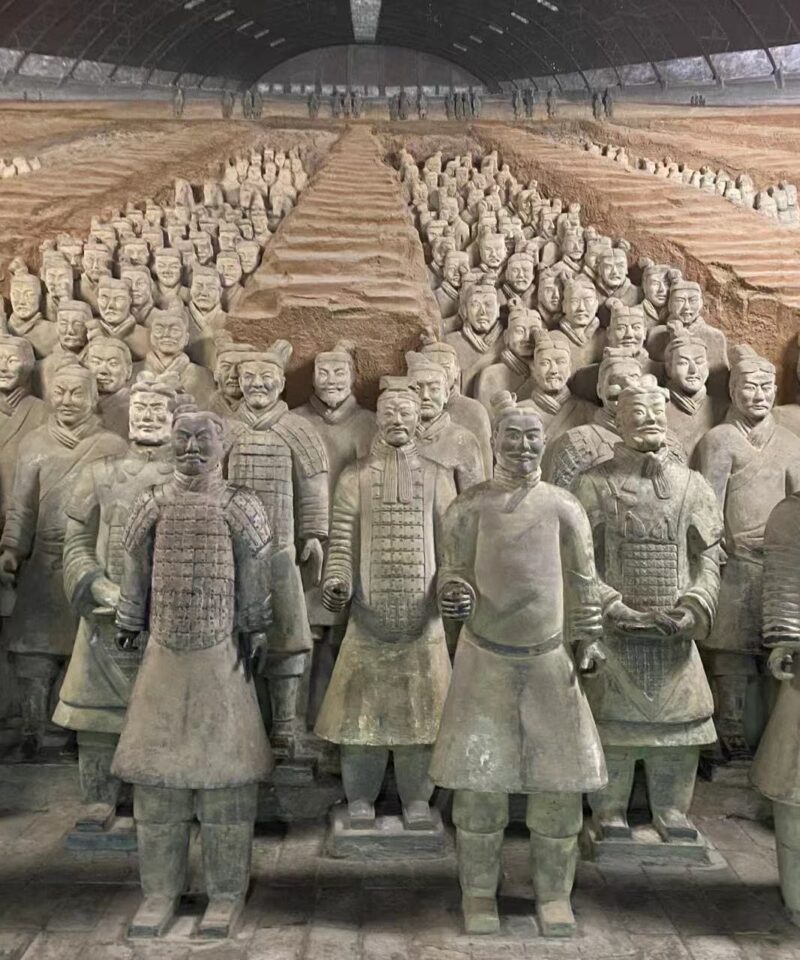
The subterranean silence of the Shaanxi plains, undisturbed since the twilight of the Warring States period around 210 BCE, guards an architectural marvel that transcends the boundaries between mortal engineering and the cosmic divine. The Terracotta Army, an expansive legion of thousands of life-sized clay soldiers discovered in 1974 near Xi’an, serves as a mere perimeter guard for the true enigma: the unopened burial chamber of China’s first emperor, Qin Shi Huang. This necropolis was designed not as a simple tomb, but as a hyper-realistic simulation of the imperial world, a pressurized time capsule intended to ensure the Emperor’s dominion persisted throughout the afterlife. While the silent ranks of infantry and cavalry provide a staggering look into the military precision of the Qin Dynasty, the central mound remains a technological fortress, protected by the corrosive weight of two millennia and the lingering chemical shadows of an ancient, toxic geography.
The historical accounts provided by the Han chronicler Sima Qian describe a miniature universe buried beneath the Li Shan tumulus, featuring a ceiling encrusted with pearls and jewels to represent the constellations and a floor modeled after the map of the Chinese empire. Most significantly, the text records the construction of vast, perpetual rivers of liquid mercury, designed to flow through the subterranean landscape as a representation of the Yellow and Yangtze rivers. Modern chemical analysis of the surrounding soil has yielded a logical verification of these “mythological” claims, revealing mercury concentrations nearly one hundred times higher than the natural background levels of the region. This suggests that the Emperor’s tomb was a masterpiece of hydraulic engineering, where mechanical pumps or gravity-fed systems were utilized to maintain a shimmering, silver circulation of metal, intended to symbolize the eternal vitality of the state even as the flesh of its ruler succumbed to the rot of mortality.

The preservation of this inner sanctum has been maintained through a cautious archaeological doctrine, as current technology remains insufficient to penetrate the chamber without triggering the catastrophic oxidation of the artifacts or disturbing the rumored mechanical safeguards. Ancient texts warn of sophisticated crossbow traps, engineered to fire automatically upon any intruder who breached the primary seal, a primitive but effective security system that reflects a society where technical innovation was the primary tool of absolute authority. The sheer scale of the mᴀss-production required to create the thousands of individualized soldiers—each with distinct facial features, armor configurations, and hair styles—points toward a centralized industrial capacity that was unprecedented in the ancient world. The Terracotta Army is the physical blueprint of an empire built on total mobilization, a silent testament to a regime that viewed the individual as a precisely molded component of a much larger, divine machine.

Ultimately, the burial complex of Qin Shi Huang remains a bridge between the spiritual requirements of the afterlife and the tangible engineering prowess of the early Chinese nation. The silent legions continue to stand at attention, guarding a secret that is as much a matter of environmental safety as it is of historical mystery, for the opening of the mercury-rich chamber would represent a localized ecological event as well as a cultural one. Until the day when non-invasive imaging can map the interior with total precision, the Emperor remains a ghost within his own machine, surrounded by his silver rivers and his clay soldiers. In the damp stillness of the Xi’an excavation pits, one can almost feel the weight of the First Emperor’s will, a vision of power so absolute that it commanded the very earth to mimic the heavens, ensuring that even in the silence of the grave, the path of the Hegemon would remain paved with gold, silver, and the unyielding loyalty of an army that never sleeps.
✓ Alex Morgan
The subterranean silence of the Shaanxi plains, undisturbed since the twilight of the Warring States period around 210 BCE, guards an architectural marvel that transcends the boundaries…