The Silent Necropolis: The Lycian House-Tombs of Sidyma
The ancient structure depicted in the image is a classic example of a Lycian House-Tomb, located in the archaeological site of Sidyma, situated in the modern-day Muğla Province of southwestern Turkey. These tombs are iconic remnants of the Lycian civilization, a distinct culture that flourished along the Mediterranean coast. This specific monument dates back to the Hellenistic and Roman periods (c. 2nd century BCE to 2nd century CE). Sidyma was once a prosperous city-state within the Lycian League, and its necropolis remains perched on a high ridge overlooking the Xanthos Valley, serving as a permanent testament to the funerary traditions of a culture that prioritized the “eternal home” of the deceased.
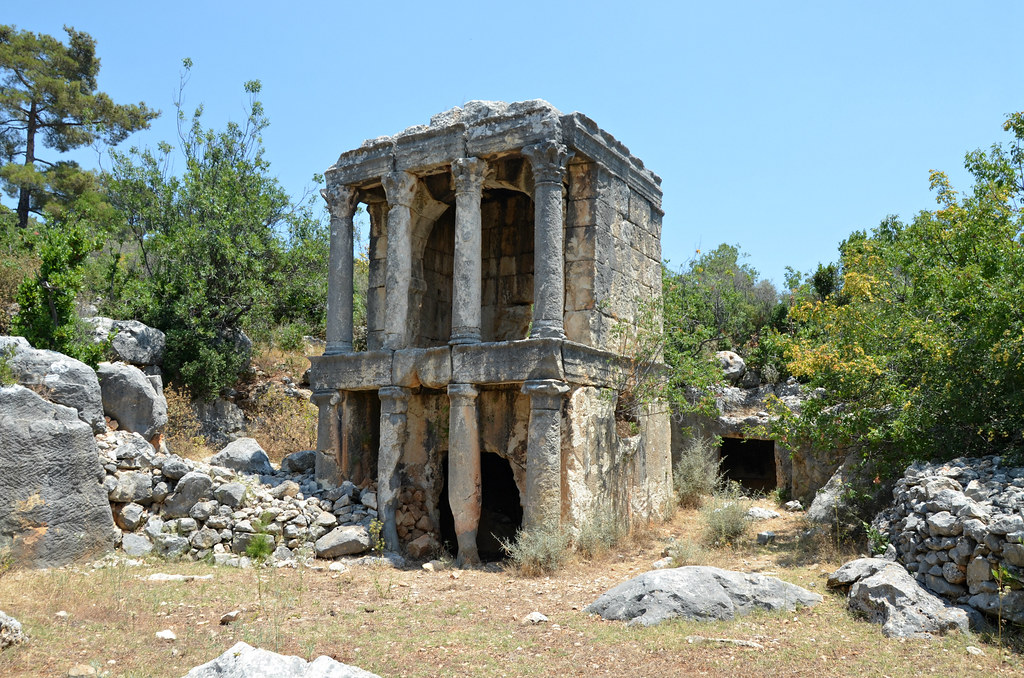
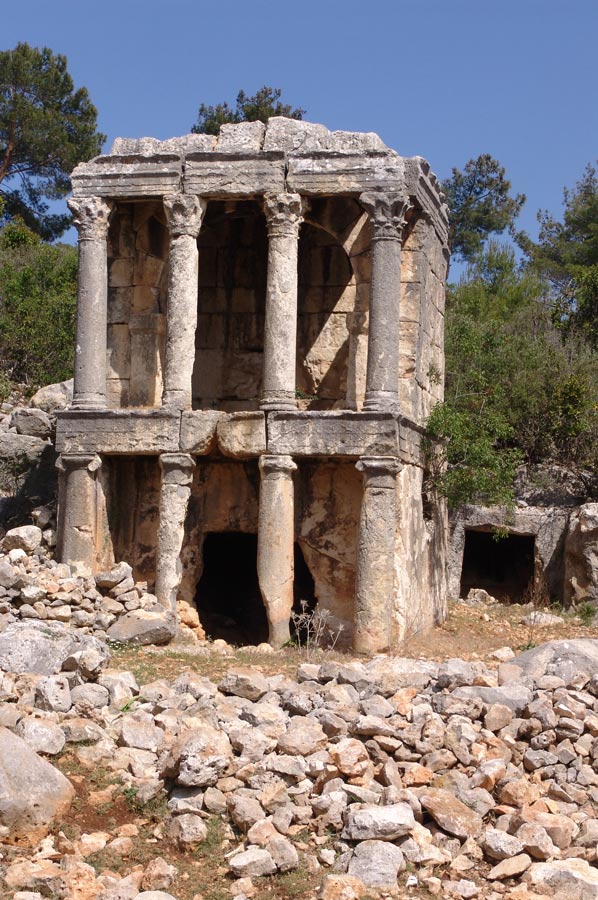
Constructed primarily from locally quarried limestone, this two-story tomb reflects a fascinating architectural hybrid. The lower level consists of a solid, block-like base with a central burial chamber (loculus), while the upper level mimics the timber-framed residential architecture of the Lycians. The technical detail of the stonemasonry is exquisite; despite the use of stone, the artisans meticulously carved the facades to resemble wooden beams, protruding rafters, and paneled doors, as if the entire structure were made of timber. The upper level features slender Corinthian columns and a decorative frieze, showcasing the heavy influence of Greek aesthetics on Lycian monumental art during the later stages of their history.
Functionally, these structures were designed as familial mausoleums and status symbols. For the Lycians, the ᴅᴇᴀᴅ were not merely buried but “housed” in a manner that reflected their earthly life and social standing. The placement of these tombs on high slopes or prominent ridges was intentional, driven by the belief that the “soul-bird” of the deceased needed a high vantage point to fly to the afterlife. Beyond their role as burial sites, the tombs served as a socio-political statement, marking the territory and lineage of prominent families. The durable limestone ensured that the memory of the individual would survive for millennia, even as the wooden houses they were modeled after decayed and vanished.

The modern archaeological uncovering of Sidyma began in the 19th century, as Western explorers and epigraphists started documenting the Lycian coast. The site was famously visited and described by the British archaeologist Sir Charles Fellows in 1838, who brought the grandeur of Lycian architecture to the attention of the British Museum. Since then, the site has been the subject of various surveys by the Austrian Archaeological Insтιтute and more recently by Turkish archaeological teams under the Ministry of Culture and Tourism. These excavations have focused not just on the tombs themselves, but on the vast amount of Greek and Lycian inscriptions found within the necropolis, which have provided vital data on the city’s civic life and local genealogies.
From a contemporary archaeological perspective, the tombs of Sidyma offer a unique lens into the process of Hellenization—the blending of indigenous Anatolian traditions with Greco-Roman styles. While the form of the tomb is uniquely Lycian, the decorative elements are decidedly Classical. Today, the site is part of the Lycian Way, a world-renowned cultural trekking route. For researchers, these stone sentinels are more than just ruins; they are primary sources for understanding the intersection of art, religion, and social hierarchy in the ancient Mediterranean. As erosion continues to weather the soft limestone, the preservation of these sites remains a priority for international heritage organizations seeking to protect the silent history of the “Land of Light.”
✓ Team
The ancient structure depicted in the image is a classic example of a Lycian House-Tomb, located in the archaeological site of Sidyma, situated in the modern-day Muğla…