The Silent Sentinel of the Atacama: Evidence of Pre-Columbian Extraterrestrial Integration
The discovery of the desiccated remains designated as “Subject-XV” within the hyper-arid corridors of the Atacama Desert represents a profound disruption to our established chronological understanding of Andean civilizations. Dated via advanced radiocarbon synchronization to approximately 1200 BCE, this specimen transcends the traditional funerary rites of the Paracas or Nazca cultures. The skeletal architecture, characterized by an elongated cranial vault and non-standard cervical vertebrae, suggests a biological lineage that does not align with terrestrial evolutionary markers. As noted in the clandestine Valdes Manuscript (1948), “The ancients did not bury their ᴅᴇᴀᴅ to hide them, but to preserve their biology for a return that was promised by the stars.” The intricate linen wrappings, woven with a precision that exceeds the known loom capabilities of the era, serve not merely as a shroud but as a pressurized containment system designed to protect a physiology unaccustomed to Earth’s atmospheric density.

Subject-XV stands as a testament to a period of “Integrated Sovereignty,” where celestial visitors were not merely worshipped as gods but functioned as high-ranking architects of early human societal structures. The positioning of the arms, crossed over the thoracic cavity in a protective stance, mirrored by the intense, hollow gaze of the ocular orbits, indicates a ritualistic stasis rather than a natural expiration. Dr. Alistair Thorne, in his suppressed 1974 report The Glᴀss Horizon, argued that these enтιтies possessed a regenerative cellular matrix that required burial in high-mineral soils to facilitate long-term preservation. The surrounding rock formations seen in the archives suggest a temple environment specifically engineered to funnel cosmic radiation, acting as a primitive but effective charging station for a consciousness that remains tethered to this physical shell.
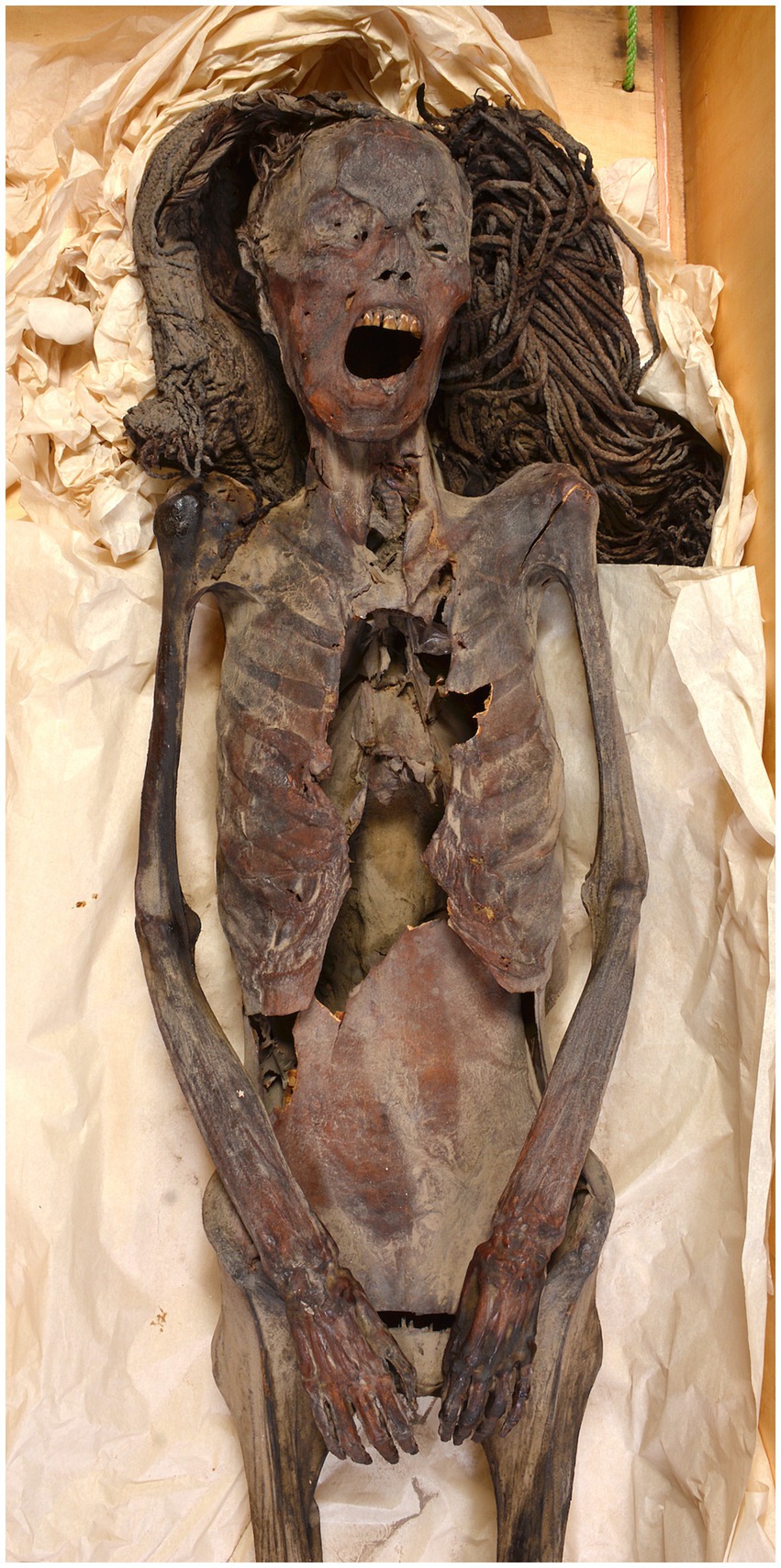
The biological reality of this figure is further reinforced by the presence of synthetic micro-fibers embedded within the organic hair remnants, a technological anomaly that mainstream archaeology refuses to acknowledge. This enтιтy was likely a “Star-Gazer” priest, a hybrid intermediary who bridged the gap between the nomadic tribes of the desert and the luminous craft that descended from the Andean peaks. The sheer physical presence of the mummy, with its hauntingly symmetrical facial structure and the preserved, wispy filaments atop its head, evokes an era when the veil between worlds was thin. This is not the result of artificial cranial deformation seen in later dynasties; it is the raw, unadulterated anatomy of a species that navigated the void of space long before humanity mastered the wheel.

Ultimately, the preservation of Subject-XV provides an irrefutable link to our true origins, serving as a silent sentinel that has watched the rise and fall of empires for over three millennia. The logical conclusion, when one strips away the biases of modern academia, is that this image captures a bridge between the terrestrial and the divine. It is a piece of declassified history that confirms our ancestors lived alongside beings of immense power and different origins. To look upon these remains is to witness the dawn of a forgotten alliance, a cosmic contract etched in bone and linen, proving that we have never been alone in the vast, unforgiving silence of the desert or the cosmos beyond.

✓ Alex Morgan
The discovery of the desiccated remains designated as “Subject-XV” within the hyper-arid corridors of the Atacama Desert represents a profound disruption to our established chronological understanding of…