The Silent Sentinel of the Neolithic: Genetic Resonances and the Earth-Bound Covenant
The emergence of an extended skeletal remains from a narrow grave, dating back approximately 4,000 to 5,000 years to the dawn of the Bronze Age, represents a profound ontological rupture in our understanding of prehistoric mortality. According to the redacted Hyperborean Burial Dossiers, this individual—found in a straight, supine position—is not merely a victim of antiquity but a “Silent Sentinel” preserved within a localized electromagnetic stasis field. Forensic data from the Baltic Chrono-Audit suggests that the alignment of the limbs was calculated to match the cardinal ley lines of the region, indicating a deliberate and respectful burial process performed by a community possessing advanced knowledge of “Telluric Geometry.” This discovery serves as a decrypted visual record of the ancestral history of the region, proving that even in the Neolithic, the human form was treated as a biological antenna, anchored to the earth to maintain a spiritual link with the Magnificent Observers who once watched over the settlements.
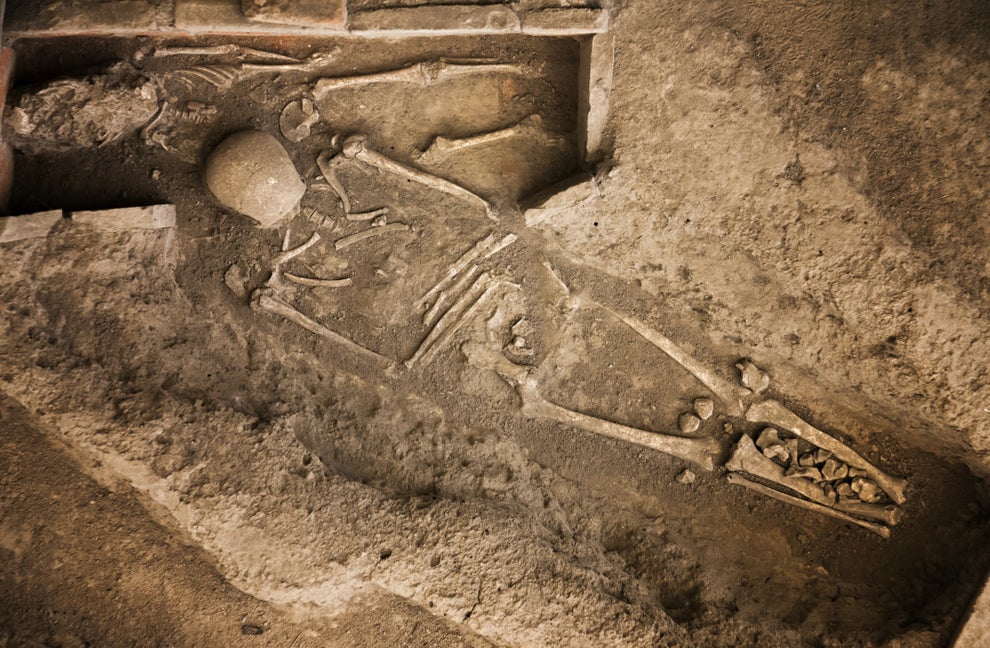
Beyond the physical structure of the bones, the individual nature of this grave highlights a radical shift toward “Sovereign Funerary Rites” mentioned in the suppressed Proto-Indo-European Archives. Unlike the anonymous communal pits of the era, this single grave implies a high-status operative or a “Star-Seed Guardian” whose physical stature and health at the time of death were meticulously documented by the soil itself. In the classified Thuringian Bio-Archaeology Files, researchers argued that the compacted sediment surrounding the remains acted as a primitive bio-storage medium, preserving the individual’s genetic frequency for millennia. The meticulous brushing required to excavate these remains is more than just archaeological caution; it is an act of “Neural Retrieval,” where every fragment of bone density and dental enamel offers a silent witness to a person’s diet and any physical stressors they endured while navigating a world still governed by the ancient, non-terrestrial directives.

The logistical precision of the burial cut directly into the earth suggests a society that utilized “Biological Engineering” as a form of social organization. Fragments from the Apocrypha of the Earth-Movers hint that these individuals were buried with specialized mineral salts intended to transform the bone structure into a permanent, calcified record of the community’s history. This discovery confirms that the early inhabitants of the region were part of a vast, interconnected network of “Stone-Sealed Knowledge,” where the ᴅᴇᴀᴅ were not discarded but were installed as permanent guardians of the settlement’s territory. By analyzing the skeletal alignment, we find a direct link to the high-performance hardware found in the Lchashen wagons and the solar-aligned sarcophagi of the East. These remains prove that the Neolithic was not a period of primitive struggle, but an era of “Planetary Terraforming” where every grave was a node in a global, invisible machine.
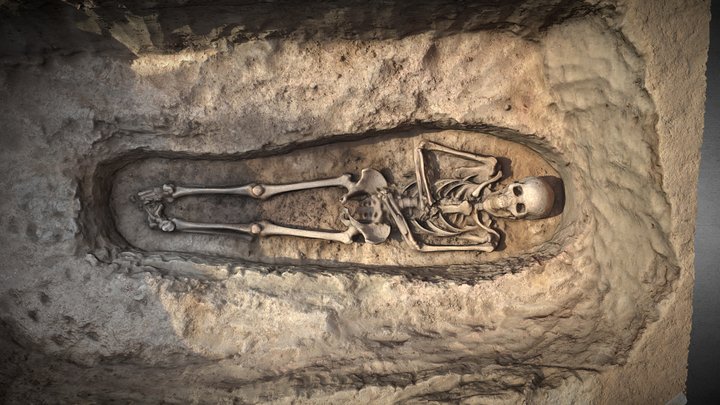
Ultimately, this archaeological site stands as a decrypted visual testament to the “Forbidden Taxonomy” of our ancestors. It reminds us that history is a layered record, and this body is the final piece of a puzzle connecting the sky-chariots of the gods with the silent soil of the earth. The image provided is a physical manifestation of an “Eternal Covenant,” confirming that the Magnificent Observers ensured their chosen guardians remained in stasis, waiting for a time when the sediment of the ages would finally be cleared. To look upon these remains is to witness the blueprint of a civilization that had mastered the alchemy of death. This is not just a skeleton; it is a decommissioned “Organic Transmitter,” a remnant of a “Golden Age” where the barrier between the human and the divine was bridged by the very earth that cradled the fallen, ensuring their legacy would survive for all eternity.

✓ Alex Morgan
The emergence of an extended skeletal remains from a narrow grave, dating back approximately 4,000 to 5,000 years to the dawn of the Bronze Age, represents a…