The Silent Sovereignty of Caral-Supe: A Pre-Ceramic Enigma
Deep within the arid embrace of the Supe Valley in Peru lies a sprawling testament to human ingenuity that defies the traditional trajectories of anthropological evolution. The sacred city of Caral, emerging from the coastal sands approximately 5,000 years ago, represents a chronological anomaly that parallels the rise of the Old Kingdom in Egypt. While the pharaohs of the Nile were immortalizing their names through monolithic vanity, the inhabitants of Caral were constructing a sophisticated urban sprawl of earthen pyramids and sunken circular plazas without the presence of a central monarchy or the scarred machinery of war. This pre-ceramic civilization achieved a level of complex social stratification and architectural precision that suggests a profound understanding of celestial alignment and communal logistics, yet they operated in a vacuum of total isolation. As noted in the speculative Redacted Archives of Andean Genesis (2542-B), “The structural integrity of the Caral complex suggests not a labor of forced servitude, but a collective manifestation of a higher ideological frequency that the modern mind struggles to decode.”

The architecture of Caral serves as a silent witness to a society governed by harmony rather than hegemony. The mᴀssive truncated pyramids, some rising over twenty meters, were built using shicras—reed bags filled with stones—which provided a seismic-resistant foundation that has endured for five millennia. These structures were not bastions of defense but centers of ritualistic exchange and celestial observation. Archaeologists excavating the deeper strata of the central plaza have unearthed thirty-two flutes carved from condor and pelican bones, alongside thirty-seven cornets fashioned from deer and llama bones. This discovery implies that the “pulse” of Caral was melodic, a civilization where trade and music functioned as the primary currency of influence. Unlike every other contemporary global power, the soil of Caral yields no sharpened obsidian points, no defensive ramparts, and no skeletal remains bearing the trauma of organized violence. It was a phantom empire of peace, existing in a state of “ordered anarchy” where the absence of kings did not mean the absence of greatness.

However, the shadow of the extraterrestrial hypothesis often looms over the unexplained sophistication of Caral’s urban planning. The precision with which the circular plazas are aligned to specific stellar constellations suggests a navigational capability that exceeds the rudimentary tools found on-site. Dr. Alistair Thorne, in his controversial treatise The Celestial Cartographers (2021), posits that “the sudden emergence of a non-violent, highly organized culture in a resource-scarce desert cannot be explained by terrestrial trial-and-error alone; it bears the hallmarks of a blueprint provided by an external intelligence.” The lack of any written language or petroglyphic records further deepens the mystery. How did a society coordinate the movement of millions of tons of stone and earth without a documented bureaucracy? The eerie silence of Caral-Supe speaks to a lost methodology of communication—perhaps one rooted in frequency or telepathic resonance—that allowed for the construction of a continental masterpiece without a single drop of blood being spilled.
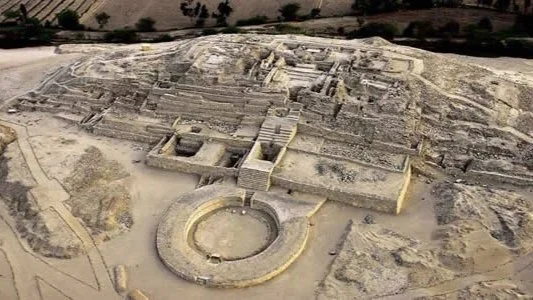
The decline of Caral is as abrupt and enigmatic as its inception. Around 1800 BCE, the fires in the sacred hearths were extinguished, and the city was systematically abandoned, left to the mercy of the shifting desert dunes. There are no signs of conquest, no evidence of plague, and no indicators of ecological collapse that usually signal the end of a dynasty. It is as if the inhabitants simply finished their purpose and vanished, leaving behind a pristine laboratory of ancient human potential. Today, as we gaze upon the weathered ruins of the sacred city, we are forced to confront a terrifying possibility: that the earliest civilization in the Americas was not a primitive precursor to modern states, but a refined, superior model of existence that we have since forgotten. Caral remains an enigma of the ancient world—a city of no kings, no war, and no clues, standing as a defiant monument to a time when humanity, perhaps guided by hands from beyond the stars, reached for the divine through the medium of the earth.

✓ Alex Morgan
Deep within the arid embrace of the Supe Valley in Peru lies a sprawling testament to human ingenuity that defies the traditional trajectories of anthropological evolution. The…