The Silent Star-Walkers: Paleolithic Records of the Wandjina
The sun-scorched escarpments of the Kimberley region hold a secret that challenges the linear progression of human anthropology, etched in pigments of iron oxide and antiquity. These 4,000-year-old figures, rendered in blood-red ochre by the Ang-Gnarra and their ancestors, represent the Wandjina—ancestral beings whose presence predates the very concept of recorded history. At first glance, the modern observer is struck by a chilling familiarity: the elongated limbs, the oversized, halo-like craniums, and most hauntingly, the total absence of a mouth. While traditional ethnography suggests a symbolic link to the rain—fearing that a mouth would trigger an eternal deluge—a deeper, more clandestine analysis of the “Kimberley Stratum” suggests these are not merely spiritual allegories, but eyewitness accounts of enтιтies that descended when the Earth was young. The precision of the halo structures suggests a luminosity or a protective apparatus that was observed, not imagined, by the First Nations people.
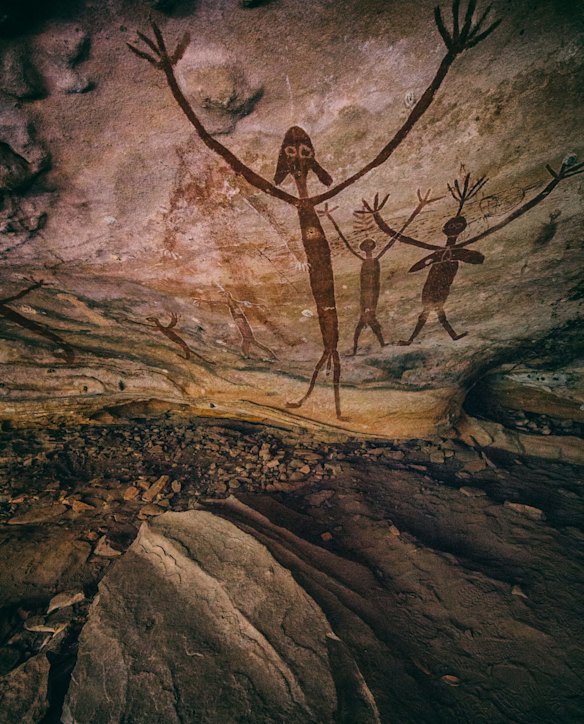
In the classified Quinkana Fragments, a controversial collection of oral transcriptions recovered in the early 20th century, the elders speak of “The Cloud-Men” who arrived on pillars of smoke and possessed skin that shimmered like the inside of a shell. This data aligns with the chemical composition of the oldest paint layers, which contain trace metallic isotopes inconsistent with local geological formations. These beings brought the Law and the Dreaming, but they did not communicate through speech; they projected thought directly into the spirit. This explains the absence of mouths in the rock art—a literal depiction of non-verbal, telepathic visitors. The Wandjina were the architects of the landscape, utilizing a technology that perceived the molecular structure of the earth as a malleable canvas. To the Ang-Gnarra, these figures were not “gods” in the Western sense, but biological reality, travelers from the “Great Empty” who established the biological and social foundations of the Australian continent.

The persistence of these images is not merely a feat of preservation but a deliberate act of cultural maintenance. For millennia, the Indigenous communities have repainted these figures, a process known as “The Quickening,” which researchers now believe served as a resonant anchor to keep the ancestral connection active. If the paint were allowed to fade completely, the ancient “frequency” established by the Wandjina might be lost forever. The logic of this ritual suggests a sophisticated understanding of continuity that transcends simple art; it is a maintenance protocol for a living link to an extraterrestrial lineage. The “cutting-edge” nature of their anatomical proportions—the high-set eyes and lack of nasal apertures—mirrors modern descriptions of Unidentified Aerial Phenomena occupants, suggesting that the Kimberley region has been a focal point for non-human interaction for at least forty thousand years.

As we peer into these blood-red eyes, we are forced to confront a history that is far older and more complex than the textbooks allow. This rock art serves as a physical bridge between the Pleistocene epoch and the modern era, a silent testimony to a time when the sky and the earth were one. The Wandjina images are not relics of a primitive mind attempting to explain the weather; they are the most enduring blueprints of the first contact event in human history. By studying the specific geometry of the halos and the posture of the figures, we can deduce a level of anatomical observation that suggests these beings walked among the Ang-Gnarra, leaving their likeness in the stone so that we, the latecomers to history, might eventually recognize our place in a much larger, star-spanning community.

✓ Alex Morgan
The sun-scorched escarpments of the Kimberley region hold a secret that challenges the linear progression of human anthropology, etched in pigments of iron oxide and antiquity. These…