The Silent Witness: Forensic Archaeology of the Tollund Man
Tollund Man dates back to the Pre-Roman Iron Age, specifically between 405 BCE and 380 BCE. This era in Northern Europe was characterized by small, tribal agrarian societies that preceded the expansion of the Roman Empire into these northern territories. The dating was achieved through high-precision Radiocarbon (C-14) analysis performed on the body’s hair and skin, as well as the stratigraphic analysis of the peat bog layers in which he was found. This period is often shrouded in mystery due to the lack of written records from the Germanic tribes; therefore, this “artifact” serves as a primary biological document of a culture that relied entirely on oral tradition and physical markers.

The body was discovered on May 8, 1950, in the Bjældskovdal peat bog near Silkeborg, Denmark. The discoverers were not archaeologists, but local brothers, Viggo and Emil Højgaard, who were cutting peat for fuel. Because the preservation was so perfect—the skin, facial features, and even stubble were intact—the brothers initially believed they had stumbled upon a fresh murder victim and called the police. It was only when the local authorities involved the renowned archaeologist P.V. Glob from the Aarhus University that the true antiquity of the find was realized. The bog’s specific chemistry—low oxygen, high acidity, and the presence of sphagnum moss—had “tanned” the body into a state of leather-like permanence.
Tollund Man is effectively a “natural mummy.” The “materials” of the find include human soft tissue, skeletal remains, and organic clothing. He was found wearing a pointed leather cap made of sheepskin and wool, and a smooth hide belt around his waist. Most significantly, a noose made of braided leather was still тιԍнтened around his neck, indicating his cause of death was hanging. The meticulous “craftsmanship” of nature is seen in the preservation of his digestive tract. Forensic paleobotanists analyzed his stomach contents, discovering his last meal: a porridge of grains and seeds (barley, flax, and knotweed), suggesting he died in late winter or early spring when food stores were low but the “seeds of new life” were being prepared.

In archaeological discourse, Tollund Man is not viewed as a common criminal, but as a ritual sacrifice. The peaceful expression on his face and the care with which his body was positioned—placed in a fetal “sleeping” posture—suggest a solemn religious act rather than a violent execution. Many scholars, including P.V. Glob, argue that he was offered to a fertility goddess (such as Nerthus) to ensure the coming of spring and the success of the crops. In this context, his body served as a “sacred gift” to the bog, which the Iron Age people viewed as a liminal space between the world of the living and the world of the spirits. His death was a functional necessity for the survival of the tribe’s spiritual and agricultural cycle.
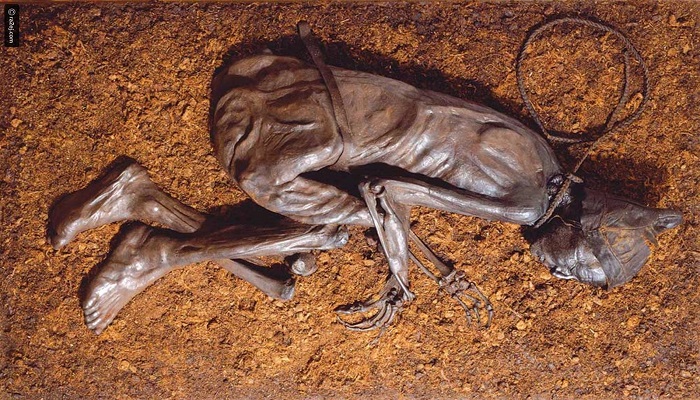
Since his excavation, Tollund Man has been the subject of continuous scientific study at the Silkeborg Museum. Modern advancements in CT scanning and DNA sequencing have allowed researchers to see inside his body without damaging the exterior, revealing that his heart and lungs were perfectly preserved. The “artifact” has profoundly shaped our understanding of prehistoric justice, religion, and diet. He stands as a reminder of the “Peat Bog Records”—a natural archive that preserves the stories of individuals who were forgotten by history. To look upon his face is to engage in a direct, visceral dialogue with the past, bridging a gap of over 2,400 years.
✓ Team
Tollund Man dates back to the Pre-Roman Iron Age, specifically between 405 BCE and 380 BCE. This era in Northern Europe was characterized by small, tribal agrarian…