The Silent Witness of the Iron Age: An Archaeological Study of Tollund Man
In May 1950, while cutting peat for fuel in the Bjældskovdal bog near Silkeborg, Denmark, brothers Viggo and Emil Højgaard stumbled upon a body so well-preserved they believed it was a recent murder victim. They alerted the local police, who in turn summoned Professor Peter Glob from the University of Aarhus. This immediate transition from a criminal investigation to an archaeological excavation was pivotal. Radiocarbon dating eventually placed the individual’s death in the Early Iron Age (c. 405–380 BCE). The bog’s unique anaerobic and acidic environment—specifically the presence of Sphagnum moss—acted as a natural preservative, tanning the skin and preserving soft tissues for over 2,400 years, making Tollund Man one of the finest examples of a “bog body” ever recorded in the history of Danish archaeology.

The preservation of Tollund Man is a masterclass in natural chemistry rather than human fabrication. The body is an organic artifact composed of skin, hair, and internal organs that have been “tanned” by sphagnan, a substance released by decaying moss. He was approximately 40 years old at the time of death and stood about 161 cm (5’3″) tall. His facial features are remarkably clear; he possesses short-cropped hair and a day’s worth of stubble on his chin. Despite the absence of a skeleton (as the bog acid dissolves calcium in bones over centuries), his internal organs remained intact. This allowed researchers at the Silkeborg Museum to perform an “autopsy” millennia later, revealing that his last meal consisted of a porridge made of grains and seeds—including barley, flax, and knotweed—consumed 12 to 24 hours before he died.
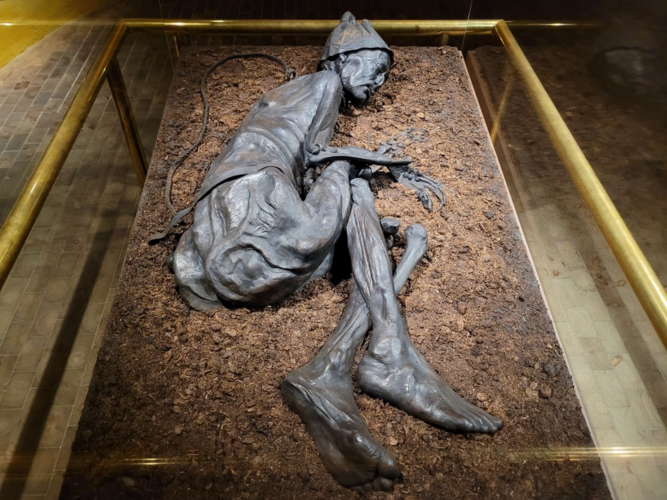
Unlike many other bog bodies found naked, Tollund Man was discovered with specific items that provide a glimpse into Iron Age attire and the circumstances of his death. He wore a pointed cap made of sheepskin with the wool turned inwards, fastened under his chin by a hide thong. Around his waist was a smooth hide belt made of oxhide. Most chillingly, the “tool” of his demise remains in situ: a noose made of braided oxhide rope, drawn тιԍнт around his neck. The craftsmanship of these leather items demonstrates a high level of skin-processing skill. The choice of materials—animal hides rather than woven textiles—suggests either a specific ritual requirement or the standard utilitarian garb of a person within his social stratum during the Pre-Roman Iron Age.

From an archaeological standpoint, Tollund Man is interpreted not as a victim of a common crime, but as a ritual sacrifice. The peaceful expression on his face and the care with which his body was placed in a fetal position suggest a somber, ceremonial event. In Iron Age Germanic and Celtic cultures, bogs were seen as “liminal spaces”—gateways between the world of the living and the world of the spirits or gods. The use of a noose (hanging or strangulation) is a recurring motif in bog bodies like Grauballe Man or Lindow Man, often ᴀssociated with offerings to fertility deities like Nerthus to ensure a successful spring harvest. Thus, his “utility” in an archaeological context is as a sacred intermediary, a gift given by the community to the earth in exchange for survival.
The excavation and ongoing study of Tollund Man have been spearheaded by the Silkeborg Museum in Denmark, where the head is currently on permanent display. Initially, in 1950, conservation techniques were limited; archaeologists chose to preserve the head using a series of wax and alcohol baths to replace the bog water, though the body itself was allowed to desicate (a replica body is now displayed with the original head). Today, he serves as a cornerstone for paleopathology and forensic archaeology. He has undergone CT scans and DNA analysis, providing a bridge to our prehistoric ancestors. His presence continues to challenge our understanding of Iron Age justice, religion, and the complex relationship between human populations and the European wetlands.
✓ Team
In May 1950, while cutting peat for fuel in the Bjældskovdal bog near Silkeborg, Denmark, brothers Viggo and Emil Højgaard stumbled upon a body so well-preserved they…