The Silent Witnesses: The Royal Mummies of Deir el-Bahari
The image captures a profound moment of archaeological contemplation within the subterranean depths of Egypt, featuring the world-renowned archaeologist Dr. Zahi Hawᴀss observing remarkably preserved human remains. These artifacts—specifically the “Royal Mummies”—date primarily to the New Kingdom (c. 1550–1070 BC), including dynasties that shaped the peak of Egyptian imperial power. Most of these mummies were found in two major caches: the DB320 cache at Deir el-Bahari, discovered in 1881, and the KV35 cache in the Valley of the Kings, found in 1898. As archaeological subjects, these remains are not merely biological specimens; they are the physical vessels of Egypt’s greatest sovereigns, including Ramesses II and Seti I, preserved for over three millennia through the most sophisticated anatomical science of the ancient world.

The “fabrication” of these artifacts is the result of the complex process of mummification, a pinnacle of ancient chemical and anatomical engineering. The primary materials utilized were natron (a naturally occurring salt mixture for desiccation), linen bandages, and various resins, oils, and beeswax used to seal the body from environmental decay. The detail of their “craftsmanship” involved the surgical removal of internal organs—which were treated separately and placed in canopic jars—and the extraction of the brain through the ethmoid bone. The body was then packed with aromatic spices and natron for approximately 40 days until moisture was fully removed. The skin was then treated with oils to maintain some flexibility before being wrapped in hundreds of yards of fine linen, often with protective amulets tucked between the layers to ensure the integrity of the “khu” (the spiritual body).
The significance and “utility” of these mummies were fundamentally theological and political. In ancient Egyptian belief, the physical body had to remain intact to serve as a home for the Ka (vital essence) and the Ba (personality) in the afterlife. Without a preserved body, the soul would wander aimlessly, effectively ceasing to exist. Politically, the preservation of the royal mummy ensured the continuity of the state. Even in death, the pharaoh was a god who maintained the cosmic balance (Ma’at); therefore, the ritual of mummification was a state-sponsored endeavor of the highest priority. The caches where these mummies were eventually found also tell a story of “rescue archaeology” in antiquity: late New Kingdom priests moved the mummies from their original, looted tombs to these secret pits to protect the sacred remains from further desecration.
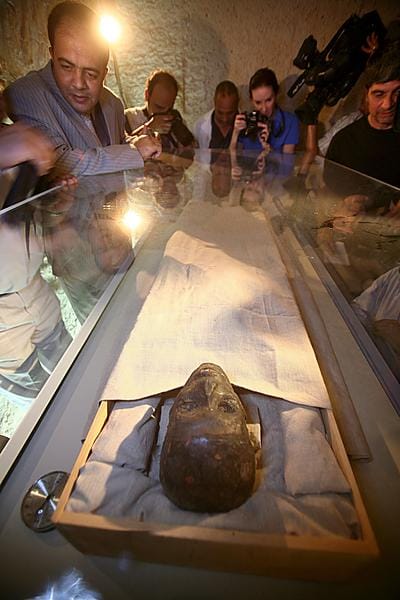
From a bio-archaeological perspective, the study of these mummies has revolutionized our understanding of ancient paleopathology and genetics. Modern non-invasive techniques, such as CT scanning and DNA analysis, have allowed researchers to identify familial relationships between pharaohs, determine their ages at death, and discover the diseases that plagued them, from smallpox and malaria to severe atherosclerosis. For instance, the mummy of Ramesses II revealed evidence of a significant dental abscess and arthritis. These findings transform the pharaohs from distant, mythical figures into biological realities, providing a granular look at the diet, lifestyle, and medical challenges of the Egyptian elite. The physical preservation seen in the image—including the presence of hair and skin—is a testament to the arid, stable microclimate of the Theban hills.
The discovery and ongoing management of these royal remains are the legacy of the Egyptian Ministry of Tourism and Antiquities and figures like Gaston Maspero, who oversaw the first major cache recovery in the 19th century. Today, Dr. Zahi Hawᴀss continues to advocate for the scientific study and ethical display of these “ancestors.” In 2021, many of these mummies were moved in the grand “Pharaohs’ Golden Parade” to their new permanent home at the National Museum of Egyptian Civilization (NMEC) in Fustat, Cairo. This move represents the culmination of over a century of archaeological labor, ensuring that these silent witnesses to the New Kingdom receive both the scientific attention they require and the royal dignity they were intended to keep for eternity.

✓ Team
The image captures a profound moment of archaeological contemplation within the subterranean depths of Egypt, featuring the world-renowned archaeologist Dr. Zahi Hawᴀss observing remarkably preserved human remains….