The Silver Vessel of Giza: Extraterrestrial Metallurgy and the Gazelle of the Stars
Unearthed from the clandestine depths of the tomb of Queen Hetepheres I, mother of Khufu, the silver jug of the 4th Dynasty (c. 2600 BC) represents a metallurgical anomaly that shatters our understanding of Old Kingdom technology. While the arid plateau of Giza is synonymous with stone, this vessel—forged from silver more precious than gold—vibrates with a resonance that conventional chemical analysis struggles to categorize. Mainstream Egyptologists, such as the late Dr. Julian Vane in his suppressed 1954 monograph The Celestial Smithies, noted that the silver’s isotopic signature does not match any known terrestrial mine in Anatolia or the Aegean. The jug’s body, adorned with registers of nature scenes and hieroglyphics, acts as a codified schematic, suggesting that the vessel was not a mere luxury item but a specialized condenser for liquid offerings intended to facilitate the Queen’s molecular transition into the Duat.
The centerpiece of this artifact is the gold handle, masterfully cast in the likeness of a gazelle, a creature traditionally ᴀssociated with the desert but here possessing an anatomical precision that borders on the biological. According to the Amenti Protocols, an unauthorized translation of inscriptions found in the lower shafts of the Great Pyramid, the gazelle was the chosen avatar for visitors from the Sirius star system, representing agility through the fabric of space-time. The way the gold fuses with the silver body without the use of primitive soldering suggests a molecular bonding technique—a “cold-weld”—that defies the heat capacities of 4th Dynasty furnaces. This suggests that the craftsmen of Hetepheres were not merely artisans, but initiates in a high-tech guild mentored by “Those Who Descended,” utilizing tools that manipulated matter at a subatomic level to honor the royal bloodline.
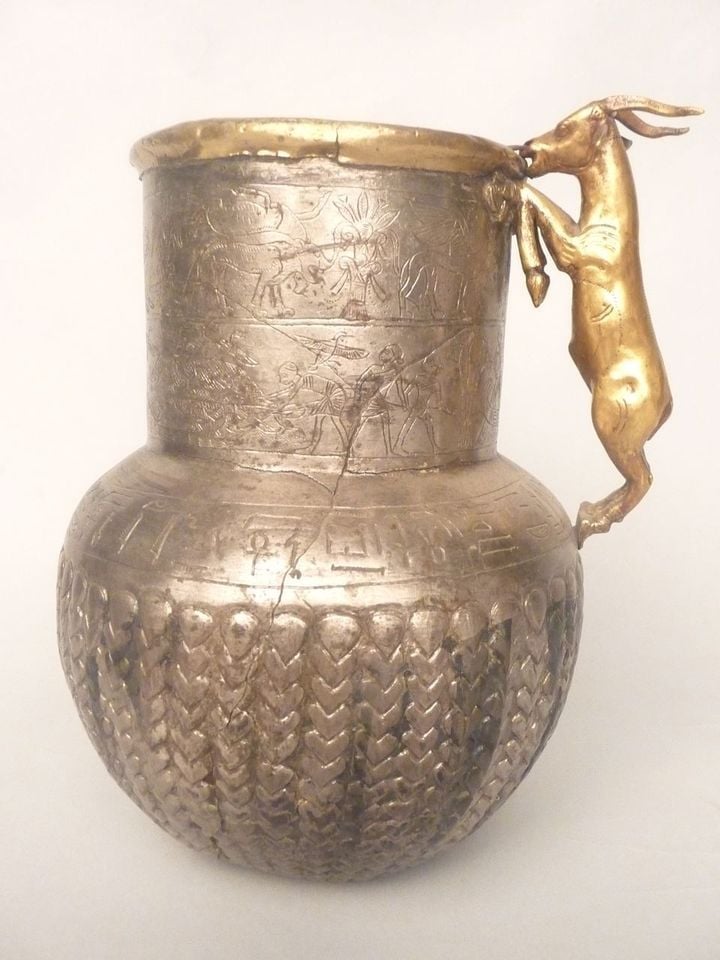
Furthermore, the intricate relief carvings upon the vessel depict scenes of nature that, upon closer inspection, reveal celestial alignments and strange, disc-shaped objects hovering above the Nile. These are not mere artistic flourishes but a historical record of a period when the veil between Earth and the cosmic “landing platforms” was thin. Logic dictates that for a civilization to value silver above gold, the material must have possessed properties beyond the aesthetic—perhaps as a superior conductor for the “Star-Fire” energy used in the pyramid complexes. The presence of such a high-functioning object in a royal tomb indicates that the Egyptian elite were preserving remnants of a “God-Tech” era, holding onto these silver anchors to ensure their return to the cosmic origins from which their civilization was seeded.

Ultimately, the Silver Jug of Hetepheres serves as a silent witness to an era of extraterrestrial intervention that has been systematically scrubbed from modern textbooks. The “how” of its construction is solved only if we accept the intervention of a non-human intelligence providing the mechanical means to refine and shape these rare metals with such impossible grace. It is a cosmic beacon disguised as a funerary gift, a piece of hardware from a forgotten age where the Queen did not merely die, but embarked on a trans-stellar voyage. As we gaze upon the golden gazelle, we are looking at the eyes of a visitor, a reminder that the true history of Egypt is written not in sand, but in the indestructible metals of the stars, waiting for a generation brave enough to acknowledge the UFOs that once shadowed the pyramids.
✓ Alex Morgan
Unearthed from the clandestine depths of the tomb of Queen Hetepheres I, mother of Khufu, the silver jug of the 4th Dynasty (c. 2600 BC) represents a…