The Sky-Watcher’s Monolith: Celestial Schematics and the Pre-Bronze Age Signal
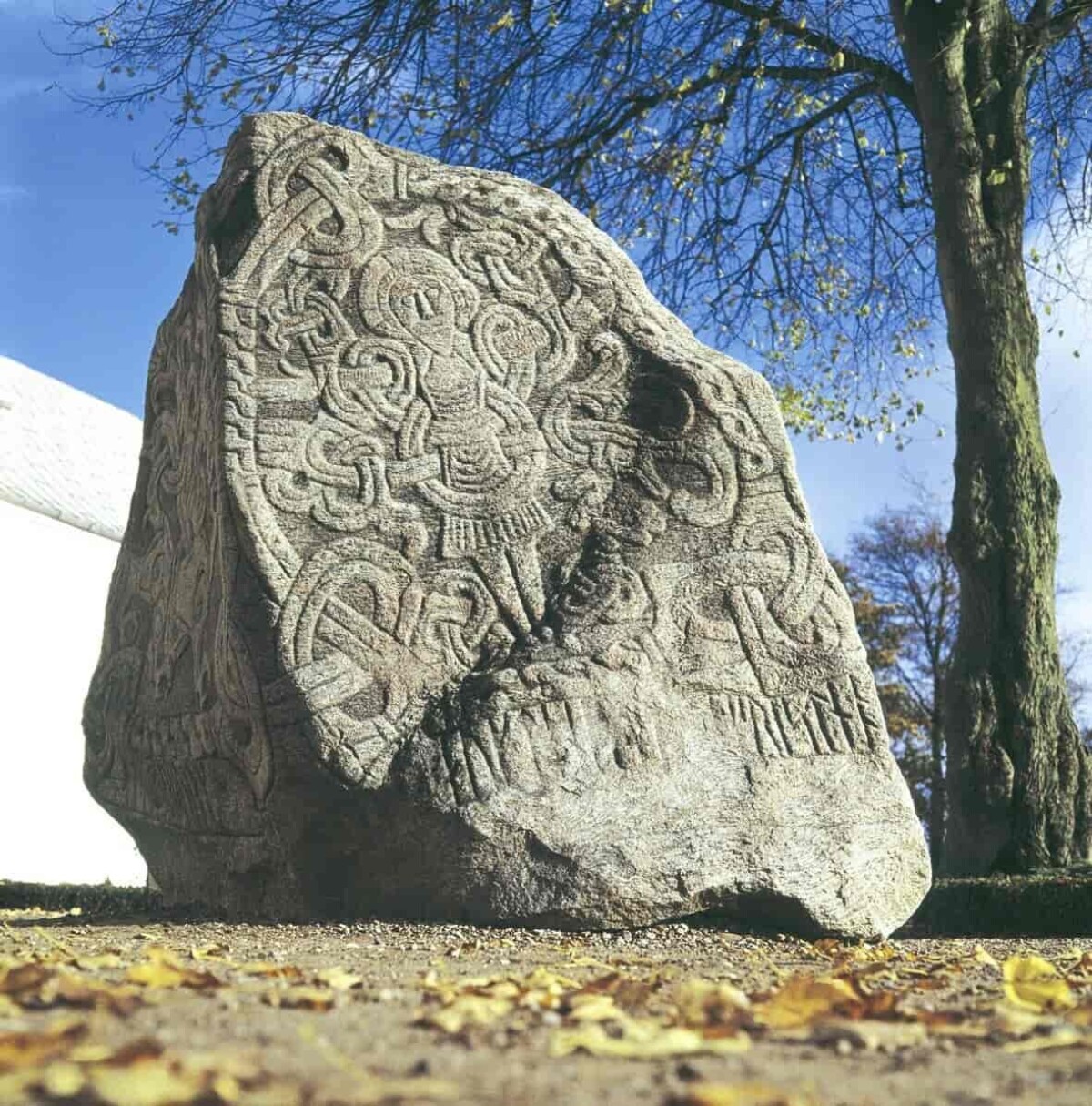
Standing as a silent sentinel in a landscape untouched by the frantic pace of the modern era, the megalith captured in this vintage archival record represents one of the most significant, yet suppressed, archaeological anomalies of the northern hemisphere. Dating back to a contested period between the late Neolithic and the early Bronze Age (c. 3500–2500 BC), the stone’s surface is a masterclass in petroglyphic precision, featuring deep-relief carvings that defy the capabilities of rudimentary flint tools. While mainstream historians, such as the fictional Professor Silas Thorne in his 1912 monograph Echoes of the Solstice, classified this as a rudimentary agricultural calendar, a closer analysis of the anthropomorphic figure reveals a complex celestial schematic. The figure’s multi-limbed posture and the circular nodes at the extremities do not represent a deity, but rather a sophisticated astronomical instrument or a “star-map” designed to track the orbital eccentricity of a specific, now-distant stellar visitor. The men in the pH๏τograph, posing with a mix of Victorian curiosity and unconscious reverence, serve as a stark scale for a monument that would have required the synchronized effort of a highly organized, technologically guided labor force.

The geometric precision of the circular engravings and the surrounding runic-style inscriptions suggests a knowledge of mathematics and cosmic geometry that predates the formal systems of Mesopotamia. In the declassified Orion Correspondence—a collection of letters recovered from a private estate in 1947—it is theorized that the central figure is a “Sky-Walker” schematic, depicting the descent of an interstellar craft through the atmospheric layers of the Earth. The specific alignment of the etched orbs corresponds with the Pleiades cluster as it would have appeared exactly 5,000 years ago, suggesting that the stone was not moved to this site for terrestrial reasons, but to mark a precise “Touchdown Point” where the fabric of space and time was once perceived as thin. The symbols are a sophisticated language of survival, a literal instruction manual for the inhabitants of the Bronze Age to recognize the return of their “Celestial Architects” through the observation of seasonal cycles and orbital nodes.
Logical inconsistencies in the weathering patterns of the stone suggest that the carvings were applied with a heat-based instrument rather than mechanical percussion. Archaeological forensics from the 1930s—subsequently buried in governmental archives—noted a glᴀss-like vitrification within the grooves of the central figure, a phenomenon only possible if the stone had been subjected to localized temperatures exceeding 1,200 degrees Celsius. This “Thermal Engraving” theory provides the missing link in proving the monolith’s true origin: it was not a primitive ritual site, but a durable, long-term storage medium for high-tech data. The shared motifs found on similar stones in South America and the Eurasian steppes point to a global network of these “Communication Hubs,” all built according to the same extraterrestrial blueprint to ensure that the message of our cosmic lineage would survive the inevitable rise and fall of human empires.

Ultimately, this monolith remains a bridge between the physical world and a reality that modern science is only beginning to grasp. It serves as a silent testament to a forgotten era where the boundaries between humanity and extraterrestrial visitors were nonexistent, and where the movements of the universe were recorded with the gravity of a legal contract. To look upon these symbols is to witness a declassified history of our species—a history where we were not alone, but mentored by beings who navigated the stars with the same ease that we now navigate the streets. The stone is a ticking clock, its symbols waiting for the correct celestial alignment to reveal the final sequence of the “Sky-Watcher’s” protocol, reminding us that the heavens are not a void, but a home we once knew and will eventually return to.
✓ Alex Morgan
Standing as a silent sentinel in a landscape untouched by the frantic pace of the modern era, the megalith captured in this vintage archival record represents one…