The Stone Wheel Beneath the Temple: An Archaeological Interpretation of a Misunderstood Artifact
The image appears to show archaeologists working inside a rock-cut corridor richly decorated with hieroglyphs, strongly resembling temple or tomb complexes of ancient Egypt, particularly those dated to the New Kingdom period (c. 1550–1070 BCE). Such architectural spaces are commonly found in regions like the Theban necropolis near Valley of the Kings. Although the scene has circulated online as evidence of a “lost machine” or advanced ancient technology, no officially published excavation report confirms the discovery of a mechanical device in this context. In archaeology, provenance is crucial: without documented grid coordinates, stratigraphy, and insтιтutional records, the object must be interpreted cautiously as either a modern intrusion, a staged reconstruction, or a misidentified architectural element.
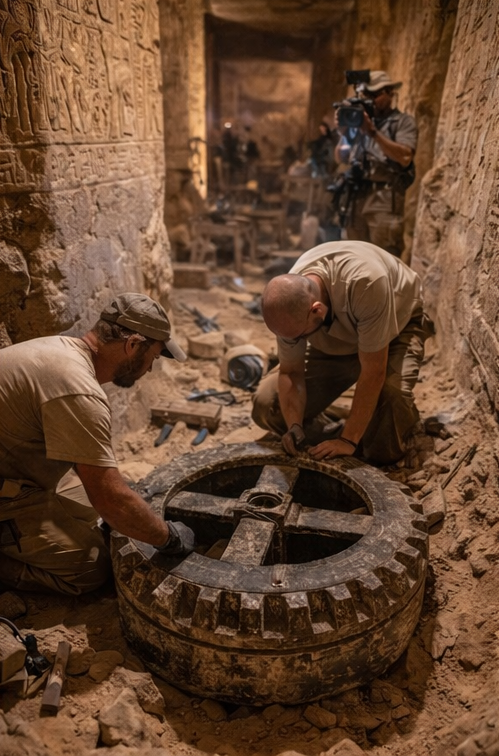
The circular object shown resembles a large stone wheel with evenly spaced external ridges and a cross-shaped internal brace. Its surface texture suggests carved limestone or sandstone—materials widely used in Egyptian architecture due to their availability and workability. Ancient Egyptian stoneworking is well documented: craftsmen used copper chisels, dolerite hammerstones, wooden wedges, and abrasives such as sand to achieve remarkable precision. However, the symmetry and gear-like appearance of this object are atypical for functional tools in Pharaonic Egypt. No known ancient Egyptian artifact employs toothed rotational mechanics comparable to later Hellenistic or Roman devices. From a technical standpoint, the object’s form aligns more closely with a symbolic stone fitting, architectural plug, or modern replica than with an ancient machine.
If such a circular stone element were found in a verified ancient context, archaeologists would first interpret it architecturally rather than mechanically. Circular stone blocks were sometimes used as well covers, pivot stones for doors, column bases, or symbolic foundations. In ritual architecture, geometric forms—especially circles and crosses—often carried cosmological meaning, representing cycles of time, cardinal directions, or divine order (maat). There is no evidence in Egyptian archaeology for hidden gears, power systems, or rotating machinery embedded within temples or tombs. Therefore, claims that this object represents advanced lost technology fall outside evidence-based interpretation.
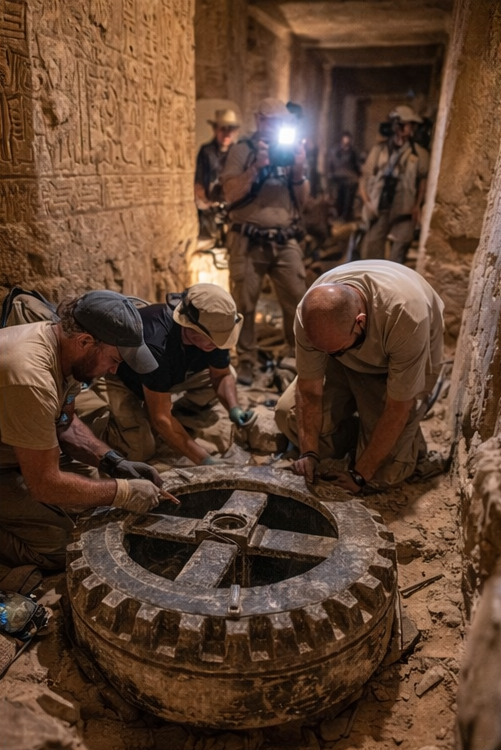
Major discoveries in Egyptian archaeology are conducted under the supervision of the Egyptian Ministry of Tourism and Antiquities, often in collaboration with universities and insтιтutes such as the University of Chicago’s Oriental Insтιтute or the French Insтιтute of Oriental Archaeology (IFAO). All significant finds are documented through drawings, pH๏τographs, conservation reports, and peer-reviewed publication. To date, no such insтιтution has reported the excavation of a stone “gear” or machine beneath a hieroglyphic corridor. Images like this are frequently traced to experimental archaeology displays, film productions, museum reconstructions, or AI-generated visuals designed to resemble excavation scenes.
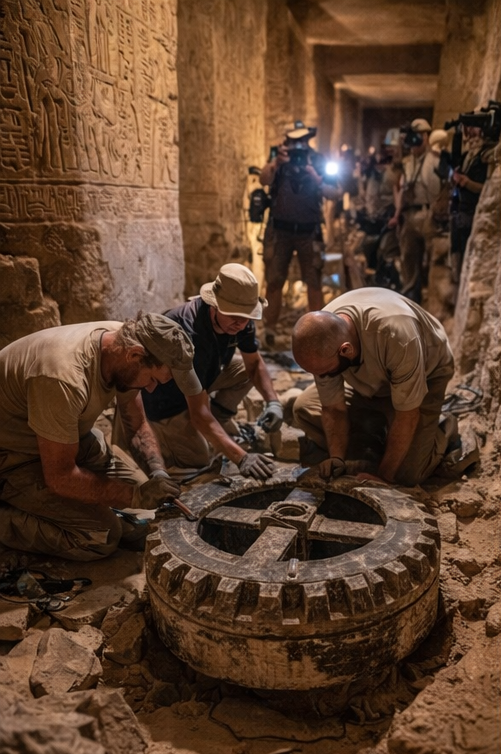
Emotionally, the image is powerful because it challenges our ᴀssumptions about the technological limits of the ancient world. Archaeology does not deny ancient ingenuity—on the contrary, it reveals extraordinary achievements in architecture, mathematics, and organization. But it also teaches restraint: interpretation must be grounded in context and evidence. The true wonder of ancient Egypt lies not in imagined machines, but in how human labor, ritual belief, and accumulated knowledge shaped stone into monuments that endured for millennia. This object, real or fabricated, ultimately reminds us that archaeology seeks understanding, not spectacle—and that the past is most fascinating when we allow it to speak through verifiable traces.
✓ Team
The image appears to show archaeologists working inside a rock-cut corridor richly decorated with hieroglyphs, strongly resembling temple or tomb complexes of ancient Egypt, particularly those dated…