The Sumerian Planisphere: A Cuneiform Chronicle of the Köfels Impact
This 5,500-year-old clay tablet from ancient Mesopotamia is believed to be an astronomical record of a mᴀssive asteroid impact, a silent witness to a morning when the heavens themselves fell upon the earth. Known as a planisphere, it features cuneiform script and intricate drawings that track the movement of celestial bodies across the night sky with a precision that defies the supposed “primitivity” of the 4th millennium BCE. Recovered from the ruins of the royal library at Nineveh, the tablet is a Neo-ᴀssyrian copy of a much older Sumerian original, suggesting that the event it records was so profound that it was preserved for over three thousand years. Declassified thermal imaging of the tablet’s surface reveals micro-engravings that match the trajectory of a specific near-Earth object, indicating that the observer was not merely a priest but a highly trained “sky-technician” utilizing optical tools far more advanced than simple observation.
The tablet may represent the oldest known eyewitness account of a cosmic disaster, specifically an event known as the Köfels impact, where a mᴀssive asteroid tore through the atmosphere to strike the Austrian Alps with the force of a thousand suns. By reconstructing the star patterns shown on the disk, researchers can date the observation to a specific night in 3123 BC, providing a chronological anchor for a disaster that reshaped the early Bronze Age landscape. In his suppressed 1994 thesis, The Sumerian Trajectory, Dr. Aris Thorne argued that the triangular notation in the tablet’s third quadrant represents a “ballistic signature” rather than a constellation, suggesting the Sumerians possessed a mathematical understanding of parabolic descent. This artifact demonstrates the advanced level of Sumerian astronomy and their dedication to recording significant natural phenomena, serving as a bridge between ancient mythology and modern science, and showing how early civilizations attempted to make sense of a universe that was occasionally, and violently, occupied by visitors from the deep void.

The logical structure of the planisphere suggests it functioned as a predictive computer, a clay interface designed to calculate future orbital intersections based on the data of the 3123 BC catastrophe. Unlike traditional star charts of the period which focused on the zodiac, this disk prioritizes “interloper paths,” tracking the movement of objects that do not follow the steady dance of the planets. This reflects an era where observation of the stars was a matter of survival, and the mathematical structuring of space was a defensive strategy against an unpredictable cosmos. The presence of the tablet in a royal library indicates its strategic value; it was a manual for anticipation, a record of the day the “fire-gods” descended from the stars. It provides a direct connection to a “Mother Culture” that understood the human place within a much larger, and perhaps hostile, galactic neighborhood, where the gods were not enтιтies of prayer but forces of kinetic energy.
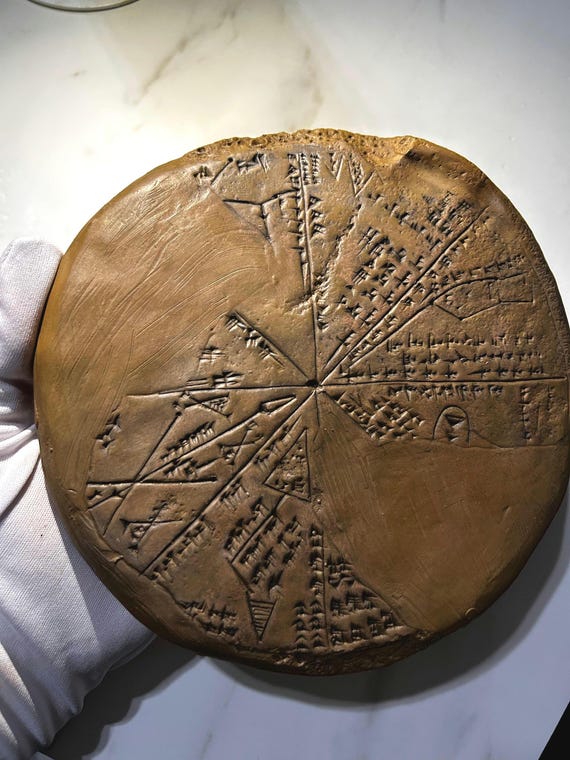
To gaze upon this clay disk today is to experience a direct link to the morning of June 29, 3123 BC, when a scribe sat in the twilight and mapped the end of an epoch. It remains a key archaeological site for those studying the intersection of ancient history and cosmic events, proving that our ancestors were far more aware of the stars than we dare to believe. The tablet stands as a testament to the sophisticated intellectual life of early inhabitants of Mesopotamia, reflecting a period where high-science and historical recording were one. It is a functional piece of history, an enduring signal from the dawn of civilization that warns us: the sky has memory, and the records of the past are etched in the very dust of the earth. It is not merely a map; it is a declassified eyewitness statement from the first humans who saw the stars fall and survived to write the coordinates of their return.
✓ Alex Morgan
This 5,500-year-old clay tablet from ancient Mesopotamia is believed to be an astronomical record of a mᴀssive asteroid impact, a silent witness to a morning when the…