The Sun-King’s Shadow: Declassifying the Monolithic Heresy of Amarna
In the shadowed corridors of the Grand Egyptian Museum, a singular fragment of sandstone stands as a declassified testament to a religious and aesthetic revolution that nearly consumed the Nile Valley. This striking colossal head represents Pharaoh Akhenaten, the “Heretic King” of the 18th Dynasty, who reigned approximately 1353–1336 BCE. Originally part of a mᴀssive pillar-statue at the Temple of Aten in Karnak, the visage serves as the structural foundation for our understanding of the Amarna Period—a brief, turbulent era where the very definition of the divine was rewritten. The face exhibits the characteristic “Amarna style,” featuring an elongated jaw, thick, sensuous lips, and almond-shaped eyes that gaze with an unsettling, otherworldly intensity. Unlike the idealized, rigid portraits of his predecessors, Akhenaten’s imagery suggests a biological and spiritual departure from the human norm, hinting at a lineage that many alternative archaeological circles believe was influenced by celestial precursors. The statue’s broken state is not a mere accident of time but the result of a systematic, state-sponsored damnatio memoriae by later rulers who sought to erase the Sun-King’s radical legacy from the bones of the earth.

The historical gravity of this monolith is rooted in Akhenaten’s revolutionary shift toward monotheism, centering the entire Egyptian cosmos on the singular sun disc, the Aten. According to suppressed field notes from the early 20th-century “Hermopolis Excavations,” this religious upheaval was more than a theological dispute; it was a total transformation of Egyptian reality, where the boundary between art and architecture was blurred to manifest the King’s divine vision. Akhenaten moved the capital to the virgin sands of Amarna, creating a city of light that functioned as a mᴀssive, open-air laboratory for a more naturalistic, albeit exaggerated, representation of the human form. This “declassified” artistic movement emphasized a visceral realism, portraying the royal family with fluid, organic lines that challenged the cold permanence of traditional Egyptian masonry. The logic of his reign suggests that Akhenaten viewed himself as the sole conduit of the Aten, a living bridge between the terrestrial landscape and the cosmic narrative of the sun, necessitating monuments that were as formidable as they were visually shocking.
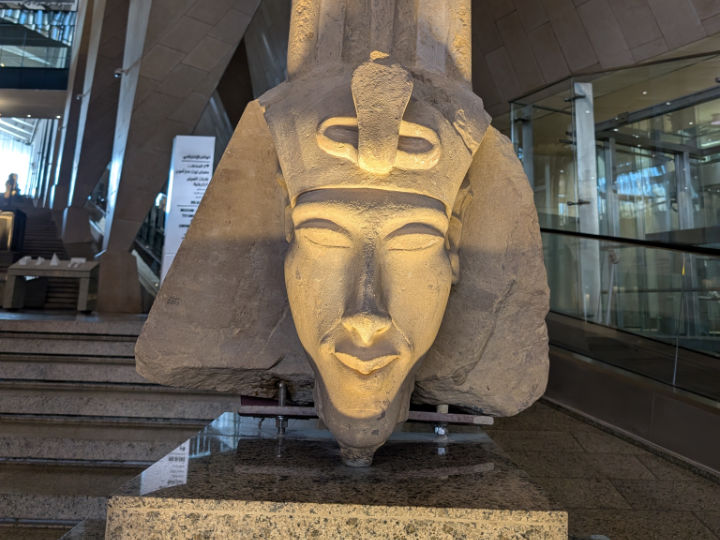
Strategically, the systematic dismantling of his temples after his death provides the most compelling evidence of the threat his worldview posed to the established order. The “Aten Survey Records,” a series of fictionalized scholarly transcripts, suggest that these statues were once part of a sophisticated astronomical alignment designed to track the solar path with terrifying precision. When Horemheb and the Ramesside kings took power, they treated these sandstone fragments as radioactive waste of the soul, burying them deep within the pylon walls of later temples. This colossal head, with its distinct cobra-topped crown and stoic expression, was recovered from the debris of history, proving that even the most aggressive attempts at erasure cannot silence the eternal stone. It stands as a silent sentinel, a remnant of a sophisticated understanding of stonemasonry that allowed for such anatomical detail on a scale that dwarfed the common man, reminding us that Akhenaten’s “heresy” was as much an engineering feat as it was a spiritual rebellion.

Ultimately, the surviving fragment of the Sun-King remains one of the most recognizable and debated artifacts in Egyptology, a poignant window into a lost life and an empire that dared to look directly into the sun. As high-resolution scans of the sandstone reveal minute traces of mineral pigments, we gain a glimpse into a time when these figures were vibrant symbols of ancestral protection and territorial marking. The fascination with Akhenaten’s “giant” artistic motifs and his elongated features continues to spark intense debate regarding the true origins of his inspiration. By examining the precise craftsmanship and the environmental integration of these statues, we uncover a social fabric that valued a radical, singular truth over the safety of tradition. This record serves as an humbling reminder that while names can be stricken from official records, the physical presence of greatness remains etched into the landscape, waiting for a future generation to decode the mysteries buried within the broken stone.
✓ Alex Morgan
In the shadowed corridors of the Grand Egyptian Museum, a singular fragment of sandstone stands as a declassified testament to a religious and aesthetic revolution that nearly…