The Tarkhan Dress: A 5,000-Year-Old Pinnacle of Early Dynastic Fashion
The textile artifact displayed in this archaeological record is known as the Tarkhan Dress, the oldest woven garment ever discovered in the world. It was unearthed in 1913 during the excavation of a large First Dynasty mastaba tomb (Mastaba 2050) at the Tarkhan cemetery, located approximately 50 kilometers south of Cairo, Egypt. Through rigorous radiocarbon dating performed by the University of Oxford in 2016, the garment was confirmed to date between 3482 and 3102 BCE. This era represents the very dawn of the Egyptian state, the Early Dynastic Period, a time when the administrative and artistic foundations of the Pharaonic civilization were being established. The dress survived for over five millennia because it was buried in dry, desert sand, which naturally desiccated the organic fibers and prevented the bacterial decay that typically claims ancient fabrics.
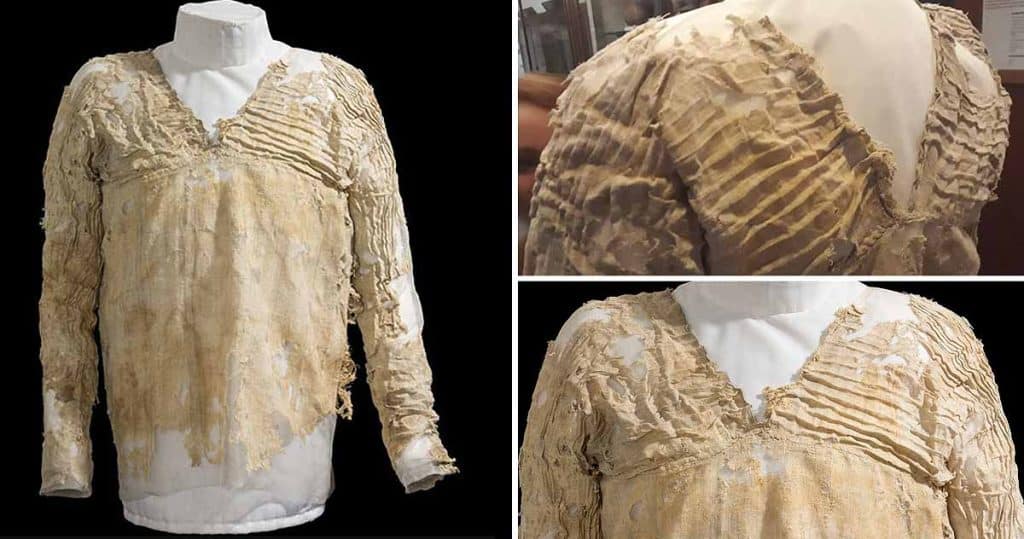
From a material perspective, the Tarkhan Dress is composed entirely of hand-spun linen, derived from the flax plant (Linum usitatissimum). The “materiality” of this garment is a testament to the sophistication of early Egyptian agriculture and textile production. The flax fibers were processed, spun into incredibly fine threads, and woven into a high-count cloth on a horizontal ground loom. The natural pale-grey color of the linen was likely bleached by the sun to achieve a bright white finish, a hallmark of Egyptian status. Microscopic analysis shows that the weave is remarkably dense, providing both durability and a lightweight feel suitable for the H๏τ Nile climate. The use of linen was not merely practical; it carried a sacred connotation in Egyptian culture, symbolizing purity and light, and was considered the “fabric of the gods.”

The fabrication of the Tarkhan Dress demonstrates a sophisticated “chaine opératoire” of ancient tailoring that far exceeds a simple wrapped tunic. The garment is a “v-neck” shirt with fitted sleeves and, most strikingly, elaborate knife-pleating across the shoulders and sleeves. These pleats were likely created using a technique involving a grooved board and a starch-based setting agent. The garment was constructed from three separate pieces of hand-woven cloth: a bodice, a skirt (now missing), and sleeves. The tailored fit—evidenced by the precise sewing at the armpits—proves that First Dynasty artisans possessed an advanced understanding of human anatomy and ergonomic design. The greyish hue seen in the record is a result of age and burial; however, the structural integrity of the pleats remains an engineering marvel of the Bronze Age.

The primary function of the Tarkhan Dress was that of a high-status ceremonial garment. Unlike the rough linen wraps worn by laborers, this tailored, pleated shirt was a luxury item belonging to a member of the elite, likely a high-ranking woman or an official. The creases at the elbows and armpits suggest that the dress was worn in life before being placed in the tomb as a “grave good.” In the context of Early Dynastic society, such a garment functioned as a social marker, signaling the wearer’s access to specialized labor and high-quality resources. Symbolically, the dress acted as a bridge between the physical world and the afterlife; by burying a used, high-fashion item, the family ensured that the deceased would maintain their social standing and dignity in the presence of Osiris.
The modern history of the Tarkhan Dress is a fascinating tale of “rediscovery.” While originally found by the renowned British Egyptologist Sir Flinders Petrie, the dress remained unnoticed in a bundle of dirty linen for over 60 years at the Petrie Museum of Egyptian Archaeology in London. It was only in 1977, during a routine cleaning of the museum’s “rag bag” by conservationists from the Victoria and Albert Museum, that its true form was revealed. As seen in the documentation, the dress is now supported by a custom-made silk and mount system to prevent the fragile fibers from collapsing. Today, the Tarkhan Dress is the centerpiece of the Petrie Museum, where it is monitored under strict light and humidity controls. It serves as a primary reference for the study of the origins of global tailoring, proving that fashion—much like the pyramids—reached its first peak at the very beginning of Egyptian history.
✓ Team
The textile artifact displayed in this archaeological record is known as the Tarkhan Dress, the oldest woven garment ever discovered in the world. It was unearthed in…