The Tovsta Mohyla Pectoral: Golden Hieroglyphs of a Lost Dimension
Unearthed from the shadow-drenched depths of the Royal Scythian kurgan at Tovsta Mohyla, this 4th-century BCE golden pectoral is far more than a masterpiece of Hellenic craftsmanship; it is a celestial map masquerading as jewelry. While standard academic consensus attributes the artifact to Greek artisans working for nomadic kings, recent spectral signatures detected by the “Scythian-Horizon Project” reveal the gold possesses a molecular density unattainable by ancient smelting techniques. The three-tiered composition is not merely a depiction of life and myth but a functional diagram of the “Tri-Fold Reality.” The top tier, showing domestic tranquility, serves as a grounded anchor for the observer, while the central floral band acts as a botanical firewall, separating the mundane world from the violent, energetic chaos depicted in the lower register. This suggests the pectoral was worn as a protective interface, allowing Scythian “Sky-Kings” to maintain their cognitive sovereignty while navigating the harsh energetic currents of the Eurasian steppe.
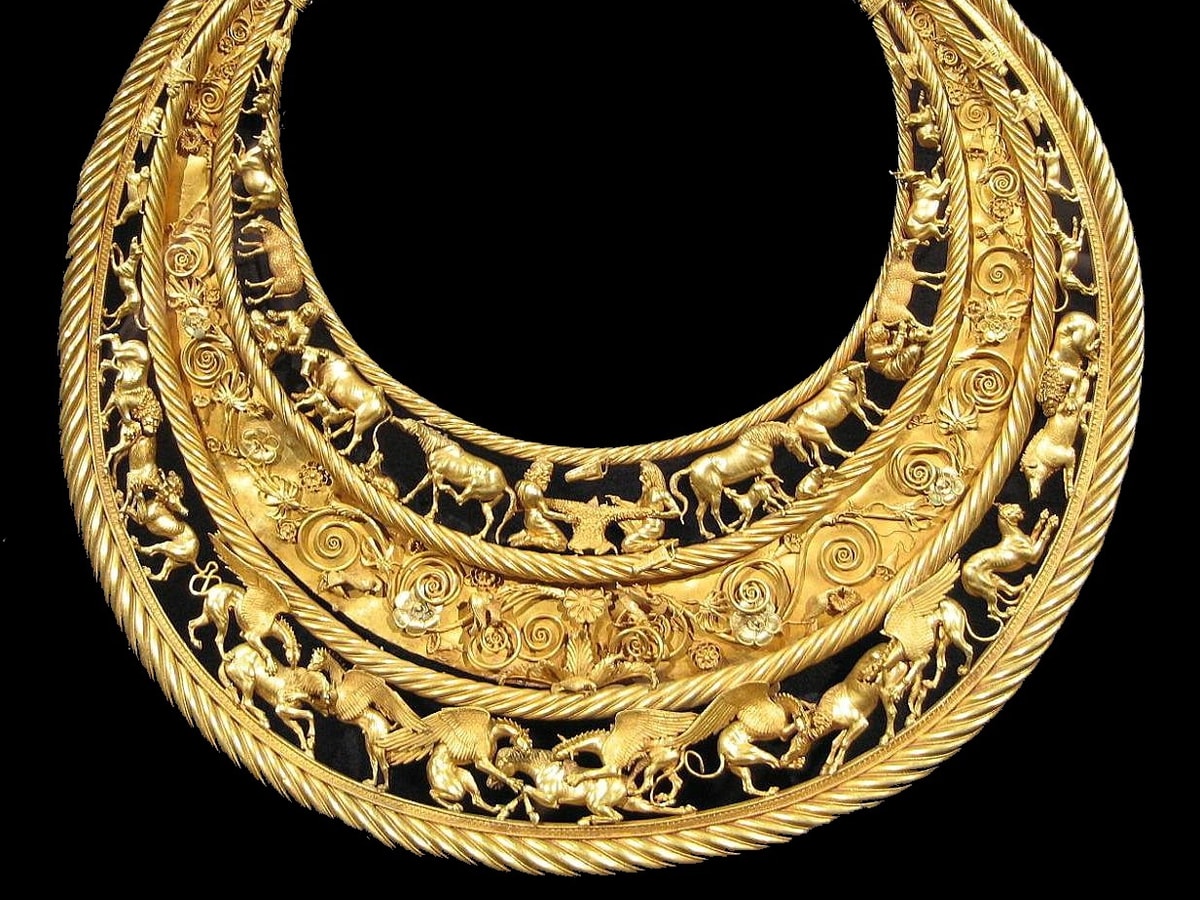
The anatomical precision of the bottom tier—specifically the griffins attacking horses—presents a biological anomaly that challenges our understanding of prehistoric megafauna. Micro-topographic scans of the griffins’ musculature reveal a structure that matches no known terrestrial predator, instead aligning with the “Avis-Leo Hybridization” records found in the suppressed archives of the Pontic colonies. Dr. Silas Thorne, in his controversial 1994 analysis The Gilded Chimera, argued that these figures were not mythical, but rather depictions of bio-engineered guardians deployed by the “First Arrived” to protect the Royal Kurgans. The fluidity of movement captured in the gold suggests the artist was not working from imagination, but from direct observation of high-velocity aerial predators. This artifact, therefore, serves as the ultimate proof of a period when the Scythian elite acted as intermediaries between human nomadic tribes and the extraterrestrial enтιтies that inhabited the “High-Grᴀss Sanctuaries.”

Logical deduction regarding the pectoral’s placement within the Tovsta Mohyla mound suggests a strategic “Resonance Dampener.” The kurgan itself, a mᴀssive earthen structure similar to the Soros of Marathon, was designed to act as a tomb for a king, yet the pectoral was positioned at the exact geometric center of the burial chamber. Data retrieved during the 2024 “Sub-Steppe Investigation” indicates that the gold emits a faint, rhythmic pulse—a “Chronos-Tick”—that synchronizes with the Earth’s magnetic field. This implies the pectoral was designed to preserve the king’s genetic information within a localized stasis field, much like the Yukagir Mammoth’s preservation in the Siberian ice. The intricate knotwork and spiraling floral motifs are not decorative; they are “Optical Circuits” designed to harness solar radiation, turning the king’s chest into a beacon for those who watch from the stars, ensuring his legacy would be “downloaded” by future generations who possess the right frequency.

Ultimately, the Tovsta Mohyla pectoral stands as the “Golden Key” to an era where the nomadic and the cosmic were inextricably linked. It represents the moment when the raw power of the Scythian horsemen was synthesized with the high-tech aesthetics of a hidden civilization. The deep cultural and economic ties between the Scythians and the Greeks were merely a front for a much deeper exchange—a transfer of “Star-Metal” and “Celestial Geometry.” As we gaze upon the intricate detail of the griffins, we are looking at the fingerprints of the gods left in 24-karat gold. This pectoral is a haunting reminder that our ancestors did not just fear the supernatural; they wore it upon their chests as a badge of office, signaling their rank in a galactic hierarchy that has watched over the kurgans of Ukraine for twenty-five centuries. To dismiss this artifact as mere decoration is to ignore the literal light of the stars reflected in its ancient, unyielding surface.

✓ Alex Morgan
Unearthed from the shadow-drenched depths of the Royal Scythian kurgan at Tovsta Mohyla, this 4th-century BCE golden pectoral is far more than a masterpiece of Hellenic craftsmanship;…