The Turquoise Scarab from the Sands: An Archaeological Study of Symbolism, Craftsmanship, and Belief in Ancient Egypt
The object shown in the image is a finely carved scarab amulet, discovered during a controlled archaeological excavation conducted within a temporary field tent—an arrangement typical of modern scientific digs in arid regions of Egypt. Scarabs of this type are most commonly dated to the Middle Kingdom through the New Kingdom (c. 2000–1070 BCE), a period when amulets became central to both daily life and funerary practice. Such artifacts are frequently unearthed at settlement sites, burial shafts, and temple precincts across Upper and Lower Egypt, including areas surrounding ancient Thebes and the Nile floodplain. The careful handling with gloves and documentation tools visible in the image reflects contemporary conservation standards, emphasizing the object’s recognized historical value at the moment of discovery.
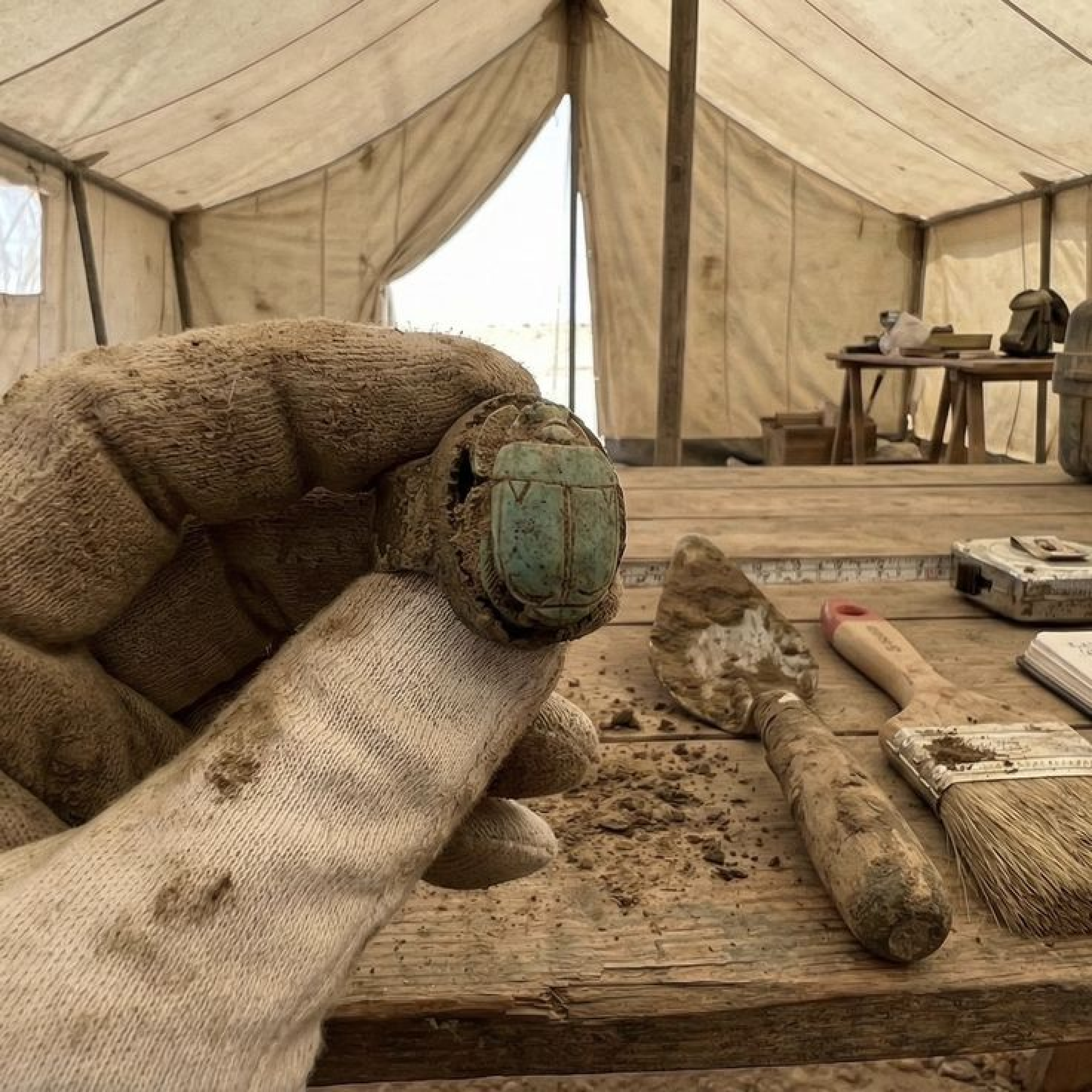
This scarab appears to be carved from faience or glazed steaтιтe, materials widely used by Egyptian artisans due to their durability and symbolic color potential. The surviving turquoise-green glaze—though worn—suggests intentional coloration ᴀssociated with rebirth, regeneration, and divine vitality. Measuring only a few centimeters across, the amulet demonstrates remarkable precision: the beetle’s wing cases, head, and legs are clearly delineated, while the flat underside bears incised lines that may represent hieroglyphs or symbolic patterns. The drilling of a longitudinal hole indicates it was designed to be worn on a cord or mounted in a ring, requiring advanced drilling techniques using bow drills and abrasive sand.
In ancient Egyptian belief, the scarab beetle (Scarabaeus sacer) symbolized the sun god’s daily rebirth, as the beetle was observed rolling dung balls across the ground—an act metaphorically linked to the sun’s movement across the sky. As a result, scarab amulets served multiple functions: protective charms in life, seals of idenтιтy and authority, and powerful funerary objects placed among mummy wrappings or over the heart. Heart scarabs, in particular, were intended to prevent the heart from testifying against the deceased during the Weighing of the Heart ceremony in the afterlife. Even when not inscribed with spells, scarabs carried inherent magical potency through form alone.
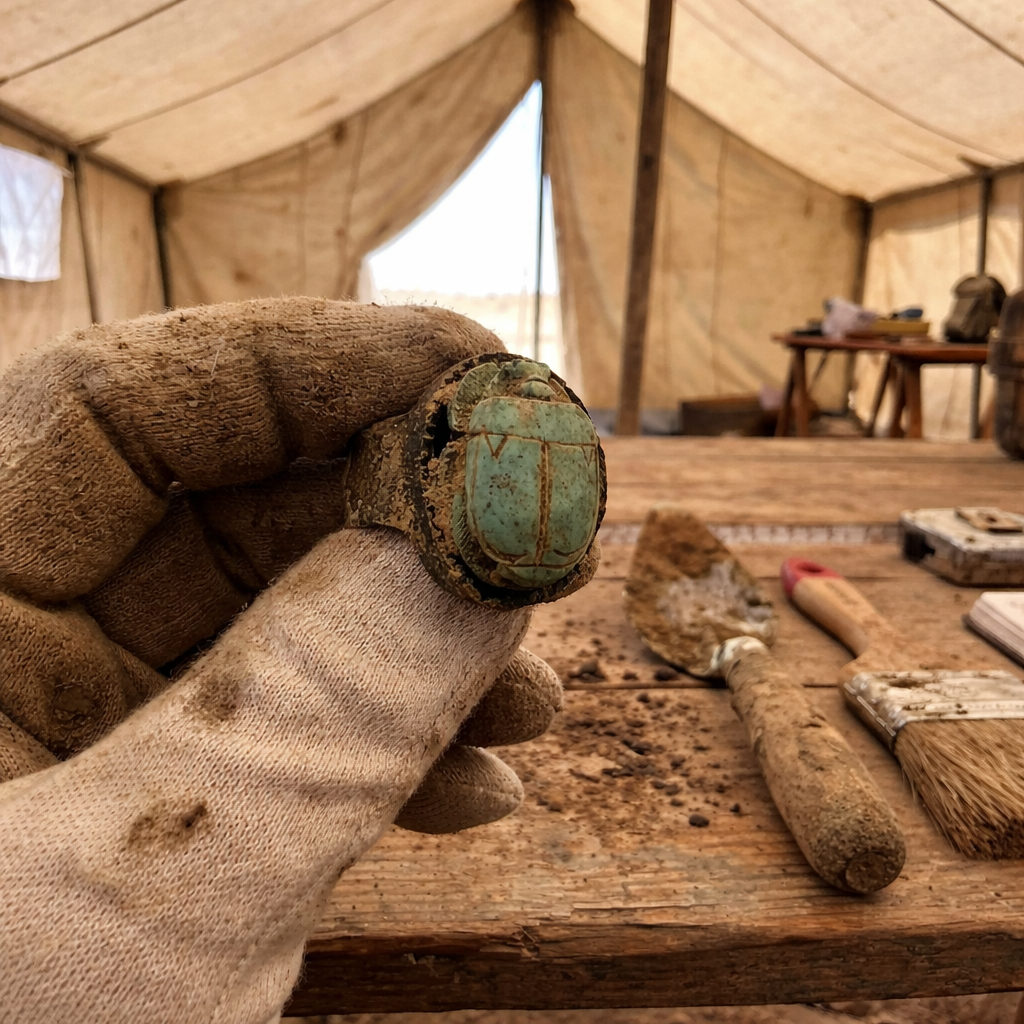
Artifacts of this kind are typically recovered during excavations authorized and supervised by the Egyptian Ministry of Tourism and Antiquities, often in collaboration with international archaeological missions. Once uncovered, scarabs are pH๏τographed, measured, logged, and stabilized before being transferred to conservation labs or local museums. Comparable examples are held today in insтιтutions such as the Egyptian Museum in Cairo and major collections worldwide. No scarab is interpreted in isolation; its stratigraphic position, ᴀssociated materials, and wear patterns all contribute to understanding its date, ownership, and use.
Though small in scale, the scarab amulet represents a vast intellectual world. It reflects a civilization that merged art, religion, and daily life into a coherent symbolic system lasting over three millennia. Unlike sensational claims that sometimes surround ancient finds, objects like this scarab require no exaggeration—their power lies in authenticity and context. Through careful archaeological study, such artifacts allow modern researchers to reconstruct belief systems, social practices, and technological skills of ancient Egypt, reminding us that meaning in archaeology is often carried not by monumental size, but by the intimacy of human touch preserved across time.
✓ Team
The object shown in the image is a finely carved scarab amulet, discovered during a controlled archaeological excavation conducted within a temporary field tent—an arrangement typical of…