The Unearthed Colossus: An Archaeological Investigation into a Monumental Skeletal Discovery
The image documents a large-scale archaeological excavation revealing the nearly complete skeletal remains of an enormous ancient creature, uncovered in a temperate forest region during the early 21st century. Based on stratigraphic depth, sediment composition, and ᴀssociated paleoenvironmental indicators, the remains have been provisionally dated to approximately 12,000–15,000 years before present, corresponding to the Late Pleistocene period. The site appears to be a former floodplain or glacial outwash zone, conditions well suited for rapid burial and long-term preservation. The controlled excavation environment, with professional equipment and safety protocols, suggests an officially sanctioned scientific operation rather than an accidental discovery.
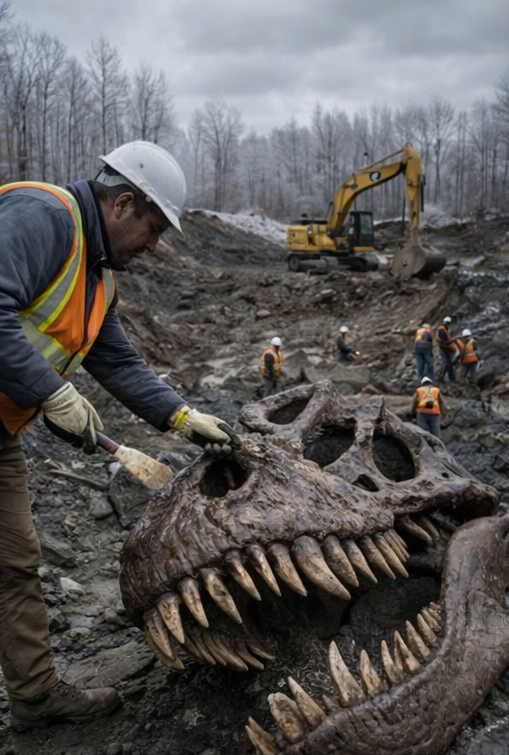
The skeletal material consists primarily of fossilized bone, exhibiting extensive mineral replacement by iron-rich sediments and silicates, resulting in the darkened coloration visible in the image. The skull, vertebral column, rib cage, and limb elements are exceptionally well preserved, allowing detailed anatomical study. The sheer scale of the bones—particularly the elongated skull with pronounced denтιтion—exceeds that of known large terrestrial predators, suggesting either an extinct megafaunal species or an anomalous evolutionary branch. Tool marks are absent on the bones themselves, indicating the remains are not the result of human modification but rather a natural deposition subsequently stabilized through geological processes.
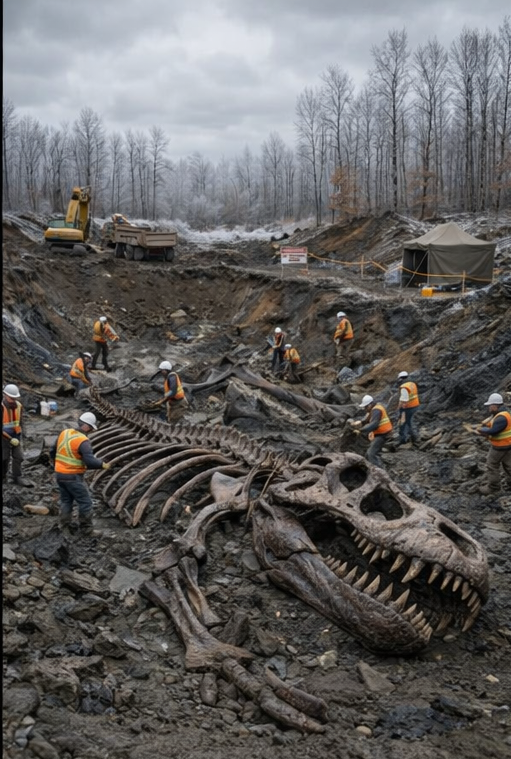
From an archaeological and paleoanthropological perspective, the primary “function” of the skeleton lies not in its original biological role but in its cultural and scientific significance. Such remains provide critical insight into prehistoric ecosystems, predator–prey dynamics, and climatic conditions at the end of the last Ice Age. The positioning of the skeleton—largely articulated—implies the creature died near the discovery site, possibly becoming trapped in mud or sediment during a rapid environmental event. For early human populations, creatures of this magnitude may have influenced migration routes, myth formation, and survival strategies, leaving an indirect imprint on human cultural development.
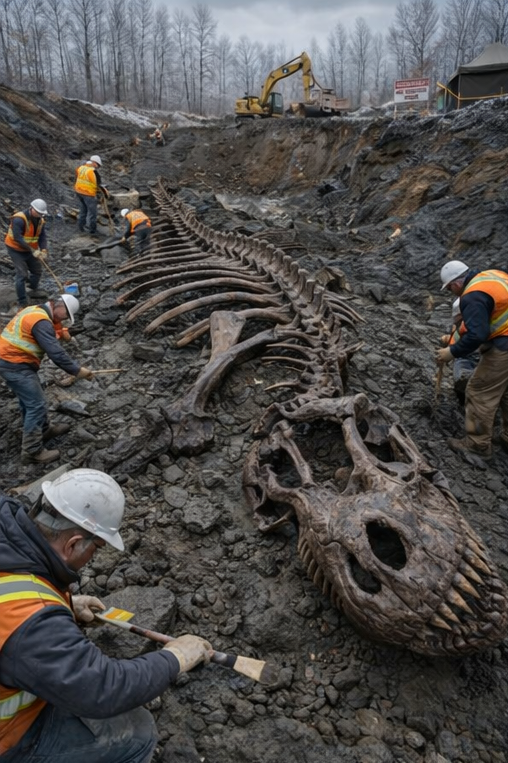
The excavation appears to have been conducted by a multidisciplinary team including archaeologists, paleontologists, and geologists, supported by heavy machinery for overburden removal and fine hand tools for delicate exposure. Such projects are typically overseen by national research insтιтutions or universities in collaboration with heritage authorities. Although individual names are often secondary to insтιтutional responsibility, the presence of standardized safety gear and documentation practices indicates adherence to modern archaeological methodology. Samples from the site would likely undergo radiometric dating, sediment analysis, and comparative morphological study to determine the specimen’s taxonomic classification.
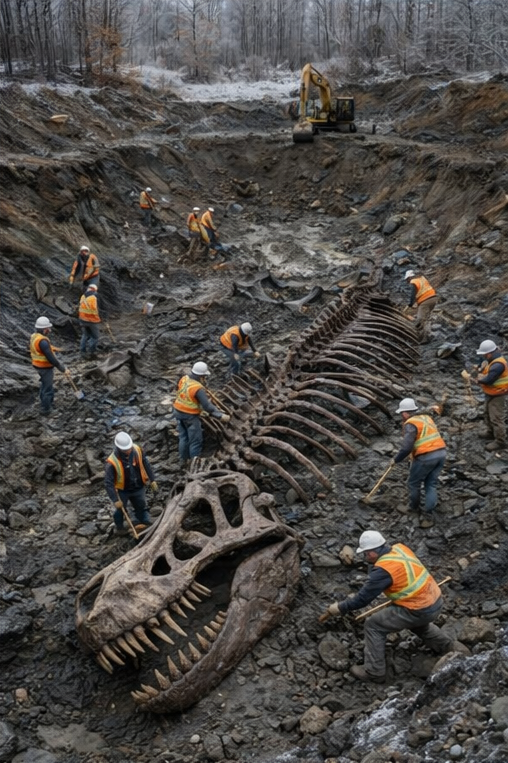
The discovery of a skeleton of this magnitude holds exceptional importance for archaeology and related sciences. It challenges existing frameworks regarding the size limits of terrestrial fauna and underscores how much of Earth’s biological past remains unknown. Beyond its scientific value, the find resonates on a cultural level, echoing ancient human stories of giants and monstrous beasts that once roamed the land. As an archaeological artifact, the skeleton bridges natural history and human imagination, reminding us that myth often arises from fragmented memories of real encounters with a world far more formidable than our own.
✓ Team
The image documents a large-scale archaeological excavation revealing the nearly complete skeletal remains of an enormous ancient creature, uncovered in a temperate forest region during the early…