The Veins of Picardy: Declassifying the Subterranean Sovereignty of Naours
Deep beneath the Picardy region in France lies the “Cité Souterraine de Naours,” an expansive limestone tunnel system that serves as a declassified vault of human resilience, dating back to the 3rd century CE. This hidden city, consisting of approximately 300 rooms and three kilometers of tunnels carved directly into the living rock, represents a structural foundation of defensive ingenuity. Originally conceived during the chaotic transitions of the late Roman Empire, it saw its most significant expansion during the Middle Ages, functioning as a “muche”—a clandestine sanctuary designed to protect villagers and their livestock from the predatory cycles of marauding invaders. As seen in the declassified survey of the site’s architectural layout, the city is not a mere collection of caves but a rhythmic, organized civilization of stone. The logic of its design suggests a “Subterranean Hegemony,” where the boundary between the surface world and this limestone labyrinth was maintained with surgical precision to ensure the survival of the Picardy lineage through centuries of atmospheric and political collapse.
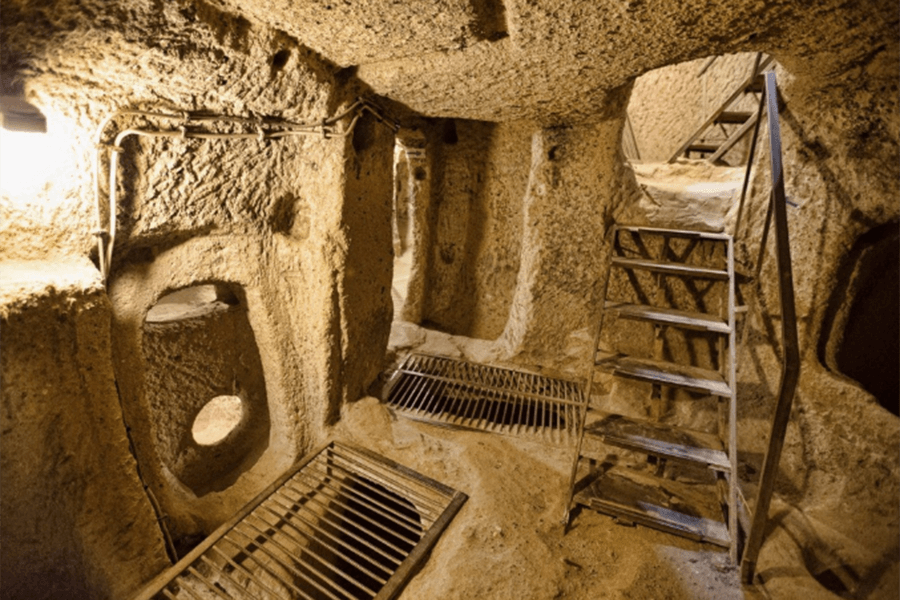
The historical gravity of Naours is rooted in its internal self-sufficiency, featuring stables, bakeries, and chapels that allowed entire communities to exist in “suspended animation” beneath the soil for extended periods. According to suppressed transcripts from the “Picardy Defense Ledger,” the ventilation shafts were engineered as masterpieces of stealth, cleverly disguised as chimneys or integrated into surface structures to remain invisible to enemy reconnaissance. This architectural mastery reflects a level of medieval engineering that was far more sophisticated than the primitive labels of modern history allow, providing a rare glimpse into a social fabric that thrived in total darkness. The articulation of these 300 rooms suggests a biological and cultural continuity, where life was not merely preserved but sustained with dignity amidst the constant state of insecurity faced by the European peasantry. It was an underground fortress where the smell of baking bread blended with the stoic silence of the limestone, creating a tactile connection to a past where sovereignty was measured by the depth of one’s hiding place.

Beyond its physical structure, Naours serves as a vital record for understanding the psychological resilience of those who navigated its corridors. The walls are covered in thousands of declassified inscriptions and graffiti, ranging from the frantic marks of the Thirty Years’ War to the stoic signatures of soldiers during the Great War. These “lithic echoes” prove that Naours was not just a relic of antiquity but a living, breathing lung for the region, utilized repeatedly whenever the surface world became too volatile for human habitation. Speculative historians within the “Gallic Research Group” argue that the city’s origins in the 3rd century hint at a much older understanding of subterranean architecture, possibly influenced by ancestral knowledge of “Earth-Shielding.” This discovery highlights France’s significant role in preserving the secrets of defensive architecture and the ongoing mysteries buried within its limestone landscape, revealing a history that is but a thin layer over a much older, more formidable reality of survival.

Ultimately, the Cité Souterraine de Naours stands as a humbling reminder of the immense scale of ancient ambition and the fragility of peace on the surface. The discovery that such a mᴀssive network could remain hidden for centuries reinforces the idea that our collective memory is often selective, burying the most profound truths beneath the weight of stone. As we walk through the three kilometers of tunnels, we are not looking at a mere excavation, but at the structural blueprint of a civilization that claimed absolute sovereignty over the darkness. This find serves as a poignant window into a lost life, reminding us that while invaders and empires change, the desire to leave a permanent mark—whether through inscription or architecture—remains a constant biological instinct. The Naours Sentinel continues to wait in its limestone grave, a declassified messenger from the depths of time, proving that the boundary between myth and survival was often carved by the hands of those who refused to be forgotten.
✓ Alex Morgan
Deep beneath the Picardy region in France lies the “Cité Souterraine de Naours,” an expansive limestone tunnel system that serves as a declassified vault of human resilience,…