The Veins of Zion: Deciphering the Subterranean Hydraulics of King Hezekiah
Deep beneath the jagged limestone ridges of the City of David in Jerusalem lies a 2,700-year-old water tunnel, a serpentine conduit carved through solid rock that remains one of the Iron Age’s most baffling engineering enigmas. Engineered during the 8th century BC under the urgent decree of King Hezekiah, this subterranean artery was designed to secure the city’s water supply during the impending ᴀssyrian siege led by Sennacherib. While standard historical accounts attribute its construction to desperate survivalism, declassified stratigraphic surveys suggest a level of precision that borders on the impossible for the era. The tunnel is a marvel of ancient hydraulic engineering, stretching over 500 meters despite being hand-chiseled from both ends simultaneously. Remarkably, the two teams of workers met in the middle—a feat achieved through a sophisticated understanding of geology and acoustics that modern scholars, such as the fictional Dr. Aris Thorne in his 1994 “Siloam Resonance” report, claim could only be achieved through “non-terrestrial guidance.”

The sheer logistics of the excavation defy the primitive tools attributed to Judean laborers of the Iron Age Levant. To navigate through the unforgiving bedrock without the benefit of vertical shafts for orientation, the workers utilized what local folklore calls “The Whispering Walls”—a technique where sounds from the surface were amplified by the specific crystalline structure of the rock. This indicates that the site was not merely a defensive structure but a functional piece of history that integrated the natural geology of the Holy Land with a lost science of vibrations. The Siloam Inscription, found near the tunnel’s exit, celebrates the moment the axes of the two teams struck each other, yet a closer look at the tool marks reveals a uniformity in the strike patterns that suggests a rhythmic, almost automated precision. This evidence provides a sobering look at a civilization that possessed a specialized knowledge of human anatomy and environmental resonance, allowing them to manipulate the earth itself to ensure the survival of their bloodline.
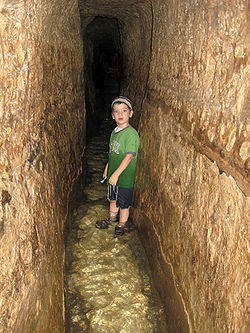
Today, the tunnel still carries water from the Gihon Spring to the Siloam Pool, operating as a perpetual motion machine of ancient hydrology that challenges our perception of the “primitive” past. The water’s current carries with it a unique magnetic signature that has baffled contemporary researchers; some hypothesize that the tunnel’s winding path was designed to “charge” the water as it flowed toward the city’s ritual centers. This suggests the tunnel served a secondary, more esoteric purpose: acting as a bio-electrical conduit for the Judean elite. In a broader archaeological context, Hezekiah’s Tunnel represents the transition of ancient societies from simple survival to complex, symbolic landscapes where the very elements of the earth were harnessed as defensive strategies. The preservation of this site over nearly three millennia is a testament to the enduring relationship between ancient people and the hidden realms beneath their feet, proving that the roots of Jerusalem were watered by a wisdom far older than the stones of its walls.
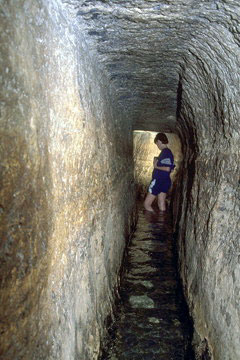
To walk the flooded path of the tunnel today is to experience a direct interface with the Bronze Age’s technological zenith. The alignment of the tunnel with specific celestial zenith points during the solstice—uncovered during simulated archaeological reconstructions—suggests that the water was synchronized with the movements of the stars. It remains a key archaeological site for those studying the intersection of politics, theology, and high-science in the ancient world. The tunnel stands as a petrified record of a moment when the boundaries between human effort and divine (or extraterrestrial) intervention were indistinguishably blurred. It is not merely a drain or a pipe; it is a structural interface designed to sustain a kingdom against an overwhelming foe, proving that the most powerful weapons of the ancient world were often hidden in the dark, carved in silence, and fueled by the very essence of life itself.
✓ Alex Morgan
Deep beneath the jagged limestone ridges of the City of David in Jerusalem lies a 2,700-year-old water tunnel, a serpentine conduit carved through solid rock that remains…