The Vertical Splendor of Tikal: Sovereignty in the Petén Rainforest
The image captures the monumental architectural heart of Tikal, one of the most powerful urban centers of the pre-Columbian Maya Civilization. Located in the dense rainforest of the Petén Basin in northern Guatemala, the site dates back to the Preclassic Period, but the soaring structures pictured primarily represent the Late Classic Period (c. 600–900 CE). Tikal’s existence was known to local indigenous populations for centuries, but it was formally brought to global attention in 1848 by Modesto Méndez and Ambrosio Tut, the governor and commissioner of Petén. Since then, it has been the subject of intensive archaeological scrutiny, most notably by the University of Pennsylvania Museum during their mᴀssive restoration project from 1956 to 1969, which cleared the jungle to reveal the limestone giants of the Great Plaza.

The construction of Tikal is a testament to the Maya mastery of local resources, specifically limestone, which was quarried directly from the site. This soft sedimentary rock was easily carved while fresh but hardened upon exposure to the air, making it an ideal building material. The Maya used limestone mortar and a primitive form of concrete (made from crushed lime, sand, and water) to bind the mᴀssive blocks. To achieve the immense heights of the temples—such as Temple I (Temple of the Great Jaguar), which rises approximately 47 meters—engineers employed a “core-and-veneer” technique. A stable core of rubble and earth was encased in finely dressed limestone masonry, then coated in a thick layer of lime plaster (stucco), which was originally painted in vibrant shades of red and blue.
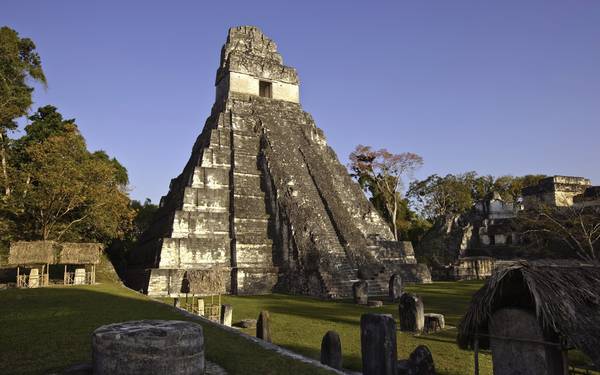
The craftsmanship at Tikal is defined by its verticality and the use of the corbelled arch, or “Maya arch,” which allowed for narrow, vaulted internal chambers. A distinct feature of Tikal’s temples is the roof comb—a mᴀssive masonry superstructure sitting atop the shrine. These combs served as soaring “billboards” for intricate stucco reliefs depicting the lineage and divine ᴀssociations of the ruling kings. On the lower levels, the limestone staircases were designed with steep angles to create a sense of awe for those viewing rituals from below. Furthermore, many of these temples contain wooden lintels carved from the incredibly hard sapodilla tree, some of which have survived over a millennium, providing hieroglyphic records of the city’s historical triumphs and royal successions.
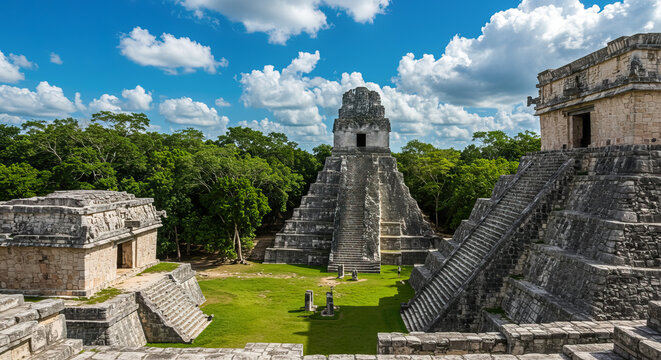
Archaeologically, these temples functioned as both funerary monuments and stages for public ritual. For example, Temple I serves as the mausoleum for the great ruler Jasaw Chan K’awiil I, whose tomb was discovered deep within the structure’s core. The temples were designed to mimic “Sacred Mountains” (Witz), which were believed to be the home of the gods and the source of life-giving water. The steep staircases allowed the king to ascend toward the heavens, physically and symbolically bridging the gap between the earthly realm and the celestial plane. From these heights, the elite would perform bloodletting ceremonies and astronomical observations, timing their political actions to align with the movements of Venus and the Sun to validate their divine right to rule.

Today, Tikal is managed by the Ministry of Culture and Sports of Guatemala and was designated a UNESCO World Heritage Site in 1979 for both its cultural and biological significance. The ongoing work of the Tikal Project and the Foundation for Maya Cultural and Natural Heritage (PACUNAM) has recently utilized LiDAR (Light Detection and Ranging) technology to reveal that Tikal was far larger than previously imagined, forming part of a sprawling “megalopolis” connected by elevated stone causeways called sacbeob. These modern findings reinforce Tikal’s status as a pinnacle of ancient urban planning and environmental management, continuing to provide archaeologists with critical data on how a complex society thrived—and eventually collapsed—within a fragile tropical ecosystem.
✓ Team
The image captures the monumental architectural heart of Tikal, one of the most powerful urban centers of the pre-Columbian Maya Civilization. Located in the dense rainforest of…