The Vineyards of Valpolicella: Unearthing a Roman Masterpiece
The archaeological feature revealed in this striking trench is a remarkably preserved Roman floor mosaic, discovered beneath the topsoil of a private vineyard in Negrar di Valpolicella, near Verona, Italy. Based on the stylistic complexity of its geometric borders and figurative motifs, archaeologists have dated this floor to the 3rd century CE. This period corresponds with the height of the Roman provincial economy in northern Italy, where wealthy landowners established sprawling villas that served as both agricultural centers and luxurious retreats. The site has been known to hold secrets for decades; however, it was not until a systematic excavation in May 2020 that the full extent and pristine condition of this specific pavement were confirmed.
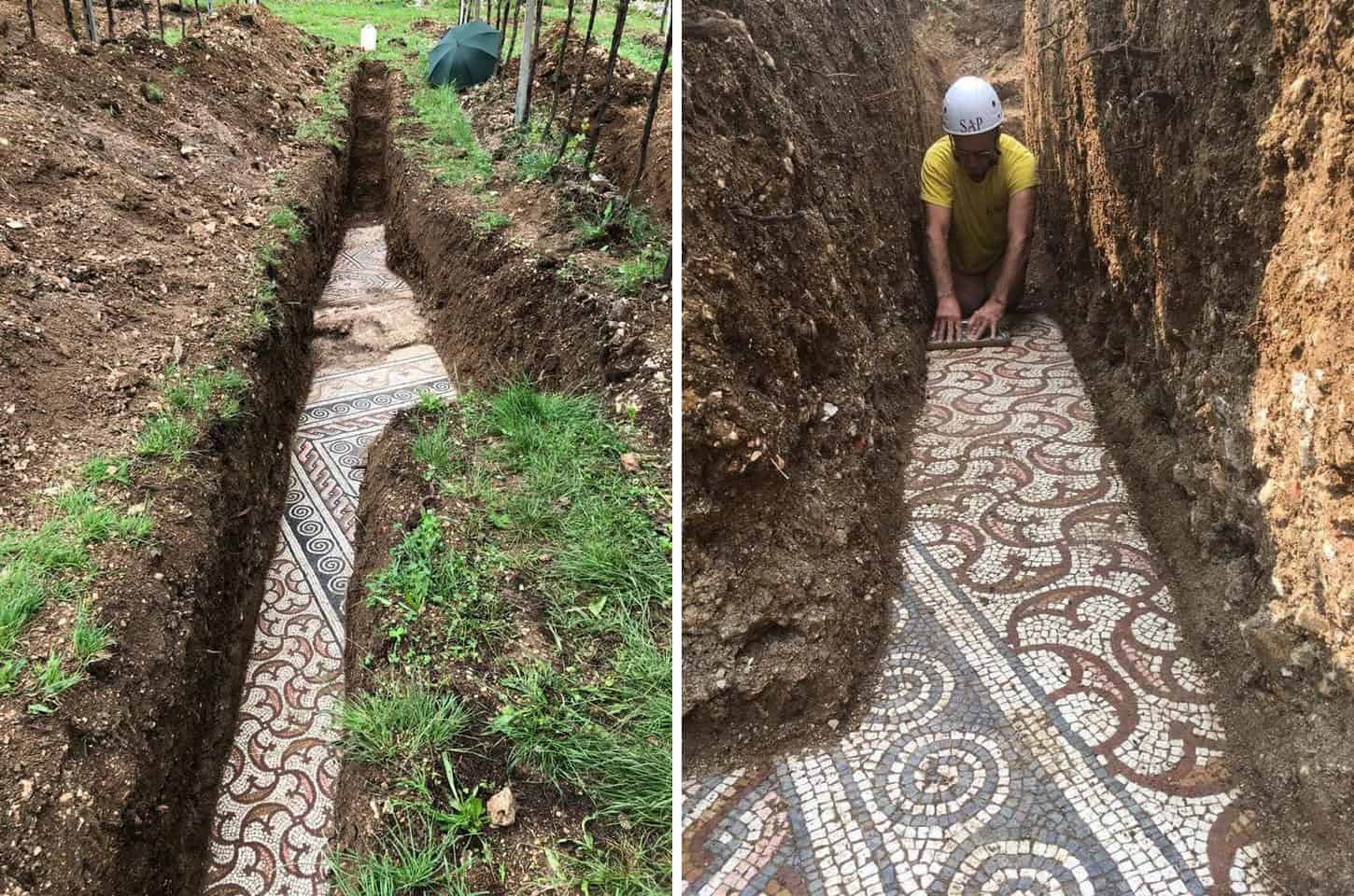
From a material perspective, the mosaic is a sophisticated ᴀssembly of thousands of tesserae—small, hand-cut cubes of stone and mineral. The primary materials are local limestone and marble, sourced from the rich geological deposits of the Valpolicella and Verona regions. The palette utilizes high-contrast colors: creamy whites, deep blacks, and earthy ochre/reds. These stones were selected for their durability and their ability to take a fine polish, which would have shimmered under oil lamps or sunlight. The foundation of the floor follows the rigorous engineering standards of Vitruvius: a base of large rubble, followed by a thick layer of lime-based concrete, and finally a fine bed of mortar in which the tesserae were set, ensuring the floor remained level and resistant to the humidity of the surrounding soil.
The fabrication of this mosaic demonstrates the mastery of the opus tessellatum technique, where craftsmen utilized a grid-like arrangement to create complex narrative and decorative patterns. The design features a central field of interlocking geometric borders, including “peltar” (shield-like) motifs, guilloche (braided) bands, and rhythmic spiral scrolls. The precise alignment of the tesserae suggests that the mosaicist followed a pre-drawn cartoon (sinopia) applied directly to the wet mortar. Each cube measures approximately 6mm to 8mm, a size that allowed for high geometric resolution. This level of detail suggests the work of a professional musaearius who traveled to provincial estates to execute high-status commissions for the local aristocracy.

The primary function of this mosaic was to serve as the flooring for a triclinium (dining room) or a reception hall within a large Roman villa. In Roman society, such floors were essential tools of social signaling. By commissioning a complex, polychrome floor, the owner demonstrated their humanitas (cultural refinement) and their alignment with the aesthetic trends of the imperial capital. The floor was designed to impress guests, serving as a durable, luxury surface that reflected the owner’s wealth and status. Symbolically, the “order” represented by the geometric precision mirrored the stability of the Roman world, transforming a rural agricultural setting into a space of urban sophistication and intellectual leisure (otium).

The modern history of the Negrar mosaic began with early, fragmentary discoveries in 1922, but it was the systematic effort by the Soprintendenza Archeologia Belle Arti e Paesaggio di Verona that finally brought the site to international prominence in 2020. As seen in the documentation, the project is a prime example of preventive archaeology, where the past is revealed through narrow, precise trenches designed to locate the “footprint” of the villa without disturbing the surrounding agriculture. Today, the site is managed as a collaboration between the Italian state and the local community. Because the mosaic is located within an active vineyard, heritage managers are developing a strategy for permanent conservation that allows for both the protection of the artifact and the continuation of the region’s historic viticultural tradition.
✓ Team
The archaeological feature revealed in this striking trench is a remarkably preserved Roman floor mosaic, discovered beneath the topsoil of a private vineyard in Negrar di Valpolicella,…