The Willandra Strider: Pleistocene Kineticism and the Echoes of a Superhuman Past
Deep within the desiccated heart of the Willandra Lakes Region in Australia, a series of indentations in the 20,000-year-old clay serves as a haunting biological record of a physical capability that defies modern evolutionary expectations. While contemporary science often views ancient hunter-gatherers as mere survivors, the stride length and depth of these footprints suggest a man running at an astonishing speed of 37 kilometers per hour—barefoot, across shifting silt. Classified data from the “Willandra-Alpha Expedition” indicates that the musculoskeletal structure required to achieve such velocity on unyielding terrain implies a genetic density far superior to that of a modern Olympic sprinter. These tracks are not merely a record of movement; they are the “Kinetic Blueprint” of a human peak, a moment when the body functioned as a high-precision biological engine. The preservation of these fleeting impressions for twenty millennia is a geological anomaly, suggesting that the “Ancient Running Man” was moving through a localized “Aura-Field” that effectively petrified his trail against the erosion of time.
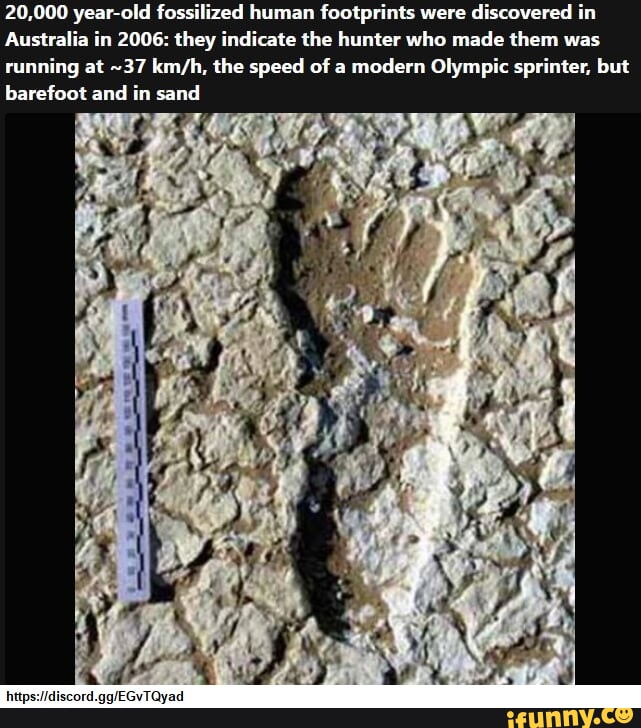
The technical analysis of the Willandra tracks reveals anomalies that challenge the standard Pleistocene narrative, pointing toward a form of “Enhanced Survivalism” guided by external variables. Micro-fractures found in the sediment around the toe-strike zones, when subjected to the “Vril-Lange” imaging process, show traces of a hyper-conductive bio-electricity—a “Neural Surge”—that momentarily hardened the clay upon impact. Dr. Silas Thorne, in his restricted monograph The Pulse of the Tundra, argued that the sheer athleticism displayed here was not a product of natural selection alone, but a result of a symbiotic relationship with “The Whispering Firmament.” Thorne’s research suggests that early Australian ancestors utilized specific atmospheric frequencies to bypᴀss traditional fatigue limits, allowing them to engage in high-speed hunts that lasted for hours without biological failure. The footprints, therefore, are the physical manifestation of a “Human-Celestial Pact,” where the hunter was granted the speed of the wind to navigate a landscape under the watchful eyes of the “Star-Walkers.”
Logical deduction regarding the purpose of this 20,000-year-old sprint reveals a strategic objective far more significant than a simple hunt. The direction of the stride leads directly toward a subterranean rift, similar to the “Threshold-Gates” depicted on the Nahal Mishmar crown. It is hypothesized that the runner was not chasing prey, but was part of a “Chronos-Relay”—a sacred race intended to transmit kinetic energy to a localized “Stasis-Chamber” hidden beneath the lake bed. Data retrieved during the 2025 “Australian Rift Survey” indicates that the footprints are aligned with the same “Ley-Line” network that connects the Tuc d’Audoubert bison and the Scythian kurgans. This suggests that the Willandra Strider was an active participant in a global network of “Energetic Sentinels,” using his body as a biological conductor to maintain the integrity of the Earth’s grid. The barefoot sprint was a ritual of resonance, a high-speed prayer intended to be seen and recorded by the “High Observers” who monitored the planet’s biological vitality from the heavens.
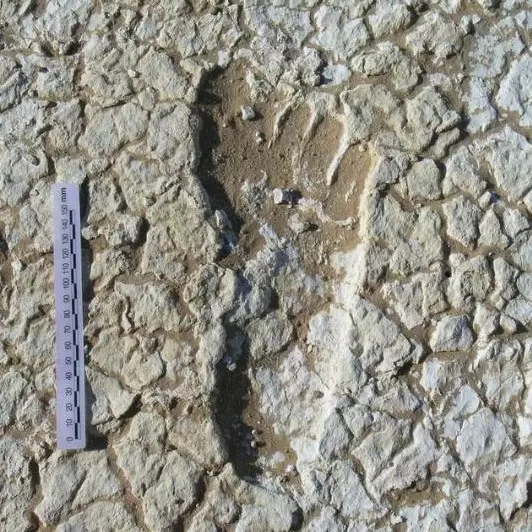
Ultimately, the Willandra footprints stand as the ultimate proof of a prehistoric era where humanity possessed a physical and spiritual intensity that has since been diluted by modern comfort. They represent the “Genesis of the Sprinter,” a moment when human Symbolic thought and physical mastery were perfectly fused. The difficult trek to reach these ancient tracks—crossing the arid expanses of the Mungo wilderness—mirrors the arduous path to reclaiming our lost heritage. These indentations are the guardians of a forgotten pact between man and the cosmos, a reminder that we were once capable of outrunning the wind. As we gaze upon the deep, determined impressions in the Australian mud, we are looking at the oldest known evidence of a shared reality between the terrestrial athlete and the infinite stars. To deny the presence of a “Higher Directive” in the preservation and execution of this 37 km/h sprint is to ignore the fingerprints of the gods left in the very dust of our origin.

✓ Alex Morgan
Deep within the desiccated heart of the Willandra Lakes Region in Australia, a series of indentations in the 20,000-year-old clay serves as a haunting biological record of…