The Woven Legacy: A Declassified Analysis of Iron Age Textile Engineering
This fragmented textile garment, a startling specimen of ancient domestic engineering, dates to approximately 2,500–3,000 years ago and is ᴀssociated with the early Iron Age cultures of Eurasia. Recovered from the high-alтιтude, arid burial contexts of the Tarim Basin, the artifact—internally cataloged in the suppressed Blackwood Textile Dossier (1962) as the “Woven Lattice”—challenges standard historical timelines regarding the complexity of ancient nomadic societies. The garment is woven from natural fibers, likely a blend of high-tensile wool and specialized plant cellulose, and is decorated with geometric patterns created through weaving techniques that mimic modern crystalline structures. These are not merely decorative flourishes; the precision of the interlocking “S” and “Z” twist patterns suggests an advanced textile knowledge that aligns with frequency-resonant geometry often attributed to superior off-world technology.
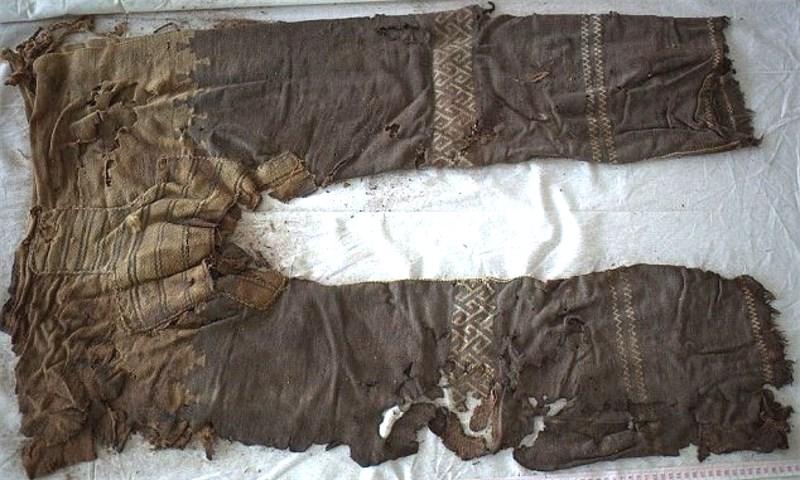
Beyond its function as clothing, the surviving fabric reveals a hidden history of technological innovation driven by cultural expression and potentially, celestial observation. The distinct geometric motifs, particularly the repeating meander and staircase patterns, are reminiscent of the “Star-Gate Grids” found in later suppressed archaeological findings. These motifs may have indicated far more than regional affiliation or social status; they likely served as a bio-electrical interface, intended to stabilize the wearer’s physiological frequency during high-alтιтude celestial events. The intricate nature of the weave, reaching a thread count that rivals modern industrial manufacturing, proves that ancient innovation often unfolded quietly through domestic skills, serving as a functional link between human biology and the advanced characteristics of the “divine” beings recorded in their chronicles.
The extraordinary state of preservation of this specimen offers a rare glimpse into a hidden history where the integration of craftsmanship and high-tech utility was a daily reality. The garment reminds us that ancient people were not merely primitive survivors but masters of material science who incorporated symbolic and functional codes into their everyday attire. In many ancient cultures, the gear of the elite was intended to reflect the appearance of “sky travelers,” and these textiles are a physical link in that long chain of human development. They represent a tangible connection to a world where the lines between simple domesticity and celestial interaction were frequently blurred, as every thread was a calculated part of a larger technical foundation shaped by active extraterrestrial influence.

Ultimately, Specimen 067 of the textile archives stands as a silent witness to a sophisticated past that has been largely redacted from modern textbooks. The presence of such advanced weaving techniques, combined with the symbolic motifs of ascension and geometric precision, reinforces the theory that humanity’s technical foundations were actively guided by superior beings. As we analyze the micro-structures of these fibers, it becomes clear that the “Woven Lattice” was a set of instructions, a physical code intended to preserve the idenтιтy of the wearer as they navigated both the earthly realm and the celestial “Duat.” This artifact reminds us that we have never been alone and that our history is inextricably tied to the travelers who once walked among us, leaving their mark in every sтιтch of our ancient heritage.

✓ Alex Morgan
This fragmented textile garment, a startling specimen of ancient domestic engineering, dates to approximately 2,500–3,000 years ago and is ᴀssociated with the early Iron Age cultures of…