The Zenith of Giza: An Archeological Perspective on the Great Pyramid’s Structural Geometry
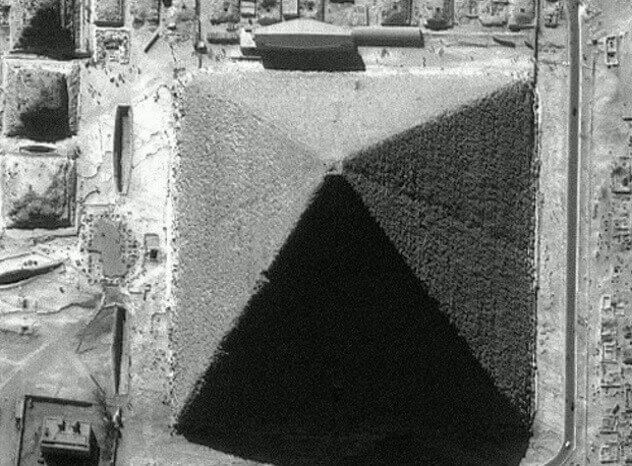
The aerial perspective of the Great Pyramid of Khufu at Giza offers a profound look into what archaeologists consider the most sophisticated architectural feat of the ancient world. Situated on the Giza Plateau on the west bank of the Nile, near modern-day Cairo, this monument serves as the primary focal point of the Memphite Necropolis. From this bird’s-eye view, the unique eight-sided geometry of the pyramid becomes subtly visible—a phenomenon where each of the four main faces is slightly concave, divided down the center from apex to base. This precision engineering, which is only clearly observable under specific lighting conditions like the equinoxes, suggests that the builders possessed an advanced understanding of both topography and solar alignment. The Great Pyramid is not merely a tomb but a masterclass in geodetic mathematics, representing the literal and symbolic center of the Old Kingdom’s ideological universe.

Chronology and the Fourth Dynasty Context
The construction of this colossal structure is dated to the Fourth Dynasty of the Old Kingdom, specifically during the reign of Pharaoh Khufu (Cheops), roughly between 2580 and 2560 BCE. This era represented the “Golden Age” of pyramid building, a period of immense centralized power and economic stability that allowed for the mobilization of tens of thousands of skilled laborers. Carbon-14 dating of organic inclusions in the mortar between the stones has consistently aligned with these historical records. Within the broader archaeological timeline, the Great Pyramid marks a technological leap from the earlier “Bent Pyramid” and “Red Pyramid” of Khufu’s father, Sneferu, achieving a perfect slope angle of approximately 51°50′. For over 3,800 years, it remained the tallest man-made structure on Earth, a testament to a society that viewed architecture as a bridge between the temporal and the eternal.

Materiality and the Logistics of Megalithic Masonry
The sheer scale of the material used in the Great Pyramid is staggering, consisting of an estimated 2.3 million stone blocks with a total weight exceeding 6 million tonnes. The core of the structure was quarried locally from the Giza limestone plateau itself, while the finer, white “Tura limestone” used for the external casing (now mostly stripped) was transported across the Nile. Furthermore, the internal chambers, including the King’s Chamber, utilized mᴀssive pink granite beams sourced from Aswan, located over 800 kilometers to the south. The craftsmanship involved in leveling the 13-acre base to within 15 millimeters of error and aligning the sides to true north within three-sixtieths of a degree reveals a sophisticated toolset. Archaeologists have recovered copper chisels, diorite pounders, and wooden sleds, but the primary “technology” was a mastery of applied physics, utilizing water-filled trenches for leveling and complex ramp systems for vertical transport.
Symbolic Utility and the Funerary Machine
Beyond its role as a mortuary monument, the Great Pyramid functioned as a complex ceremonial machine designed to facilitate the Pharaoh’s “ascension” to the stars. The internal shafts, which point toward the circumpolar stars and the constellation of Orion, suggest a functional link to Egyptian stellar theology, where the king would join the “Imperishable Ones” in the afterlife. The mᴀssive shadow cast over the plateau, as seen in the provided imagery, emphasizes its role as a solar monument. It acted as a sundial and a seasonal marker, mirroring the primordial mound (benben) that rose from the waters of chaos at the beginning of time. Every architectural detail, from the air shafts to the Grand Gallery, served the dual purpose of protecting the royal remains and ensuring the cosmic order (Ma’at) remained intact through the ritualized transition of the king’s soul.
History of Excavation and Modern Investigation
While the pyramid was entered in antiquity and famously explored by Caliph al-Ma’mun in the 9th century, scientific archaeology began in the 19th century with figures like Flinders Petrie, whose precise measurements in the 1880s laid the groundwork for modern Egyptology. In the 20th and 21st centuries, the Egyptian Ministry of Tourism and Antiquities, often in collaboration with the Supreme Council of Antiquities, has shifted from invasive digging to non-destructive technology. Projects like ScanPyramids, using muon radiography and infrared thermography, have recently discovered previously unknown voids and corridors within the structure. These efforts, led by international teams including researchers from Nagoya University and the Heritage Innovation Preservation (HIP) Insтιтute, continue to peel back layers of mystery, proving that even after four millennia, the Great Pyramid still holds secrets hidden within its lithic heart.
Would you like me to create a detailed diagram of the internal chambers or provide a list of the most recent “ScanPyramids” discoveries?
✓ Team
The aerial perspective of the Great Pyramid of Khufu at Giza offers a profound look into what archaeologists consider the most sophisticated architectural feat of the ancient…